The 7 Can't-Miss Towns In Oklahoma
Oklahoma’s can’t-miss towns offer far more than a quiet stop between its major cities. Visitors can follow Historic Route 66 through Sapulpa and Weatherford, see Chickasha’s dazzling Festival of Light, or admire the autumn scenery along the Talimena National Scenic Byway near Poteau. Tahlequah showcases Cherokee history and culture, while Altus provides access to Lake Altus-Lugert and Quartz Mountain. With a plethora of museums, river recreation, and even hot-air balloons, these seven towns reveal unique traditions that make Oklahoma worth exploring.
Altus
Altus started out as a trading post named Frazer. Cowboys driving herds up the Great Western Cattle Trail called it Buttermilk Station, after the buttermilk they bought from a settler named John McClearan. A flash flood nearly destroyed the place on June 4, 1891. Survivors rebuilt two and a half miles east on higher ground, and a resident named W. R. Baucum proposed calling it Altus, Latin for high place.

Altus started out as a trading post named Frazer. Cowboys driving herds up the Great Western Cattle Trail called it Buttermilk Station, after the buttermilk they bought from a settler named John McClearan. A flash flood nearly destroyed the place on June 4, 1891. Survivors rebuilt two and a half miles east on higher ground, and a resident named W. R. Baucum proposed calling it Altus, Latin for high place. The high ground is still the organizing idea. Altus Air Force Base trains C-17, KC-46 and KC-135 aircrews, which keep heavy aircraft moving over the wheat fields most of the week. Lake Altus-Lugert lies about 17 miles north, a 6,260-acre reservoir on the North Fork of the Red River with roughly 49 miles of shoreline. It sits within Quartz Mountain State Park, where granite outcrops draw climbers, and the swimming area fills up by July. Levels swing hard in dry years, so anglers check the lake before hauling a boat out. Closer to town, the 140-acre Altus City Reservoir has a fishing dock, jogging trails and a disc golf course. The Museum of the Western Prairie covers settlement across southwest Oklahoma, and the Great Plains Stampede Rodeo puts a parade through downtown each year.
Bixby

Washington Irving camped near the future site of Bixby in October 1832, traveling with a federal expedition into Indian Territory. The town marks the visit at Washington Irving Memorial Park and Arboretum with a statue of the writer seated on an amphitheater stage modeled after the front of Sunnyside, his house in Tarrytown, New York. The 32-acre grounds also hold a butterfly garden and memorials to the children killed in the Murrah Federal Building bombing. Bixby sits on the Arkansas River southeast of Tulsa, and it has grown fast enough that the old farm stands now share road frontage with subdivisions.
Savastano's Pizzeria builds a Chicago deep-dish two inches tall and fourteen inches across, weighing around eight pounds. The Apple Barrel works the other end of the menu with thick-cut pork chops, smothered chicken-fried steak and strawberry crepes. Carmichael's Pumpkin Patch opens in late September and runs through Halloween, with a corn maze, a petting zoo and camel rides. A paved riverwalk leaves Bentley Park along the south bank of the Arkansas River and crosses on an old steel bridge repurposed for walkers and cyclists.
Chickasha

A 50-foot leg lamp stands on permanent display in downtown Chickasha, a full-scale tribute to the prop from the 1983 film "A Christmas Story." The town lights it for the holidays, though the bigger draw is a few blocks away at Shannon Springs Park. Volunteers have run the Festival of Light there since 1993, threading roughly 3.5 million bulbs across 43 acres. It opens the day after Thanksgiving and runs through the end of December. The town's name is the Choctaw word for Chickasaw, and the townsite sat inside the Chickasaw Nation when the Rock Island Railroad platted it in 1892. The University of Science and Arts of Oklahoma gives Chickasha its college population and one of the six large murals scattered around town. The school opened in 1908 on land a rancher named J. B. Sparks donated in memory of his daughter Nellie, a Chickasaw woman whose allotment the property had been. Her name is still on a campus dormitory. Students compete as the Drovers. The Grady County Farmers Market sets up May through October.
Poteau

The sign at the base of Cavanal Hill reads 1,999 feet. That is one foot short of mountain status, and Poteau has built a civic identity on the shortfall. The figure measures rise above the valley floor rather than height above sea level, which is 2,385 feet. USGS maps label the landform Cavanal Mountain regardless. A paved road climbs to the summit in about 45 minutes, on grades steep enough that locals tell you to come back down in low gear. Each May, the Cavanal Killer 8K sends runners up the same hill, starting from Poteau Primary School. The Ouachita National Forest spreads out below, and Poteau works as the gateway to the Winding Stair country inside it. Hot air balloons crowd the sky each fall for the Poteau Balloon Fest, which closes its evenings with balloon glows on the ground. The Talimena National Scenic Byway begins southwest of town at Talihina and runs 54 miles along the ridgeline into Arkansas. The Ouachitas are the highest range between the Appalachians and the Rockies, and the drive turns over in color through October.
Sapulpa

Sapulpa bills itself as the heart of historic Route 66, and its best stop sits one block off the road. Waite Phillips built the filling station at 26 East Lee Avenue in 1923; his brother Frank founded the oil company behind the Phillips 66 brand. Barnsdall Oil bought the station in 1926 and added three service bays. The Sapulpa Historical Society restored the building, which now holds automobiles from the 1920s.The town takes its name from a Lower Creek man from Alabama known as Chief Sapulpa, who established a trading post about a mile southeast of the present downtown around 1850. Pretty Water Lake lies northwest of town, a spring-fed 25-acre city lake and one of the few warm-water trout fisheries in the state. Crews stock rainbow trout over the winter months, and the paved Pretty Trail circles the shore with ADA access the whole way around.
Tahlequah

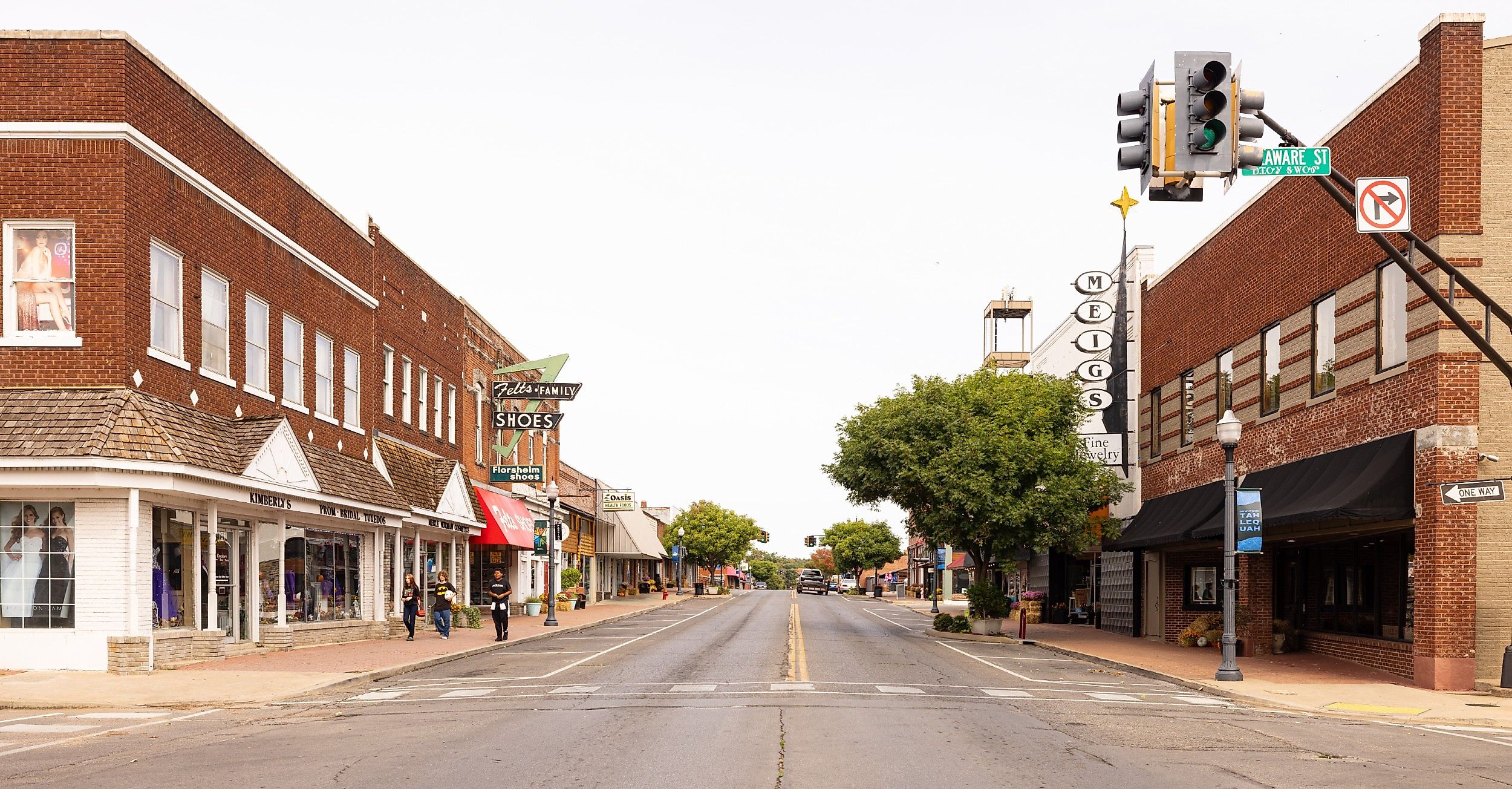
Tahlequah has served as the Cherokee Nation's capital since 1839, and the street signs downtown carry both English and the syllabary Sequoyah completed in 1821. The Cherokee National Supreme Court building went up in 1844 and stands as the oldest government building in Oklahoma. It housed the Cherokee Advocate, the first newspaper published in the territory, printed in both scripts.
The Cherokee National Capitol of 1869 reopened in 2019 as the Cherokee National History Museum, with more than 7,000 square feet of galleries and a room devoted to the Trail of Tears. Statehood in 1907 dissolved the Nation's political autonomy and turned that capital into a county courthouse. Northeastern State University grew out of the Cherokee National Female Seminary and remains the oldest institution of higher learning in the state. Every Labor Day weekend, the Cherokee National Holiday fills Muskogee Avenue. Canoes and rafts work the Illinois River through the summer, and the same river backs up southeast of town as Lake Tenkiller, also called Tenkiller Ferry Lake. Cherokee Casino Tahlequah covers the indoor hours.
Weatherford

Thomas P. Stafford flew four missions for NASA, including Apollo 10 around the Moon in 1969. His mother had come to Oklahoma in a covered wagon, and she lived to watch her only child make that trip. The Stafford Air and Space Museum in his hometown of Weatherford spans 63,000 square feet and is a Smithsonian Affiliate. The collection holds his flown Apollo 10 pressure suit, his Gemini VI-A spacecraft and a Titan II rocket. Stafford died in March 2024.
Route 66 runs through Weatherford heading west toward the Texas Panhandle, and the turbines crowding the horizon are the newer story. A single 122-foot blade lies on the ground at the Wind Energy Park across from city hall, close enough to put a hand on. Tours run by appointment through the Heartland of America Museum, which also keeps a Route 66 diner where Elvis Presley ate three times. Southwestern Oklahoma State University holds the student population steady throughout the year.
What Holds Up Across The Seven
Oklahoma’s can’t-miss towns reward travelers who give them the chance. Altus offers access to Quartz Mountain and Lake Altus-Lugert, while Bixby combines riverside parks with family attractions. Chickasha shines during its Festival of Light, Poteau opens onto the Talimena Scenic Byway, and Sapulpa preserves Route 66 history. Tahlequah brings Cherokee culture to the forefront, and Weatherford celebrates aviation and space exploration. Together, these towns prove that some of Oklahoma’s most memorable experiences are found beyond its largest cities.