The Oldest County Seats In America
Most American county seats have moved at least once. Courthouses burned, populations drifted away from the old center, and county governments followed them. Those moves are why so many courthouse towns now stand somewhere their founders never picked. A few never budged. Northampton County, Virginia has kept court records running unbroken since 1632. The court in King William, Virginia still meets in a brick room raised in 1725, in a community of 276 people at the 2020 census. Ten American towns never let go of the job. None has surrendered its county's court in two centuries or more, and the dates come from state archives rather than local legend.
Philadelphia, Pennsylvania

Philadelphia became a county seat before it became a city. William Penn split his new province into three counties in November 1682. Philadelphia, Chester, and Bucks were the first three. The town went up that same year to serve as both a county seat and the provincial capital. A city charter did not follow until October 25, 1701.
What made the arrangement permanent came much later. The Act of Consolidation arrived on February 2, 1854. It absorbed every township, district, and borough in the county into the city, and the two have covered identical ground ever since. County offices merged into city government in 1952, which effectively ended Philadelphia County as a working administration. It survives as an entity in Pennsylvania statute. The seat cannot relocate now, because no ground inside the county is anything other than Philadelphia. Penn laid the whole plan out between the Schuylkill and the Delaware River.
Kingston, New York

Kingston appears by name in the document that invented New York's counties. On November 1, 1683 the colonial assembly divided the province into 12 counties. The act specifies that Ulster County was to contain the towns of Kingston, Hurley, and Marbletown, together with the settlements west of the water. That wording survives, spelling and all, in the state's own published copy.
Dutch colonists under Captain Thomas Chambers had founded the place three decades earlier and called it Wiltwyck. Court has met there without a break since the county was created. The Ulster County Courthouse on Wall Street is the fourth building to do the job and the third to occupy that corner. Kingston also served as New York's first state capital, a role it later lost. The courthouse function stayed. The 1683 act placed the county on the west side of the Hudson River, where Kingston remains.
Dover, Delaware

Dover owes its street grid to an instruction issued 34 years before anyone drew one. Court first convened here in 1680, when the county answered to the name St. Jones, and William Penn renamed it Kent in 1682. On August 11, 1683 Penn directed that a town called Dover be laid out with its courthouse at the crossing of the two main streets.
Nobody platted the town until 1717. A courthouse had already gone up between 1697 and 1699 at the exact spot Penn specified. When surveyors finally drew the streets, they placed the crossing so the building landed where the instruction had put it. The present courthouse occupies that same corner beside The Green. State archives date the seat itself to 1722 in one account and to Penn's 1683 order in another, so the honest range spans both. Delaware made Dover its capital in 1777.
Plymouth, Massachusetts

Plymouth Colony created its own counties before Massachusetts absorbed it. The Plymouth General Court, the colony's legislature, established Plymouth County in June 1685. Annexation by Massachusetts Bay came only afterward. County government there has run for more than three centuries, which in this state is no longer typical.
A law passed in the 1990s abolished eight of the commonwealth's 14 county governments and handed their functions to the state. Plymouth was not among them, and it still operates alongside Norfolk, Bristol, and Barnstable. The vocabulary here is its own puzzle. The statutory Massachusetts term for a town where the county bench sits is shire town, though official communications tend to say county seat like everybody else. Plymouth County also recognizes two of them, Plymouth and Brockton, so the older seat shares the title with a city that came along much later.
Eastville, Virginia

Eastville keeps the oldest continuous county court records in America, and it does so with a population of 300. Local government on Virginia's Eastern Shore took hold in 1632, when commissioners met as a court in members' houses and in taverns. The clerks took the record books home, and those books survived. They run from 1632 to the present day, and no other county can make that claim.
The court moved around before it settled. State preservation records date Eastville's tenure as seat to 1690, when a courthouse went up on the green. The town itself claims 1680, and the county history points to a site chosen in 1677. Eastville stands on the Eastern Shore peninsula between the Atlantic Ocean and the Chesapeake Bay. The Northampton County Court Green carries the 1731 courthouse, a brick clerk's office with a vaulted ceiling and a flagstone floor, and a debtor's prison of about 1815. The Eastville Inn across the way is one of the few early courthouse taverns left in Virginia.
Salem, New Jersey

Salem County formed within West Jersey on May 17, 1694, carved from the tract known as the Salem Tenth. A colonial court had already operated in the area since 1681. The town was older still. An English Quaker named John Fenwick established it in 1675, and it has held the county court from the county's first day.
The Old Salem County Courthouse went up in 1735. Nothing else in New Jersey is older, and nationally only King William outranks it. That claim needs one piece of precision. Salem County put up a larger facility on the same block in 1969, so the Old Salem County Courthouse now handles municipal and city business instead. British troops occupied the building during the Revolution, and it later saw treason trials of British sympathizers. Roughly 5,300 people live in the town today.
Annapolis, Maryland

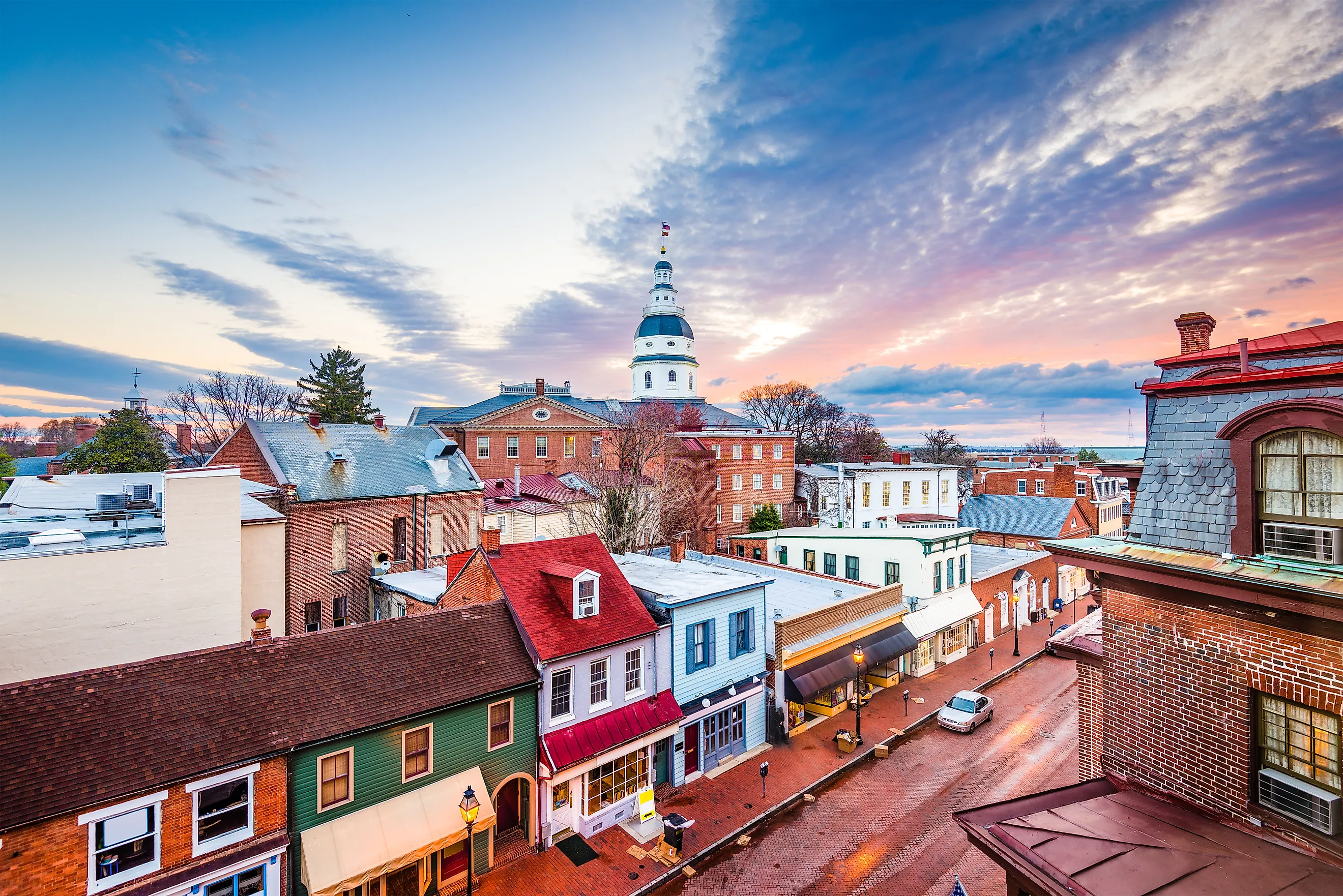
Annapolis lost its county court for most of a century and then won it back. Maryland created Anne Arundel County in April 1650, but the court did not stay put. It shifted to a hamlet called the Ridge around 1679, and by 1689 it was meeting at Londontown. The General Assembly fixed the seat at Annapolis by law on May 8, 1695. Court records show a house rented from a local landowner from about March of that year until permanent quarters were ready.
Those quarters were the colony's first State House, taken up around October 1697 and destroyed by fire seven years later. That 1704 blaze consumed nearly every county record made before it, and barely a scrap of the first 50 years survives. State archives remain candid about what the fire cost them. They flag one unresolved question: where the court met in Annapolis between the county's founding in 1650 and the move to the Ridge. The town took its present name in 1695, for Princess Anne.
King William, Virginia

King William County dates from an act effective April 11, 1702, which made it the 24th county in Virginia. Its court has convened in the same rural village ever since, and 276 people live there. The King William County Courthouse dates to 1725. No other courthouse in America has stayed in service longer, a claim the county, the state preservation office, and a resolution of the Virginia legislature all support.
Most of Virginia's early courthouses went up near the geographic center of a county rather than inside any town. King William still keeps that isolated setting, with a low brick wall around the green, put there to fend off livestock. That unbroken record survives by design. After a modern courthouse opened nearby in the 2000s, judges arranged to keep hearing some matters in the 1725 room so the streak would not break.
Edenton, North Carolina

Edenton grew up around a court rather than the other way around. Colonial authorities designated the place as a courthouse site in 1712, when it was still called the Town on Queen Anne's Creek. Incorporation followed in 1722 under a new name honoring Charles Eden, then royal governor. North Carolina counts it as the state's second oldest town, and it served as the colonial capital from 1722 to 1743.
Chowan County has worked through three courthouses. A wooden one arrived around 1718, and a replacement in 1724 drew a famously unkind description from the planter William Byrd. Then in 1767 the assembly funded the Georgian replacement that commands the courthouse green today. The Chowan County Courthouse is the oldest one surviving anywhere in North Carolina and has been a National Historic Landmark since 1970. Beside it stands the 1825 Chowan County Jail, fifth in a line going back to about 1722. About 4,500 residents live here.
St. Augustine, Florida

St. Augustine had been a town for 256 years before the United States gave it a county to run. Spanish settlers founded it in 1565, and it remains the oldest continuously occupied European settlement in the contiguous United States. Control passed to Britain in 1763, returned to Spain in 1783, and went to the Americans in 1821.
The county arrived with that last transfer. Andrew Jackson, governing the new Florida Territory, split the whole peninsula into two counties on July 21, 1821. St. Johns County took everything east of the Suwannee River, and Escambia County took the west. St. Augustine has been the seat from that day, so the town predates its own county by more than two centuries. The Castillo de San Marcos, built under Spanish rule, still overlooks the harbor.
Where The Court Never Moved
All but one settled into place before the Revolution. The last did so the year Florida changed hands. What they share is not age alone but stubbornness. Every one of them kept a function that most American counties eventually relocated for convenience. The court books at Eastville, the colonial bench that never rose in Virginia, and the surveyor's crossing at Dover are evidence of one habit. Once the court sat down, nobody moved it.