Which States Don't Use The Word County?
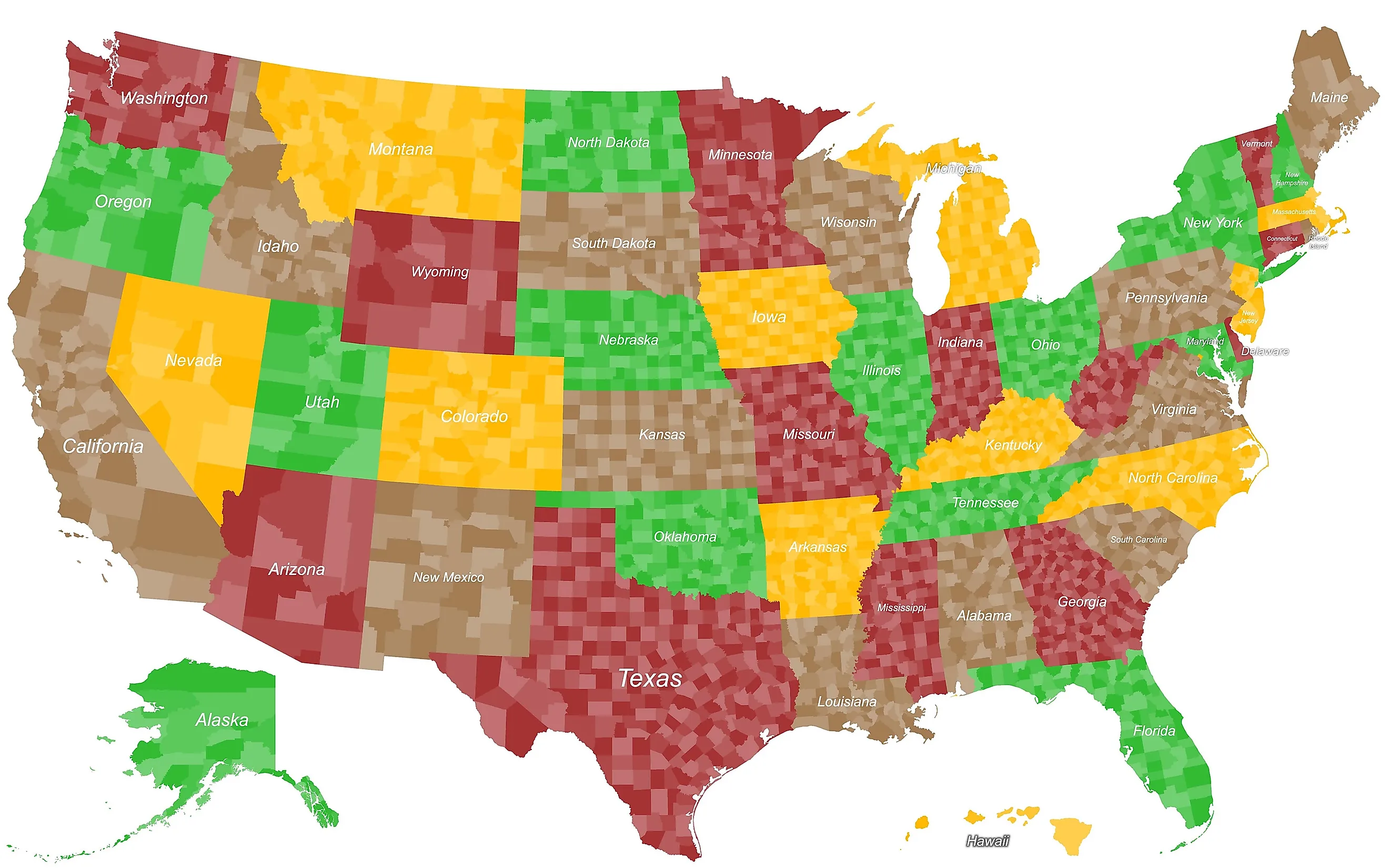
In the United States, local government is usually organized around counties, a system so common that many people assume it's the same everywhere. Yet a closer look at the map reveals two notable exceptions. Louisiana uses parishes, while Alaska uses boroughs, making them the only states that do not use the county system by name.
Their different terminology is a result of much more than simple word choice, as Louisiana's approach grew from centuries of European colonial rule and Catholic influence, whereas Alaska developed a structure tailored to its immense size and scattered population. Read on to learn more about these unique systems and the history behind why the two outliers exist.
How Counties Became the National Standard

Counties are the basic local government unit in most of the United States. The system was originally developed from English administrative traditions and spread across the country as new states were created. Today, the majority of states still use the term "county" to describe their regional governments. In fact, there are more than 3,000 traditional counties nationwide, while parishes and organized boroughs together number fewer than a hundred.
Although their responsibilities vary by state, counties commonly oversee courts, sheriff's departments, jails, property records, elections, road maintenance, and other public services that are too large for individual cities or towns to manage alone. But because counties are so widespread, many Americans rarely think about the term itself. The word appears on highway signs, weather alerts, legal documents, and mailing addresses, making it seem like a truly universal feature of American government.
That is what makes Louisiana and Alaska unusual: they perform many of the same governmental functions found elsewhere, but they do so under entirely different names rooted in their own distinct histories.
Why Louisiana Uses "Parishes"

Louisiana is the only state in the US that uses the term "parish" instead of county, and the reason is closely tied to its longstanding colonial history. Before becoming part of the United States, the region was governed first by France and later by Spain, both of which had strong Catholic traditions. During that period, local communities were often organized around church parishes, which served not only religious purposes but also acted as important centers of administration, record-keeping, education, healthcare, and general community life. You can see the similarities with the English county system now.

When the United States acquired the territory through the Louisiana Purchase in 1803, these parish boundaries were already well established. Then, after Louisiana became a state in 1812, lawmakers chose to retain the familiar term rather than replace it. Over time, the parish system became fully integrated into its civil government.
Today, Louisiana has 64 parishes, and, as said, they function much like counties elsewhere in the country. Each parish has its own local government structure, courts, sheriff's office, and public services. The continued use of the word parish is therefore only really a lasting reminder of the state's French and Spanish colonial heritage, as well as the influence Catholic institutions had on its early development.
Why Alaska Uses "Boroughs"

Alaska is the second and only other state that does not use counties. Alternatively, it is divided into boroughs, a system created specifically to suit its unusual geography and population patterns. Unlike Louisiana's parish system, which grew out of colonial history, this northern state's boroughs were designed as a modern solution to governing an enormous and sparsely populated region. Some boroughs even cover areas far larger than many entire states in the Lower 48, namely the North Slope Borough, which encompasses nearly 95,000 square miles (246,000 sq km).
When Alaska became a US state in 1959, lawmakers concluded that the traditional county model used across most of the rest of the country would not work effectively here. Many areas were (and still are) highly remote, had very small populations, and were separated by nearly impassable mountains, tundra, forests, and vast distances with limited transportation connections. Creating dozens of county governments in such conditions would have been expensive and impractical.

The Alaska Constitution, therefore, established 19 organized boroughs, which function as slightly more independent regional governments responsible for services such as schools, planning, taxation, and public administration. However, a large portion of Alaska is not actually part of any organized borough at all. This area, which covers roughly half of the state and reaches across the Interior, the west coast, and the Aleutians, is aptly known as the "Unorganized Borough," and many governmental responsibilities within it are handled directly by the state. For census and statistical purposes, the federal government divides the Unorganized Borough into census areas, which are treated as county equivalents even though they are not counties in the legal sense.
A Different Approach to Local Government
Although counties dominate the American map, Louisiana and Alaska show that the USA has never followed a singular model of local government. Both of these standout systems carry out essentially the same functions associated with counties, but their different names showcase the distinct historical and geographic forces that shaped each. Above all, they make America's governance more varied than many people realize and can teach you a thing or two about the country's diverse past and people.