The American Towns That Doubled In Size In Ten Years
Queen Creek, Arizona has no public transit and a rush-hour drive to Phoenix that can take an hour and a half, and people keep moving there anyway. The same thing is happening outside Dallas and Houston in Texas, outside Boise, and just south of Charlotte. These nine American towns at least doubled their populations between 2015 and 2025, and many are still laying water lines, adding schools, and widening roads to catch up. Anyone weighing a move to a booming suburb can see here what the next ten years can look like. (All population data is from the U.S. Census Bureau.)
Celina, Texas

Celina, Texas, a city in Collin and Denton Counties in the Dallas-Fort Worth area, grew by an astounding 772.99% from 2015, when its population was 7,380, to 64,427 residents in 2025. It was also the fastest-growing U.S. city or town with at least 20,000 residents between 2024 and 2025, expanding by 24.6% in a single year. Most of Celina's new residents came from other parts of Texas, as well as from Florida, California, Illinois, Georgia, and Missouri. This expansion has transformed Celina from a small farming town into a growing city. Housing developments are springing up across the area from developers such as Highland Homes and Toll Brothers. New businesses, including a planned country club and independent boutiques, have also come to town. Celina remains 40 miles north of Dallas, keeping the metro area's jobs within commuting distance.
Fulshear, Texas

Fulshear, Texas grew even more dramatically over the full decade, surging 928.65% from 6,283 residents in 2015 to 64,630 in 2025. The town sits in northwest Fort Bend County, about 30 miles west of Houston, squarely in the path of the metropolitan area's westward suburban expansion. Fulshear was the second-fastest-growing U.S. place with at least 20,000 residents between 2024 and 2025, according to Census Bureau estimates. The change is striking for a community that had only around 1,000 residents when it incorporated in 1977. Residential construction has since pushed outward through former agricultural land, while Houston-area workers have increasingly settled in Fulshear. New subdivisions, parks, shops, and other services have followed the population boom, turning what was once a tiny farming community into a sizable suburban city in little more than a generation.
Princeton, Texas

Another town in Collin County, Princeton, Texas more than quintupled in population, growing 410.73% from 8,522 residents in 2015 to 43,524 in 2025. The town lies about 30 miles northeast of Dallas and has median home values of $283,245 per Zillow.com, compared with $475,341 across Collin County. Princeton's population has climbed from about 1,000 in the 1960s to more than 40,000 today, placing it firmly among the country's biggest suburban growth stories. Expansion became so intense that officials temporarily halted certain new residential projects while the city worked to make sure its infrastructure could support additional development. According to CBS News, roughly 13,000 homes had already been approved for construction over a five-year period, showing just how quickly this once-small North Texas community has been changing.
Star, Idaho

Star, Idaho is a town in northwestern Ada County and Canyon County, northwest of Boise. Its population jumped from 7,820 in 2015 to 20,874 in 2025, representing a 166.93% increase. Star has been among the standout growth communities in the Boise metropolitan area as the Treasure Valley attracts more residents and residential construction pushes farther from the region's urban core. Its historic downtown remains recognizable even as subdivisions spread outward, and local festivals still draw residents into the center of town. Improvements along State Highway 44 have accompanied Star's transition from a rural community with a single stoplight into a substantial residential suburb. Larger lots and custom-built homes have also helped make it an alternative for buyers looking beyond Boise and its closer-in suburbs.
Prosper, Texas

Sitting in Collin and Denton Counties, Prosper went from 17,750 residents in 2015 to 45,605 in 2025, a 156.93% increase. The Dallas suburb grew to more than two and a half times its former size during the decade. Former Dallas Cowboys player Deion Sanders built a mansion in Prosper in 1999, when much of the surrounding landscape was still rural pasture. That property sold in 2026 for $4.5 million, a fitting marker of how dramatically the area has changed. While some neighboring communities expanded around lower-priced starter homes, Prosper has attracted larger custom houses and amenity-heavy planned developments. Public investment has followed the rooftops, including a $1 billion regional infrastructure program intended to improve transportation as this once-rural corner of North Texas becomes increasingly tied into the wider Dallas-Fort Worth metropolitan area.
Queen Creek, Arizona

A suburb of Phoenix, Queen Creek, Arizona was originally known as Rittenhouse before taking the Queen Creek name in 1947 and incorporating as a town in 1989. Its population expanded from 35,534 in 2015 to 89,770 in 2025, growth of 152.63%. The scale of that expansion has put pressure on local transportation. Queen Creek has no traditional public transit system, while road improvements have struggled to keep pace with the number of new homes and drivers. During rush hour, the roughly 38-mile trip toward Phoenix can stretch far beyond its off-peak travel time. Buyers have continued arriving for the area's master-planned neighborhoods and relatively spacious suburban development. Queen Creek straddles Maricopa and Pinal Counties, placing it directly along one of the Phoenix metropolitan area's major outward growth corridors.
Anna, Texas

The Collin County city of Anna, Texas grew from 11,249 residents in 2015 to 35,245 in 2025, a 213.32% increase. Its population climbed another 10.2% between 2024 and 2025 alone. Housing construction has spread rapidly around the community as growth from the Dallas-Fort Worth metro reaches farther north along the US 75 corridor. Anna is responding with new roads, utility investments, and plans for additional commercial development. A downtown entertainment and restaurant district is also planned as officials try to build a more substantial center for a population that has tripled in only a decade. The municipal complex and library already serve as a gathering point for community programs, but the scale of Anna in 2025 is radically different from the much smaller North Texas town that entered the decade.
Fort Mill, South Carolina

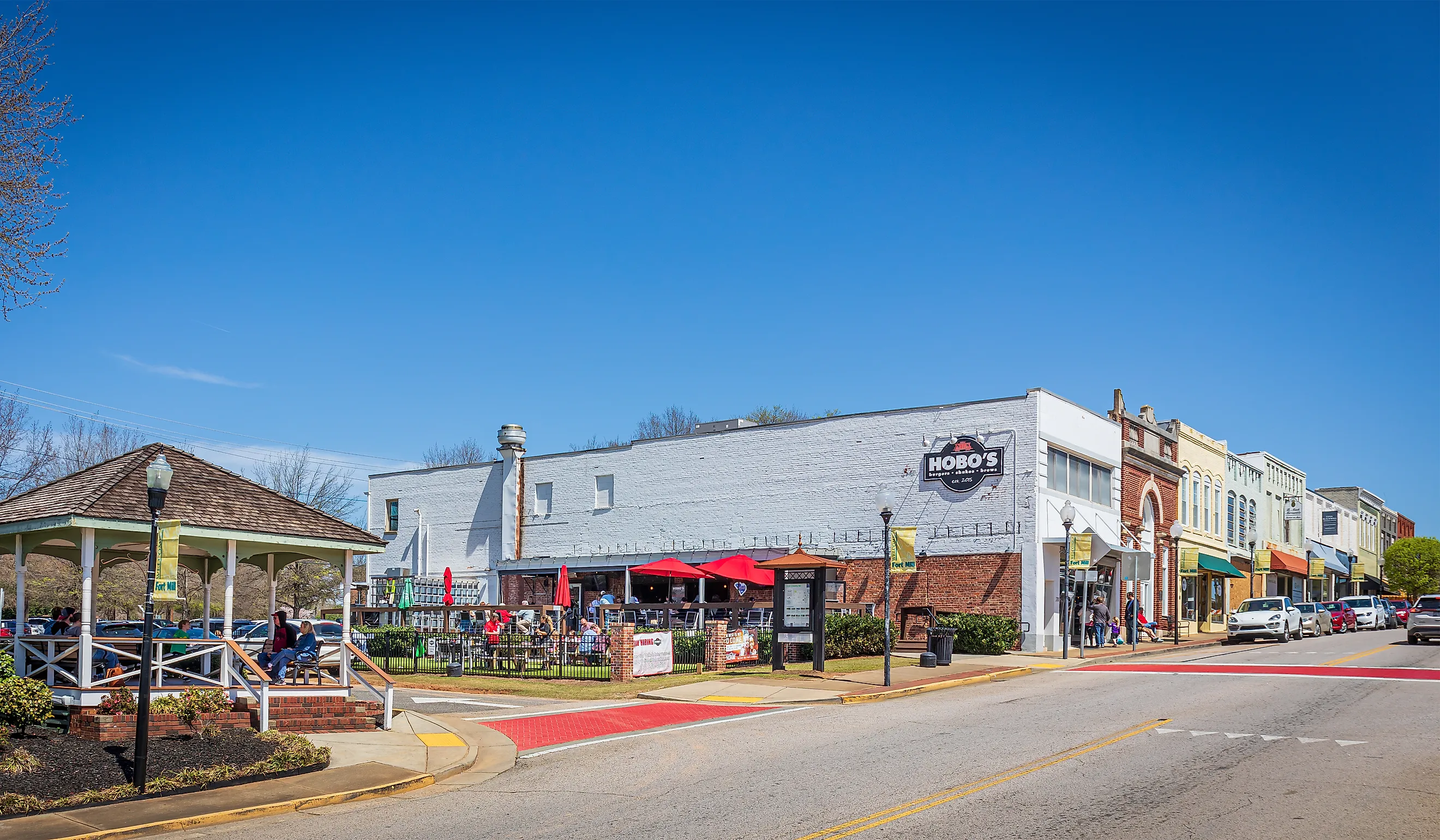
Fort Mill, South Carolina grew from an estimated 13,662 residents in 2015 to 38,673 in 2025, an increase of 183.07%. The York County town sits just south of Charlotte, placing it beside one of the Southeast's biggest employment centers while keeping a distinct downtown and municipal identity. Growth has been intense enough to become a central issue in Fort Mill's long-range planning. Its 2026 comprehensive plan notes rising pressure on housing, land, infrastructure, and community services, while residents ranked the effects of population growth as a leading concern. In March 2026, the Town Council went as far as adopting a temporary moratorium on certain new residential development applications while zoning rules and planning documents were updated. Fort Mill's jump from fewer than 14,000 residents to nearly 39,000 shows how quickly Charlotte's growth has spilled across the South Carolina state line.
Haines City, Florida

Polk County, Florida's Haines City went from 22,527 residents in 2015 to 45,973 in 2025, growth of 104.08%. That puts the city just over the threshold for doubling in a decade. Its location between the Orlando and Tampa metropolitan areas has placed it directly in one of Central Florida's major growth zones, where new subdivisions have spread across former agricultural land. The expanding population has brought a larger tax base along with new employers, including the ALDI USA Regional Distribution Center and Carvana Inspection & Distribution Center. Haines City's growth is especially notable because its population increase has occurred alongside substantial investment in housing and commercial development, turning a community of fewer than 23,000 people into one approaching 46,000 in only ten years.
Fastest-Growing U.S. Towns
Doubling a municipal population in ten years changes far more than the number printed on a Census table. Roads built for a smaller population suddenly carry thousands of additional cars, utility systems need additional capacity, and local governments must plan for neighborhoods that did not exist a few years earlier. Fort Mill's development moratorium and Princeton's temporary building restrictions show how quickly that pressure can become a policy issue. In Celina and Fulshear, meanwhile, extraordinary growth has pushed former small towns toward city-sized populations. These nine communities took different routes to the same remarkable milestone: each had more than twice as many residents in 2025 as it did in 2015.