9 Most Charming Town Squares In Utah
Brigham Young's settlers laid their towns out wide. They squared the streets into a grid, set a tabernacle or a courthouse at the center, and left room for the orchards and wagons to come. More than a century later, those old centers still hold. The streets stay wide, the frontages low and old, the center block still the heart of town. One Utah town keeps a temple on a hilltop, while another fills a summer stage with Shakespeare each season, and a third fronts the red cliffs Hollywood once filmed.
The nine Utah towns here run north to south down the spine of the state. Though none of them are big in size, they all reward an afternoon on foot.
Brigham City

An illuminated arch first crossed Main Street in 1928, welcoming visitors to Brigham City as the "Gateway to the World's Greatest Wild Bird Refuge." About 30 miles west at Promontory, the last spike of the transcontinental railroad went into the ground in 1869, and the trains that followed rolled near town. Brigham City carries the name of Brigham Young, who sent families here in 1851 to plant orchards on a bench that was once the shoreline of the ancient lake filling the Great Basin.
The Box Elder Tabernacle holds the center, its rock walls and slim spire visible blocks away. Mornings run on Peach City, a carhop drive-in pouring peach shakes up the north end of Main. The Brigham City Museum of Art & History rotates its shows for free and hosts their annual Art Quilt Show. West of downtown, the marshes of the Great Salt Lake fill with the aforementioned migrating birds every spring.
Park City

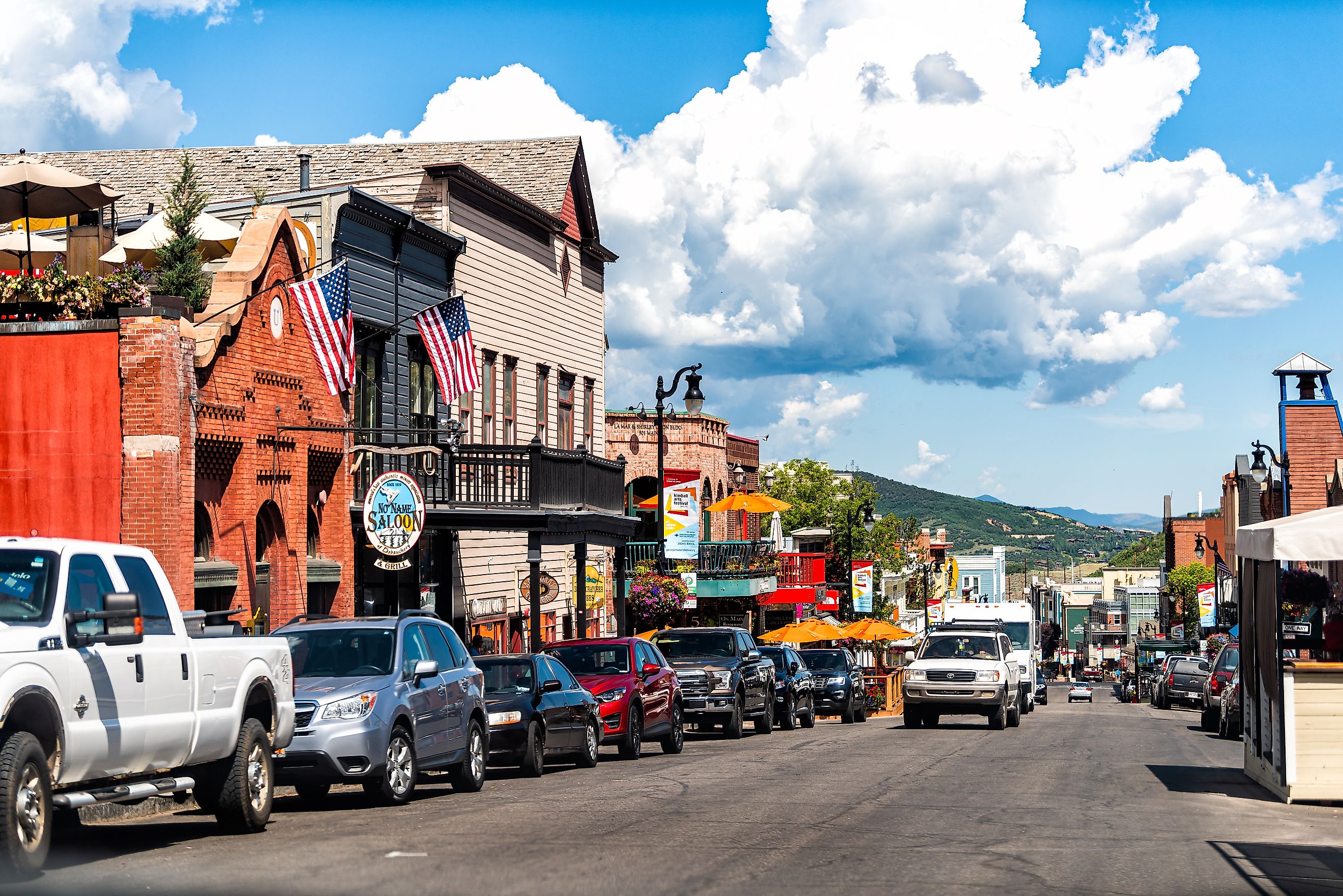
This next town was built on silver. By the 1880s, the mines above town were turning out fortunes, and the Ontario alone made George Hearst rich enough to seed a California dynasty. The boom left a Main Street of false-front Victorians running up one steep grade in the Wasatch Range, most of it rebuilt after an 1898 fire tore through. The Park City Museum keeps that era close, with the old territorial jail still bricked into its basement.
When the ore played out, snow took its place, and the slopes above led to the city becoming one of the country's busiest ski towns. The 2002 Winter Olympics sent ski jumpers and bobsledders down runs just north of downtown, and for four decades, the Sundance Film Festival packed these sidewalks every January, through its final Park City edition in 2026. The breakfast booths at The Eating Establishment have fed locals and film crews since 1972, a few doors up from the pints of Guinness at Flanagan's on Main.
Spring City

South of the ski crowds, deep in Sanpete Valley, this whole town is a museum. Spring City was added to the National Register of Historic Places as a single historic district, one of the few American towns listed start to finish, and the pioneer grid its settlers squared off in 1852 still orders every block. The early houses went up in sun-dried adobe and pale oolite limestone quarried in the foothills, the same stone used behind the Spring City Chapel, a meetinghouse finished in 1902.
Painters and potters started buying the old homes decades ago, which is how a town of barely a thousand keeps a working pottery and gallery going. Horseshoe Mountain Pottery turns out functional stoneware down the street from Spring City Arts and its rotating shows. Lunch is at Das Cafe, a German kitchen whose Basque cheesecake and carrot cake draw people in from well beyond the county.
Manti

Keep south through the valley, and you'll see one building in the skyline long before the rest of the town. The Manti Utah Temple stands on a hill of cream-colored oolite, the same stone its walls are cut from, quarried out of the rise beneath it. Brigham Young dedicated the site in 1877, and Latter-day Saint settlers spent 11 years hauling and shaping stone before the Gothic Revival towers were completed in 1888. The fortress look is deliberate with castellated walls and twin towers, the taller one rising 179 feet.
Inside each tower, a spiraling staircase climbs five stories with no center post holding it up, an engineering trick the pioneers pulled off by hand. It counts amongst the oldest temples in the state, which now holds more than a dozen, and only members go inside, though the grounds remain open for the views down the valley. The hilltop amphitheater once staged a pageant that drew crowds by the thousands until its final season in 2019. Down in town, Charlees Comfort Kitchen dishes out the kind of comfort-food brunch that fills its tables on a weekend, a few doors from the family-owned Main Street Pizza.
Fillmore

Utah's first capital was not Salt Lake City. It was here, in the Pahvant Valley, a town on the I-15 corridor west of the Sanpete Valley. Brigham Young made it the territorial capital in 1851, the year after President Millard Fillmore signed the act creating the territory: the town took his surname and the county around it his first.
The legislature met only briefly in the red sandstone building now run as the Territorial Statehouse State Park Museum, the oldest government building in the state, before the capital went north to Salt Lake City in 1856, four decades ahead of Utah's statehood. Three floors of exhibits track that short stint at the center of things. Lunch pulls off the freeway for Filly's Carhop Cafe, a counter-service throwback at the north end of Main known for delectable burgers and onion rings, a few blocks up from The Eatery & 1943 Pub and its steak and eggs.
Beaver

This small town turns out to be the unlikely birthplace of two Americans who could not be less alike. Robert LeRoy Parker was born here in 1866 and grew up to rob banks and trains across the West as Butch Cassidy. Philo Farnsworth came forty years later, in 1906, and sketched out the first all-electronic television as a teenager, earning the title "father of TV." The town preserves its history at the Beaver County Courthouse Museum, an 1882 courthouse with a bell tower and old jail cells in the basement.
Beavers trapped along the river gave the town, the county, and the stream their name back in the fur-trade years. East of Main, the volcanic Tushar Mountains rise above 12,000 feet, among the highest in Utah. For lunch or dinner, stop by Loaded Burgers, where their Zion burger and the in-house fries draw a serious line out the door, with Arshel's Cafe a longtime second on the pastrami burger and pie.
Cedar City

Every summer since 1962, a town founded to mine iron has filled its stages with Shakespeare. The Utah Shakespeare Festival draws crowds from across the country to Cedar City, much of the season playing under the open sky in a theatre modeled on London's Globe. Between shows, the crowds spill into Centro, whose wood-fired pizza and share-sized salads keep the patio full most nights. There's also the French Spot a block over, almost too good to be this deep in red-rock country, with croissants and blueberry danishes going from early morning on.
The iron came first. Brigham Young sent settlers here in 1851 to dig and smelt ore for the new territory, the effort that gave Iron County its name and left the relics now kept at the Frontier Homestead State Park Museum on the north end of town. The ore eventually played out, but by then the festival and Southern Utah University had handed the place a second life in the arts. Twenty miles east and four thousand feet up, Cedar Breaks opens into an amphitheater of red and orange spires, a national monument on the rim of the Colorado Plateau.
Panguitch

Panguitch literally built its Main Street out of brick. Local kilns fired the red and buff blocks that still front the downtown frontages and houses, a whole historic district of them. The name is Southern Paiute for big fish, after the trout in Panguitch Lake up in the mountains. Cowboy's Smokehouse Cafe/Steakhouse smokes salmon fillets and rib eyes that hold their own against anything in Salt Lake, and a few doors up, the Panguitch Gem Theater scoops its own ice cream, keeps a rock shop upstairs, and hosts weekly cinemas.
The town's oddest point of pride is Quilt Walk Park, off Center Street. In the starving winter of 1864, seven men set out for flour in Parowan and crossed the deep snow by laying quilts on the drifts and walking them like stepping stones, a rescue the town reenacts every June. Most travelers, though, treat Panguitch as a base camp, grabbing a cup at the Wanderlust Cowgirl Coffee drive-through before heading out to explore the town. Zion rests to the southwest, and about 24 miles southeast, the hoodoo amphitheaters of Bryce Canyon glow red at first light.
Kanab

Hollywood came to Kanab for the scenery. Studios rolled in during the 1920s and kept coming for decades, shooting Westerns and TV serials against the red sandstone cliffs around town, enough to earn it the name Little Hollywood. The old sets can still be seen at Little Hollywood Land on Center Street, which is a walk-through village of weathered facades and chuckwagon gear.
The Western streak carries into the food, with places like Houston's Trail's End doing country fried steak in a Western-themed room, and Rocking V Cafe dishes out bison and trout under local art. For the town's older story, the Heritage House Museum preserves a 1894 Victorian raised by the Mormon families who settled the valley. Kanab is also a crossroads of public land. The visitor center for Grand Staircase-Escalante and its slot canyons is right in town, Zion is an hour west, and eighty miles south, the highway climbs to the high North Rim of the Grand Canyon, the same red country the movies came to capture.
Charming Utah Towns
Most of these towns are easy to blow past, a few exits apart on the interstate or a few bends down a back highway, typically a place that road trips treat as gas stops... but pull off anyway. One row back from the frontages, there is almost always something worth the detour, a 1928 electric arch still lit over Main Street, a basement jail under the courthouse in Butch Cassidy's hometown, a smoker running since seven, a half hour shy of Bryce. The names can honestly blur together on a map, but the towns do not.