11 Adorable Towns In Illinois
A retired sea captain who believed in mermaids built a hotel in Lebanon in 1830, and Charles Dickens slept in it twelve years later. Fulton has a Dutch windmill that was actually made in the Netherlands and shipped over in pieces. Elsah has no street numbers. Eleven Illinois towns follow, none over 40,000 people and most under 10,000, each with something genuinely strange going on.
Galena

Roughly 85 percent of the buildings in Galena sit inside a National Register historic district, which is why the main street looks like a film set that nobody struck. The town boomed on lead mining in the 1820s, went quiet when the ore ran out, and was too broke to modernize. That turned out to be the best thing that ever happened to it.
Ulysses S. Grant lived here when the Civil War began, working in his family's leather goods store, and the town sent nine men who became Union generals. The house Galena gave Grant on his return in 1865 is open as a state historic site. Main Street runs a tight row of red-brick storefronts below the bluff, and the grades around town are steep enough to put the brakes on.
Woodstock

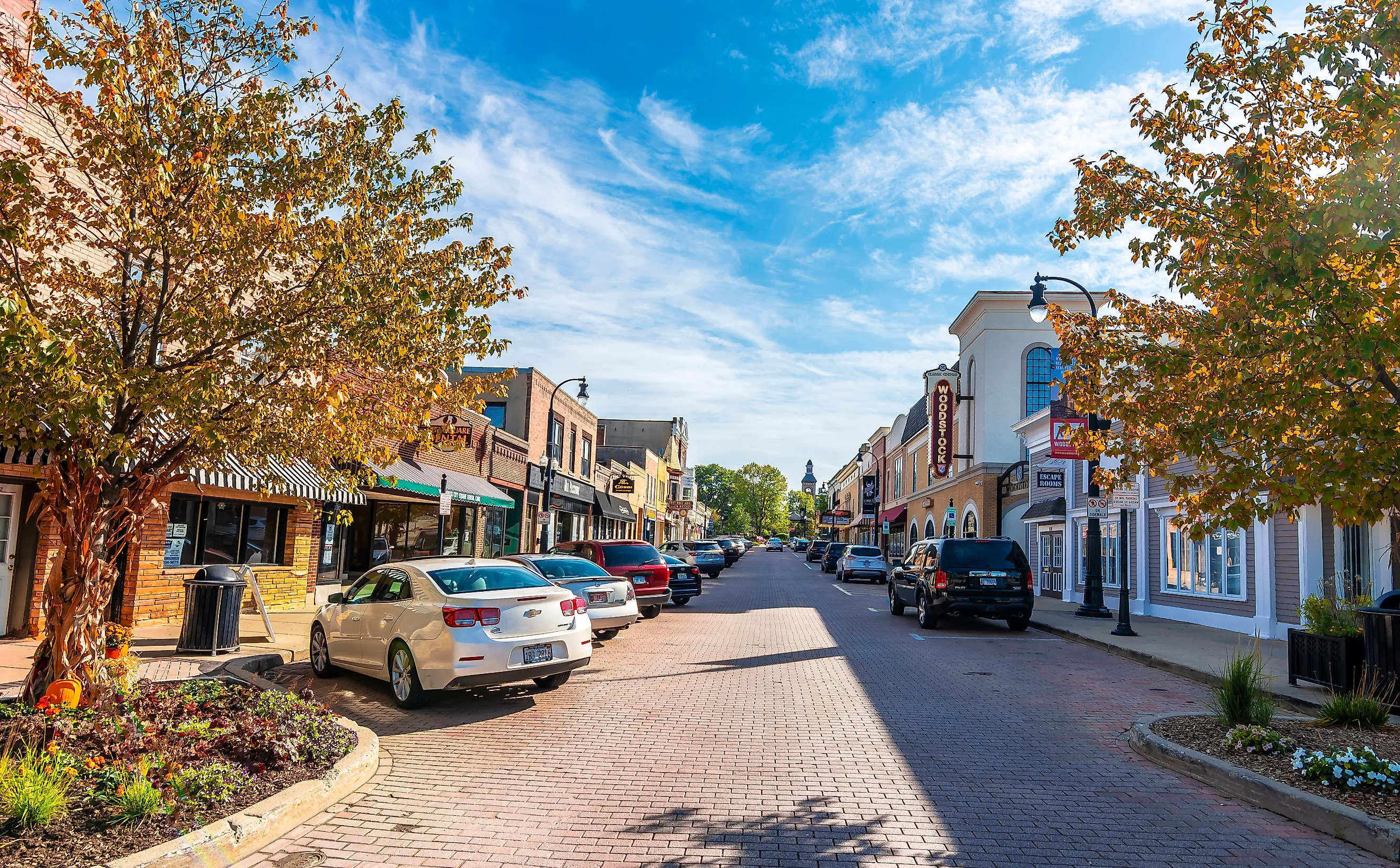
Woodstock played Punxsutawney in Groundhog Day, and the town has leaned into it ever since: there is a plaque on the curb marking the puddle Bill Murray stepped in, and the square hosts a Groundhog Days festival every February. The film crew stayed for months and the place has never quite recovered.
The square itself is the draw. The 1889 Woodstock Opera House still programs music and theater, and Orson Welles performed on its stage as a teenager while attending the Todd School here. Around 25,600 people live in Woodstock, which makes it the largest town on this list after Quincy, though the square keeps it feeling smaller.
Elsah

Around 600 people live in Elsah, and the entire village is on the National Register, every building of it. There are no street numbers. Mail goes by name, which works fine when the whole place fits in a ravine between the Mississippi bluffs and the river.

The stone cottages went up in the 1850s and 1860s, built from limestone quarried out of the bluff directly behind them. The Great River Road runs past the mouth of the ravine, which makes Elsah one of the better stops on what is arguably the best drive in the state. Principia College sits on the bluff above with a Bernard Maybeck-designed campus.
Nauvoo

In the early 1840s Nauvoo was briefly one of the largest cities in Illinois, rivaling Chicago, because roughly 12,000 Latter-day Saints had built it from swampland on a bend in the Mississippi. Then Joseph Smith was killed at Carthage in 1844, the Saints left for Utah in 1846, and the city emptied almost overnight.
About 950 people live there now. The historic district has been restored to its 1840s state with working blacksmiths and coopers, horse-drawn wagon rides, and most of it free. The temple burned in 1848, was finished off by a tornado, and was rebuilt from the original plans in 2002. Nauvoo State Park handles the swimming and camping, and there is a surprisingly good winery in town.
Fulton

There is a working Dutch windmill on the Mississippi levee at Fulton, and it is the real thing. The city commissioned millwrights in the Netherlands to build it, had it dismantled, shipped across the Atlantic, and reassembled here, and it has been grinding wheat, rye, buckwheat, and cornmeal since 2001. The town was settled partly by Dutch immigrants in the 1800s, which is the reason, and the Windmill Cultural Center next door covers the rest of that story.
Dutch Days each May fills the streets with wooden shoes and klompen dancing. Heritage Canyon, an old limestone quarry on the edge of town, has been filled with relocated 1800s buildings as an open-air village. The Great River Trail runs along the levee, so the windmill is the only Dutch-built working mill in the country you can cycle past.
Lebanon

Lyman Adams, a retired sea captain, built the Mermaid House Hotel on St. Louis Street in 1830 and named it for creatures he was convinced existed. Charles Dickens stayed the night in 1842 during his American tour and wrote about the place in American Notes. Abraham Lincoln slept there too, riding the circuit. It is a museum now, open by appointment.
The other anchor is McKendree University, founded in 1828 as Lebanon Seminary and the oldest college in Illinois, which gives a town of under 4,000 a genuine campus and a bell tower. The brick-paved downtown runs a few blocks of antique shops, and the Emerald Mound just outside town is a surviving Mississippian earthwork.
Long Grove

The covered bridge at Long Grove dates to 1906 and carries Robert Parker Coffin Road into the village center. It has been hit by trucks often enough that tracking the collisions has become a local sport, and the village keeps rebuilding it.

Across the bridge, the village deliberately zoned itself to keep chain stores out, so the center is clapboard and brick buildings holding independent shops, a confectionery, and restaurants. Around 8,000 people live here, and of everything on this list it is the easiest to reach on a whim.
Ottawa

Washington Square in Ottawa hosted the first Lincoln-Douglas debate in August 1858, in front of a crowd that overwhelmed a town of a few thousand. The square is still there, with statues of both men, and the 1855 Reddick Mansion overlooking it: 22 rooms of Italianate brick that was among the most elaborate private houses in the state before the Civil War, and free to walk through.
The town sits where the Fox meets the Illinois, with Starved Rock fifteen minutes down the road. Around 18,600 people live here.
Quincy

Quincy is the biggest town here at about 39,500, and it earns its place on architecture. The East End Historic District holds one of the denser collections of 19th-century mansions in the Midwest, and the South Side German Historic District preserves what German immigrants built when they arrived in numbers after 1848. Washington Park downtown hosted the sixth Lincoln-Douglas debate in October 1858.
The bluff above the Mississippi gives the river views, and the Villa Kathrine, a Moorish castle a merchant built in 1900 after travelling the Mediterranean, is the strangest building on the Illinois riverfront by a wide margin.
Sycamore

Sycamore runs a Pumpkin Festival every October that has been going since 1962, when a local man started putting carved pumpkins on his lawn and the whole town joined in. It now fills the streets around the 1904 DeKalb County Courthouse for most of a week, with several hundred decorated pumpkins on the courthouse lawn.
The rest of the year it is a county seat of about 18,600 with a historic district of tree-lined streets and Victorian houses. The Sycamore History Museum covers the local record.
Greenville

Greenville is the Bond County seat, about 6,700 people an hour east of St. Louis, and its downtown square has been restored rather than replaced. Greenville University anchors one end of town.
The draw for anyone with an interest in how the Midwest actually got built is the American Farm Heritage Museum, which keeps working tractors, steam engines, and a short-line railroad on a former airfield, and runs them at its summer show. The DeMoulin Museum downtown is the odder option: it holds the output of a company that manufactured elaborate mechanical initiation devices for fraternal lodges, including a goat on wheels that members were made to ride.
Picking One
These eleven share a street grid and not much else. Galena was too poor to tear itself down and got a preserved main street out of it. Nauvoo was briefly bigger than Chicago and then emptied in a year. Fulton imported a windmill. Lebanon has a Dickens connection and a sea captain who believed in mermaids. Elsah does not bother with house numbers. Greenville has a museum of ceremonial goats. Pick the oddity that appeals, because every one of these towns is small enough to see in an afternoon and strange enough to be worth the drive.