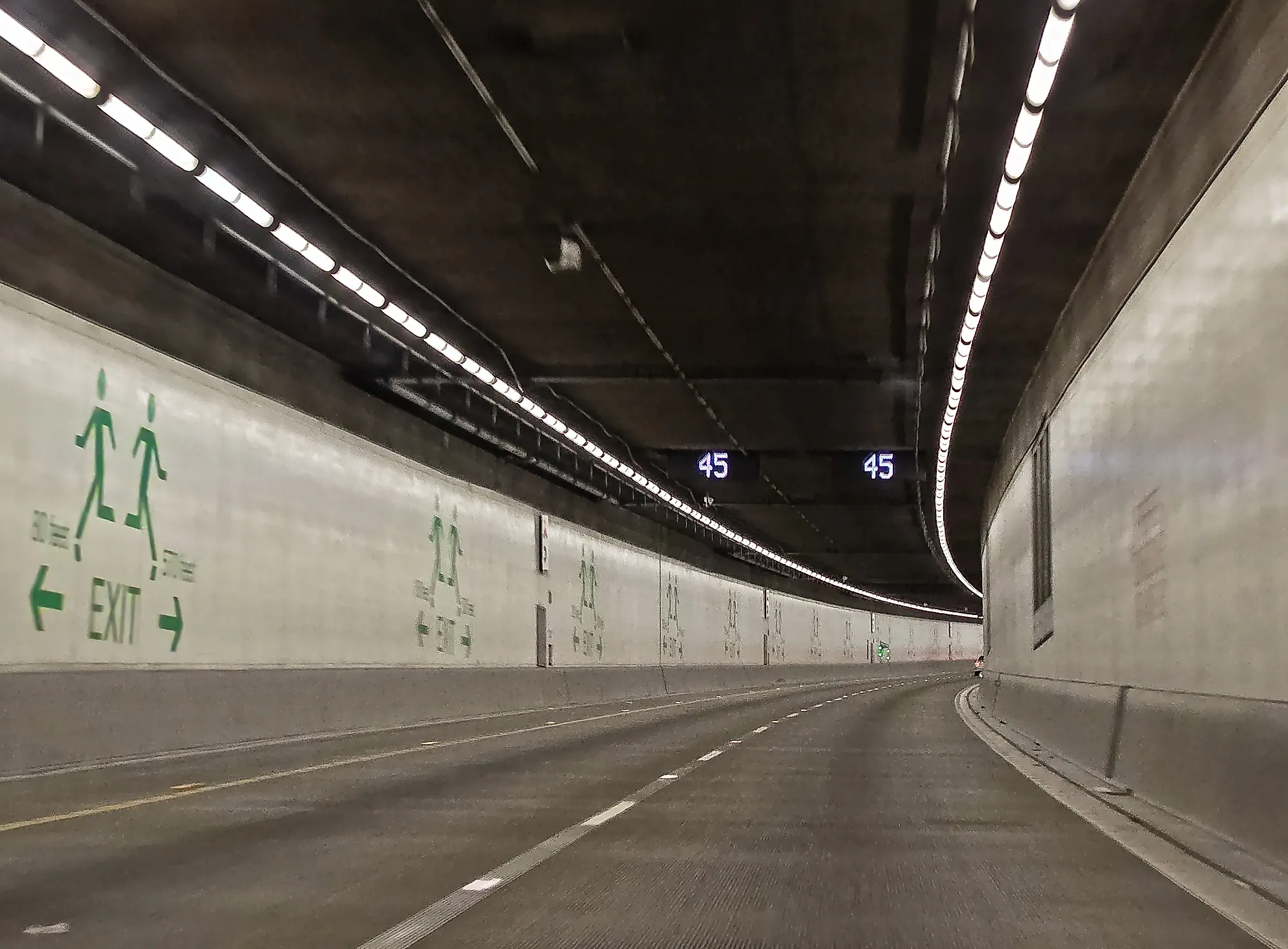
The Deepest Tunnel In The United States
The SR 99 Tunnel beneath downtown Seattle reaches at least 215 feet (65.5 m) below the surrounding ground at its deepest section, making it the deepest verified road tunnel in the United States when depth is measured below ordinary ground or street level. That figure is especially striking because it measures only to the tunnel's crown, or uppermost edge. The roadways sit farther down inside the enormous circular bore.
This definition excludes a different kind of tunnel depth created by mountains. A highway tunnel can have thousands of feet of rock overhead simply because a mountain rises above an almost level road. SR 99 presents a different engineering problem. Its route descends beneath an established city filled with streets, high-rise buildings, utilities, sewers, rail infrastructure, and groundwater. At its deepest point, even the top of the tunnel lies roughly 21 stories below grade.
The SR 99 Tunnel Runs Deep Beneath Downtown Seattle

The SR 99 Tunnel carries State Route 99 for about two miles beneath Seattle. Its bored section runs for roughly 9,300 feet beneath downtown, beginning south of the city center near the waterfront and emerging to the north near Seattle Center. Washington State Department of Transportation opened the completed tunnel to drivers on February 4, 2019.
The tunnel's depth changes along the route. Engineering documentation for the project places the crown at 215 feet below grade at the deepest location. The crown is the top of the circular tunnel lining, not the highway pavement. Since the tunnel has an outside diameter of about 56 feet and contains two stacked road decks, vehicles at that section travel lower than the published 215-foot crown depth.
The deepest point also places the tunnel crown at an elevation of about 95 feet below sea level. Above it is the built environment of central Seattle rather than a mountain ridge. Buildings along the alignment range from small structures to high-rises, while foundations, buried utilities, railroad infrastructure, and sewer tunnels occupy some of the ground between the highway and the surface.
A Damaged Viaduct Led to the Underground Highway

SR 99 previously crossed central Seattle on the Alaskan Way Viaduct, an elevated double-deck highway built during the 1950s. Its vulnerability became impossible to ignore after the magnitude 6.8 Nisqually earthquake struck Washington in February 2001. Several viaduct foundations shifted by as much as five inches during the shaking.
Washington transportation officials spent much of the following decade examining alternatives. More than 90 options were studied before state and local leaders selected a deep-bored tunnel in 2009. Moving the highway underground allowed most of the existing viaduct to remain in service while the new route was excavated beneath the city.
The replacement also changed Seattle's waterfront. Once traffic moved into the new tunnel, the old Alaskan Way Viaduct could be demolished. That removed a large elevated highway that had separated much of downtown from Elliott Bay and cleared space for new streets and public areas along the central waterfront.
Bertha Dug a 57.5-Foot-Wide Path Beneath Seattle

Excavating such a large tunnel beneath an occupied downtown required an equally unusual machine. The tunnel boring machine, named Bertha, used a cutterhead 57.5 feet (17.5 m) across. It was the world's largest-diameter tunnel boring machine when excavation began in July 2013.
Bertha worked as an earth-pressure-balance machine. The design allowed crews to control pressure at the excavation face while advancing through Seattle's complex glacial soils and groundwater. Behind the cutterhead, the machine installed precast concrete segments that formed rings around the newly excavated space. These rings became the tunnel's permanent outer lining.
The journey did not proceed smoothly. Only months after excavation began, Bertha stopped after components overheated. Engineers eventually excavated a large access shaft so damaged equipment could be reached and repaired. After extensive work, tunneling resumed. Bertha finally entered the receiving pit at the north end of the route on April 4, 2017. Crews then dismantled the enormous machine and continued building the highway inside the completed bore.
Two Highways Fit Inside a Single Circular Tunnel

SR 99 differs from many American highway tunnels because northbound and southbound traffic do not travel through separate side-by-side tubes. Engineers instead placed the roadways on two levels inside one enormous circular bore.
Each level provides two traffic lanes plus shoulders. The stacked arrangement allowed four highway lanes to fit within a tunnel whose path had to weave beneath a dense part of Seattle. The configuration also made use of the vertical space created by the unusually large tunnel boring machine.
The remaining areas inside the circular lining contain infrastructure needed to operate a road this far underground. Ventilation equipment, drainage systems, electrical systems, emergency routes, fire protection equipment, cameras, communications equipment, and structural components all share the tunnel. Emergency access points connect the roadway with protected evacuation spaces at regular intervals.
The Tunnel Was Designed for Seattle's Earthquakes
Building a major highway beneath Seattle required engineers to account for strong earthquakes. The region sits within an active tectonic setting, and earthquake damage to the former viaduct was one reason the tunnel project existed in the first place.
The concrete tunnel lining and internal roadway structure were designed so they could respond differently as the ground moves. The interior structure consists of sections that can accommodate longitudinal expansion and contraction as well as transverse movement relative to the circular tunnel lining. Engineers evaluated the structure against both more frequent earthquakes and a much rarer event with a 2,500-year return period.
Water was another concern. Parts of the alignment encounter substantial groundwater pressure, while the southern end lies close to Elliott Bay. The precast concrete rings use sealed joints to create a watertight lining. Engineers also tested the gaskets used between tunnel segments to determine whether repeated earthquake movement could affect their ability to keep water outside the bore.
Other Deep US Road Tunnels Do Not Reach Seattle's Depth

Several underwater highway tunnels rank among the deepest road crossings in the United States, but their published depths remain below the 215-foot depth measured to the top of the SR 99 bore. The new bored tunnels at Virginia's Hampton Roads Bridge-Tunnel expansion reach about 173 feet (53 m) below the water surface. Those tunnels are among the deepest major highway bores constructed on the East Coast.
Florida's Port of Miami Tunnel reaches about 120 feet (37 m) below the water. Its twin 3,900-foot tubes run beneath the Main Channel between Watson Island and Dodge Island, providing a direct road connection to the Port of Miami.
Boston's Ted Williams Tunnel is another well-known deep crossing. Massachusetts transportation records place the interface between its underwater and land sections about 90 feet (27 m) below the surface of Boston Harbor. The tunnel carries Interstate 90 beneath the harbor toward Logan International Airport.
These tunnels solve a different engineering problem because much of their depth is associated with passing beneath waterways. Seattle's SR 99 Tunnel reaches deeper beneath an urban land surface. Its published 215-foot figure is also measured to the crown, leaving the actual traffic decks lower inside the bore.
Mountain Cover Is a Different Kind of Depth

Some American road tunnels have much larger numbers attached to their depth because mountains rise above them. Alaska's Anton Anderson Memorial Tunnel, for example, passes beneath Maynard Mountain and has thousands of feet of rock above parts of its route. It carries both road vehicles and trains through the mountain.
That does not mean motorists descend thousands of feet underground after entering the tunnel. The road passes through the mountain while the terrain climbs high above it. The same issue affects comparisons involving highway tunnels through major mountain ranges.
Measuring depth below the surrounding ground near the route produces a different question. It favors tunnels that physically descend well beneath the land around their entrances and alignment. Under that definition, a tunnel five meters beneath the original ground remains five meters deep even if a 1,000-meter mountain happens to rise above it.
SR 99 Opened a New Route Under Seattle

Drivers began using the SR 99 Tunnel on February 4, 2019. The completed highway runs between the stadium district south of downtown and the area near the Space Needle to the north. There are no entrances or exits in the middle of the tunnel, so vehicles entering the two-mile underground section continue through to the opposite portal.
The tunnel later became a tolled route, with electronic toll collection beginning in November 2019. WSDOT reported that more than 47,000 vehicles per day used it during 2023, showing how quickly the underground highway became part of Seattle's transportation network.
The engineering scale is easiest to appreciate at the route's deepest point. Street activity continues hundreds of feet above a circular highway structure broad enough to contain two stacked roadways. The crown alone reaches 215 feet below grade, while vehicles travel deeper inside the bore. Under a definition based on actual depth beneath ordinary surrounding ground rather than the height of a mountain overhead, the SR 99 Tunnel is the deepest road tunnel in the United States that published engineering records currently substantiate.