7 Most Hospitable Towns In Kansas
In small-town Kansas, the welcome usually starts before you’ve finished parking. Lindsborg’s Svensk Hyllningsfest fills Main Street with costumed dancers, folk music, and Swedish food every other October. Wamego anchors its downtown around the Oz Museum, which holds over 2,000 artifacts including original 1939 movie memorabilia and L. Frank Baum first editions. Atchison’s Amelia Earhart Festival sends an air show over the Missouri River every July to honor the town’s most famous resident. The seven Kansas towns ahead each work their festival calendars into the rhythm of small-town life.
Lindsborg

About 20 miles south of Salina in central Kansas, Lindsborg sits in McPherson County with a population that still reflects the Swedish immigrants who founded the town in 1869. The community celebrates that heritage openly, and Main Street carries the nickname “Little Sweden, USA” through a corridor of dala horse sculptures, Swedish flags, and shopfronts in deep reds and yellows. The biennial Svensk Hyllningsfest each October of odd-numbered years brings costumed dancers, folk music, and Swedish food into the streets for three days.
Visitors typically begin at the Birger Sandzén Memorial Gallery, which holds the largest public collection of work by the Swedish-American painter who taught at Bethany College for over 50 years. Hemslöjd, a Main Street shop hand-painting dala horses since the 1970s, is the town’s most recognizable retail stop. The Old Mill Museum complex on the eastern edge of town preserves a working 1898 flour mill, and Coronado Heights, a sandstone bluff said to mark the northernmost point of Coronado’s 1541 expedition, sits five miles north and offers a long view across the Smoky Hill River valley. The small Swedish Country Inn on Main Street serves a complimentary Swedish breakfast and gives visitors a base within walking distance of every downtown stop.
Council Grove

Council Grove anchors the northern end of the Flint Hills National Scenic Byway, about 60 miles southwest of Topeka. The town sits along the Neosho River where the Santa Fe Trail crossed into the unbroken tallgrass prairie, and more than two dozen historic sites cluster within walking distance of Main Street.
The Hays House on Main Street has served meals continuously since 1857. The restaurant claims the title of oldest continuously operating restaurant west of the Mississippi River, a claim widely repeated by the National Park Service and the Kansas Sampler Foundation, and the original limestone building still anchors the dining room. A few doors away, the Last Chance Store, a stone storefront completed in 1857, was the final resupply point for wagon trains heading southwest along the Santa Fe Trail. Two blocks east, the Kaw Mission State Historic Site preserves an 1851 stone schoolhouse where the Kaw Nation’s children were educated under federal treaty arrangements. For a quieter afternoon, Council Grove Lake just north of town runs a stretch of shoreline well-suited to fishing and picnicking. Visitors looking to extend the experience overnight can book a room at the Cottage House Hotel on Wood Street, which has welcomed travelers since 1867 and remains a working Victorian-era guesthouse with 36 rooms.
Wamego

Fifteen miles east of Manhattan along the Kansas River, Wamego draws a steady flow of Wizard of Oz fans from across the country. The film’s “Kansas” setting gave the town the foundation for a downtown anchored by the Oz Museum, and the historic Lincoln Avenue corridor pulls neighbors and visitors into the streets multiple times a year through community events.
Most visits start at the Oz Museum on Lincoln Avenue, which holds over 2,000 artifacts spanning original 1939 movie memorabilia and vintage book editions dating to L. Frank Baum’s 1900 first printing. A few doors down, Toto’s TacOZ leans into the theme without taking itself too seriously, making it the natural lunch stop after a museum walk-through. East of downtown, Wamego City Park preserves a working 1879 Dutch windmill brought in from a nearby farm and reassembled stone by stone in 1925. The town’s biggest annual draw is OZtoberFest each October, when costumed visitors fill the streets and Oz Winery anchors the craft beer and wine element alongside the local brewery scene. The Schoolhouse Inn, a converted 1891 schoolhouse on Lincoln Avenue, runs as a small bed-and-breakfast within walking distance of the museums, restaurants, and the City Park.
Abilene

Ninety miles west of Topeka in north-central Kansas, Abilene’s residents share a town that gets most of its national profile from being Dwight D. Eisenhower’s hometown. The Eisenhower Presidential Library, Museum, and Boyhood Home complex on Southeast Fourth Street covers a 22-acre campus where the 34th president grew up and where he is buried alongside his wife and son.
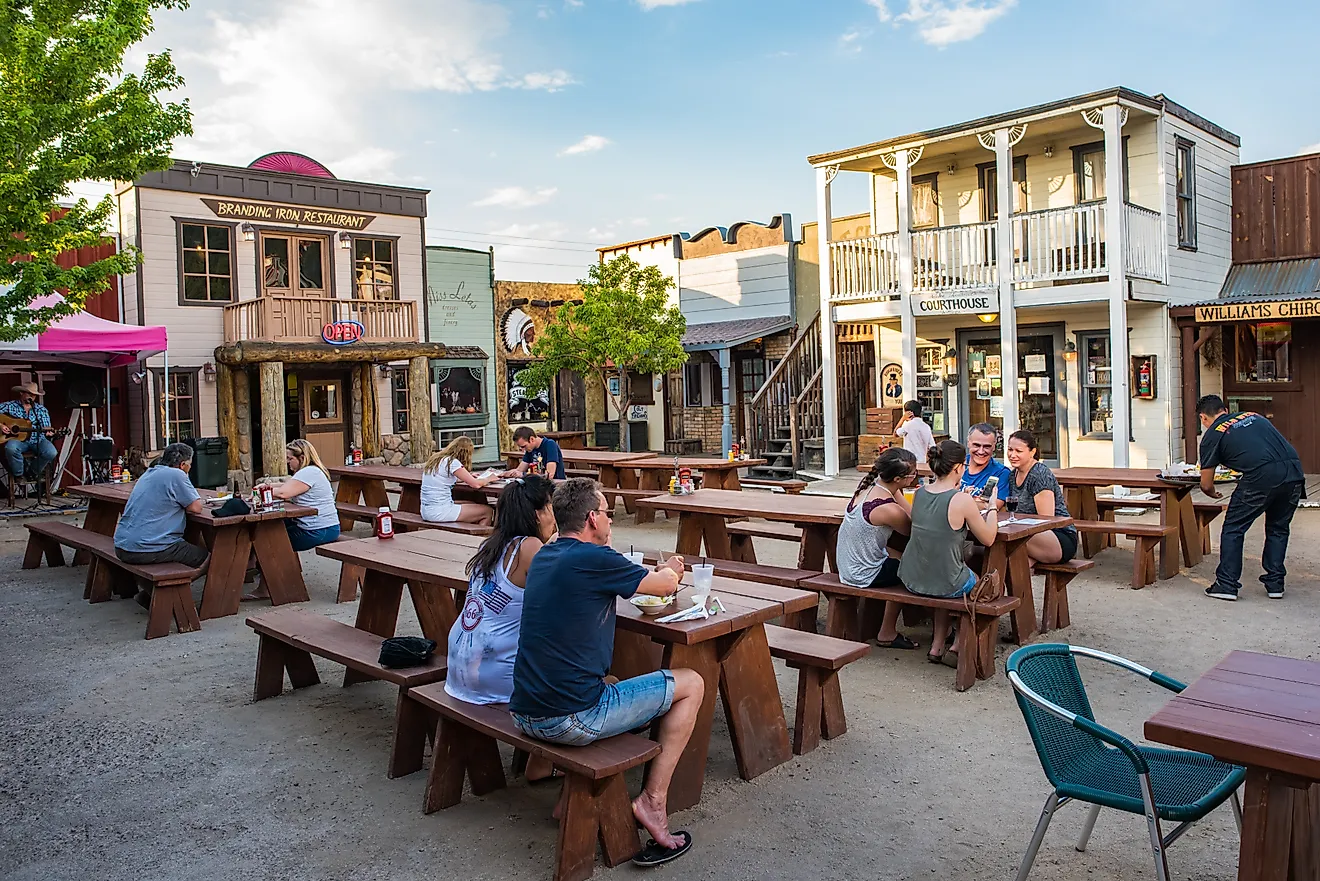
The town’s other half belongs to its 19th-century cattle-trail heritage from the years when Abilene was the original endpoint of the Chisholm Trail. Old Abilene Town on South Buckeye Avenue stages cowboy reenactments through the summer months and gives visitors a sense of what the cattle-driving era looked like at street level. Up the same street, the Greyhound Hall of Fame on North Buckeye Avenue documents the breed’s Kansas origins through a small but well-curated exhibit. For travelers with an afternoon to spare, the Abilene and Smoky Valley Railroad runs vintage 1945 steam train excursions through the Smoky Hill valley between Memorial Day weekend and late October. Visitors usually settle in at the historic Kirby House on Northwest Third Street, an 1885 Victorian mansion converted to a restaurant, or at the Abilene Victorian Inn, with several smaller bed-and-breakfasts within walking distance of downtown.
Atchison

Fifty miles northwest of Kansas City, Atchison sits along the Missouri River in northeastern Kansas. The town built its early prosperity on river trade and railroad junctions, and the 19th-century brick architecture along Commercial Street still reflects that era. Atchison is best known as Amelia Earhart’s birthplace, and her grandparents’ Victorian house above the Missouri River bluffs still stands as the home where she was born in 1897.
Most Earhart fans begin at the Amelia Earhart Birthplace Museum on North Terrace, where guided tours run through the original 1861 home with rooms preserved to reflect Earhart’s childhood years. A short drive west of downtown, the International Forest of Friendship in Warnock Lake Park, dedicated in 1976 by President Carter, contains tree specimens from all 50 states and over 30 countries along a memorial walkway honoring aviation pioneers. Back near the river, the Atchison County Historical Society Museum in the restored Santa Fe Depot rounds out the historical context with railroad and immigrant-community exhibits. The town’s biggest event is the annual Amelia Earhart Festival each July, which draws large crowds over three days with concerts and a Friday-night air show over the Missouri River. The Glancy Hotel on Commercial Street, a restored 1888 brick building, runs as a boutique inn, and several Victorian-era homes operate as bed-and-breakfasts within walking distance of downtown.
Cottonwood Falls

The seat of Chase County in the heart of the Flint Hills, Cottonwood Falls holds just around 880 residents across roughly two square miles. The town is small enough to walk end to end in 20 minutes, but the Broadway Street downtown has been preserved with the kind of architectural integrity that earned it National Register of Historic Places status. The Chase County Courthouse at the south end of Broadway, completed in 1873, is the oldest operating courthouse in Kansas and remains the visual centerpiece of the town.
The town’s main attraction sits five miles northwest of Broadway. The Tallgrass Prairie National Preserve protects nearly 11,000 acres of unplowed tallgrass prairie that visitors can explore by bus tour, hiking trail, or self-guided drive. The same landscape provides the setting for the Symphony in the Flint Hills, an outdoor concert held each June with the Kansas City Symphony performing on a temporary stage in open prairie, which has become one of the state’s most photographed annual events. Back in town, the Chase County Historical Museum on Broadway preserves local ranch and Santa Fe Trail history, and the Emma Chase Cafe a few doors down hosts Friday-night live music sessions that pull in regulars from across the county. Most overnight visitors stay at the Grand Central Hotel, an 1884 stone hotel on Broadway with 10 rooms and a steakhouse on the ground floor that serves Flint Hills beef.
Hutchinson

Fifty miles northwest of Wichita in south-central Kansas, Hutchinson’s history runs through the salt mining industry that gave it the nickname “Salt City,” and that legacy still anchors part of the visitor economy through the Strataca underground museum.
Strataca, located 650 feet below ground inside an active salt mine on Avenue G, runs guided rail tours through the original 1923 mining tunnels and is one of only a handful of underground museums in the United States. Above ground, the Kansas Cosmosphere and Space Center on East Carey Boulevard houses the largest collection of Russian space artifacts outside Moscow, alongside the actual Apollo 13 command module and an SR-71 Blackbird reconnaissance aircraft. Each September, the Kansas State Fair runs ten days on the fairgrounds and draws over 350,000 visitors annually, making it one of the largest events in the state. For evening visitors, the historic Fox Theatre on North Main Street, restored to its 1931 art deco glory, hosts touring concerts and films year-round. The Atrium Hotel and Conference Center on East 17th Avenue handles most of the visitor lodging, while the smaller Grand Prairie Hotel sits closer to the historic downtown core.
Why Kansas Communities Welcome Travelers
The seven towns share a few things. Populations small enough that the same handful of restaurants, museums, and shops anchor most visitor interactions. Calendars structured around festivals that bring locals and travelers into the same streets at the same time. Lodging options run by people who live in the community rather than chains operated from elsewhere. None of these qualities are unique to Kansas, but the combination is unusually consistent across the state, and the result is a kind of travel where the people behind the counter are likely to remember a visitor who comes back six months later.