American Towns Built Entirely Around a University
Six American towns owe their entire identity to the universities at their center. The University of Virginia opened in 1819 and the University of Mississippi welcomed its first students in 1848. Ohio University received its charter in 1804 as the first university in the old Northwest Territory. In each of the six towns ahead the campus shaped the streets and the economy from the start. Football Saturdays and commencement weekends still set the rhythm of daily life in every one.
More college towns across the South
For a wider survey of the region that includes Charlottesville and Oxford, see our roundup of the best college towns in the Southern United States.
Charlottesville, Virginia

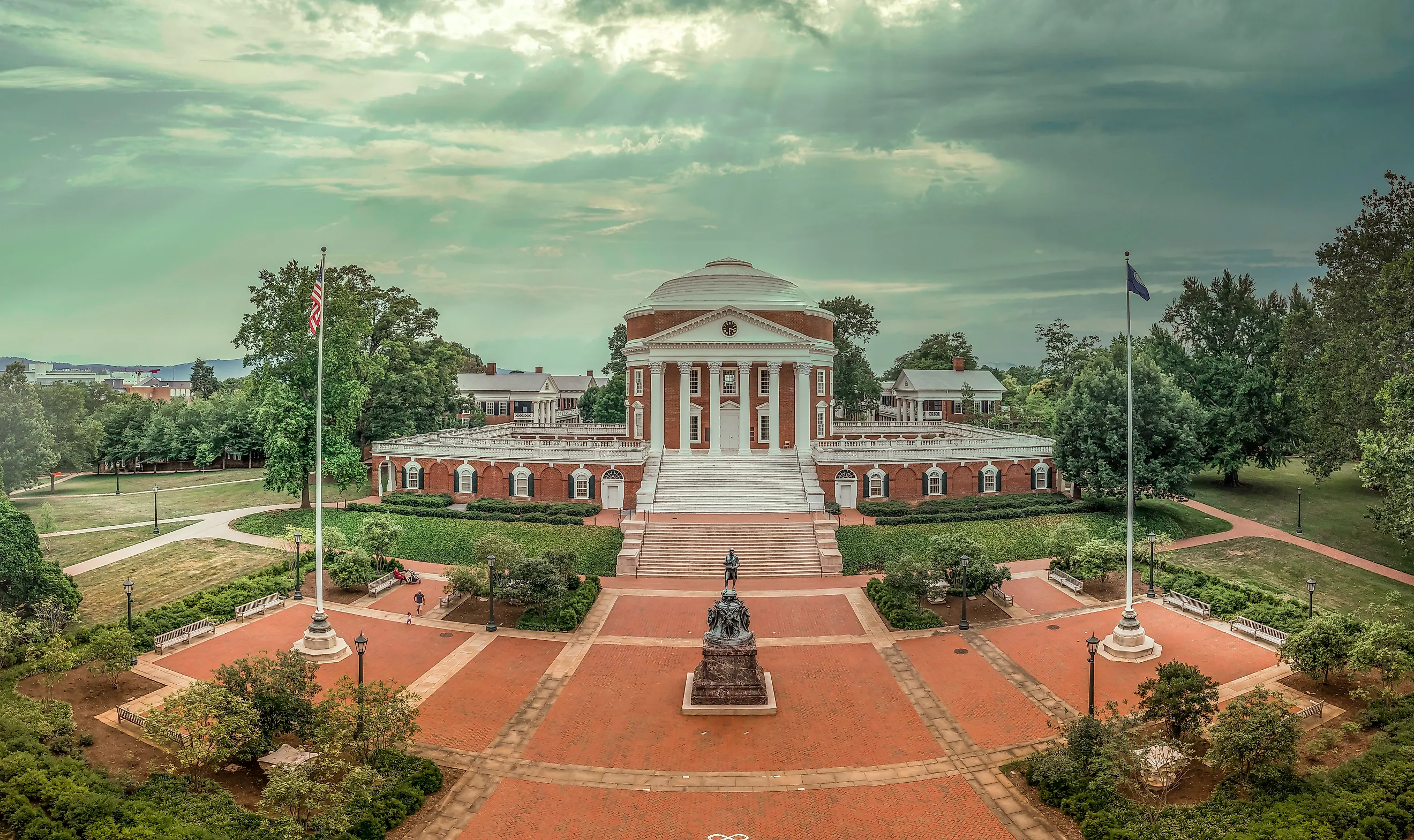
Thomas Jefferson founded the University of Virginia (UVA) in 1819, and the town that grew around it has followed his plan ever since. Students still call the campus "the Grounds," and at the north end of the central Lawn stands the Rotunda, which Jefferson modeled on the Pantheon in Rome. Along with the surrounding Academical Village and Jefferson's nearby Monticello home, it's the only university in the United States named a UNESCO World Heritage Site.
Step off the Grounds at University Avenue, and you're in the Corner, the commercial strip that has served students since the 19th century. Its cafés and bars fill up on home football Saturdays when the Virginia Cavaliers play at Scott Stadium, while basketball fans head for John Paul Jones Arena.
The university also continues to shape the town's cultural scene. October brings the Virginia Film Festival, a four-day program that screens more than 120 films across venues including the Paramount Theater, a 1931 movie palace on the Downtown Mall. The Fralin Museum of Art, part of the university and free to enter, keeps a permanent collection of more than 14,000 works.
Set between the Blue Ridge Mountains and Virginia's Piedmont region, Charlottesville was also home to Presidents James Madison and James Monroe, whose estates are just a short drive away.
State College, Pennsylvania

The borough of State College took its name directly from the school at its heart. Pennsylvania State University (Penn State) was founded in 1855 as the Farmers' High School of Pennsylvania after a local businessman donated 200 acres for the campus. While the town itself was incorporated in 1896, the oldest building on campus, Old Main, dates from 1863 and was rebuilt with the original limestone in 1930. Pop into the university lobby to see the Land-Grant Frescoes, a mural cycle that depicts its founding.
A short walk away, the Nittany Lion Shrine is a limestone mountain lion carved in 1942 that's now one of the most photographed spots in State College. Beaver Stadium is another landmark, and Saturdays in the fall see more than 100,000 fans flock to the Western Hemisphere's second-largest stadium to watch the Nittany Lions play football.
No State College institution is loved more by locals than the Penn State Berkey Creamery. Founded in 1865 and now the country's largest university creamery, students help hand-dip 750,000 ice cream cones a year. The founders of Ben & Jerry's even started their careers after taking the creamery's correspondence course in ice cream making.
Ithaca, New York

Not one but two schools define Ithaca: Cornell University, the Ivy League institution founded in 1865, and Ithaca College, a performing-arts and sciences school established in 1892. Cornell stands on a hill above this attractive college town at the southern tip of Cayuga Lake, the longest of New York's Finger Lakes, and serves as the federal land-grant university for the state.
The campus and the gorges around it have given the town its unofficial motto, "Ithaca is Gorges," and it is one of the prettiest college settings in the country. Cascadilla Creek drops 400 feet through Cascadilla Gorge between downtown Ithaca and the campus, and more than 150 waterfalls sit within 10 miles of the town.
Two of the town's most recognizable structures, McGraw Tower and the Herbert F. Johnson Museum of Art, offer wide views over Cayuga Lake. Cornell Botanic Gardens is also worth exploring and covers a third of the campus with formal gardens, an arboretum, and natural areas. Downtown Ithaca is home to Ithaca Commons, a four-block pedestrian mall just a short walk from campus.
Oxford, Mississippi

Oxford was named after the famous English university city in 1837 in the hope that it might lead to the establishment of a college in the new town. It worked. In 1841 the Mississippi legislature chose Oxford as the site of the state's first public university, and the University of Mississippi (affectionately known as Ole Miss) opened in 1848 with just 80 students.
At the center of campus, the Lyceum is a handsome Greek Revival building completed in 1848. It still bears bullet holes from riots in 1962 over the enrollment of James Meredith, the college's first African American student. Also worth seeing are the nearby Circle, a ring of academic buildings around an oval green, and the Grove, a 10-acre stand of oaks where as many as 100,000 fans gather to tailgate on football Saturdays.
Oxford's literary heritage also runs deep. Novelist William Faulkner, awarded the 1949 Nobel Prize in Literature, lived here from 1930 until his death in 1962 at Rowan Oak, his home. Now open to the public as a museum, it's connected to the Ole Miss campus by a pleasant trail through Bailey's Woods.
Athens, Ohio

Founded by settlers from Marietta in 1797, Athens owes its existence to a land grant set aside for a college. That college, Ohio University, received its charter in 1804, making it the first university in the old Northwest Territory, the federal lands north of the Ohio River. Athens and the school have grown in lockstep along the banks of the Hocking River ever since, with residents and students equally proud of the connection.
College Green is very much at the center of both college and town life. It is here on this 10-acre quad known as the Ohio University College Green Historic District that the town's oldest buildings stand, including Manasseh Cutler Hall, completed in 1819 and named for the New England minister who helped found the university. Now protected as a National Historic Landmark, its chimes can still be heard ringing out over campus every half hour.
Alumni Gateway, a gift of the class of 1915, marks the spot where the university meets the town. Court Street, the main thoroughfare, runs from there past attractive 19th-century brick storefronts, while across the Hocking River attractions like the Kennedy Museum of Art draw locals, students, and visitors. Set in the former Athens Lunatic Asylum, admission is free to this university-run facility with its collections of Native American art.
Claremont, California

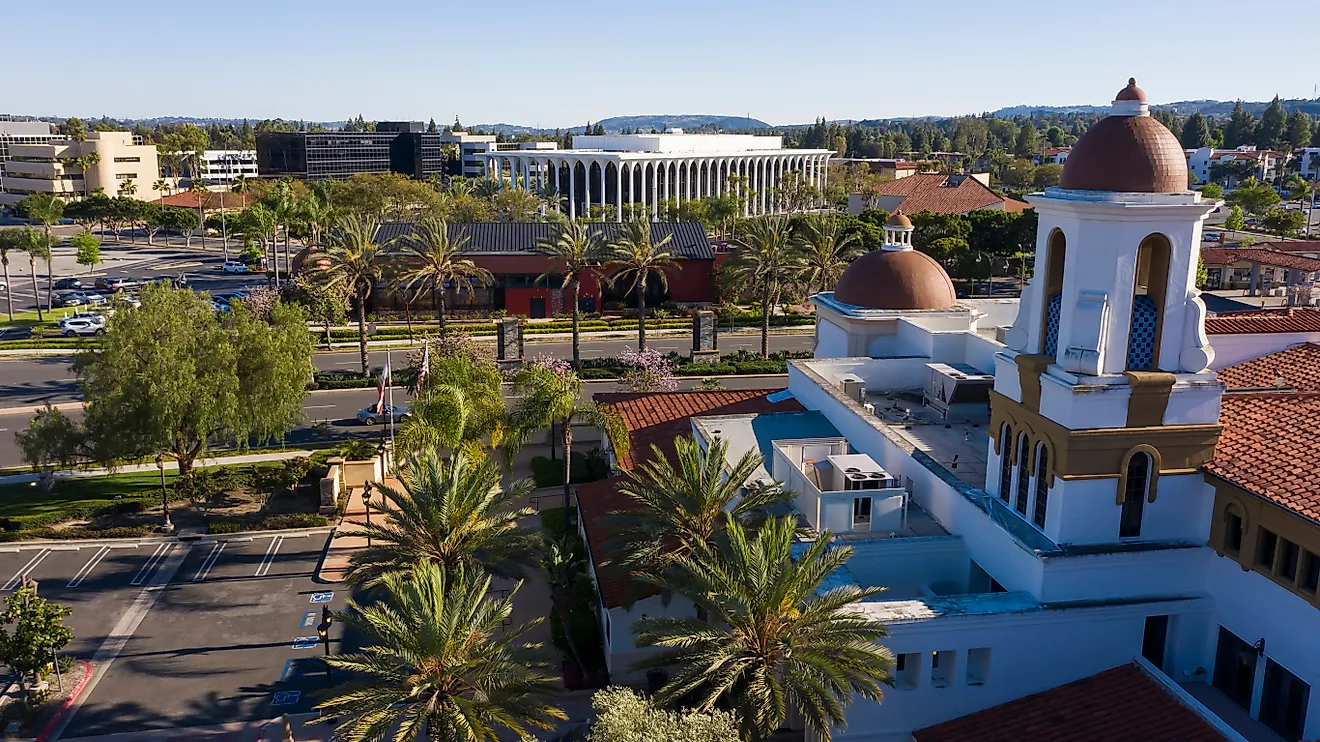
Forty miles east of downtown Los Angeles, at the foot of the San Gabriel Mountains, Claremont is a Californian town that owes its existence to higher education. Pomona College, founded in 1887 and relocated to Claremont in 1889, set the pattern for everything that followed. In 1902, residents voted to name the leafy north-south streets after colleges, which led to the city's nickname of "the City of Trees and PhDs."
What grew up here is now known as the Claremont Colleges, a group of seven independent schools (five undergraduate colleges and two graduate institutions) sharing adjoining campuses across a square mile of town. Together they enroll thousands of students and share a central library and other services, a model based on Oxford University in England.
College culture spills over into the town and benefits residents and students alike. The Benton Museum of Art at Pomona College hosts rotating exhibits of American and European artwork, while the Folk Music Center, a combo instrument shop and museum, hosts a spring folk festival that has run for decades.
Just north of campus, the Raymond M. Alf Museum of Paleontology at the Webb Schools is the country's only nationally accredited museum on a high school campus. It was built around fossils that students themselves have helped collect.
More Ithaca-style scenery up the road
For a closer look at the New York college towns that match Ithaca's setting, see our list of the most beautiful college towns in New York.
Towns the Campus Built
Together, these six towns show the impact a single university can have on a community. Each was either created to host a university or has been reshaped so completely by one that the school now sets the town's tone. Visit any of them, and you find the same thing: a town and a school so tightly bound that it is hard to imagine one without the other.