11 Main Streets Where England Comes Alive
These 11 historic streets keep the country's past alive through centuries-old landmarks and businesses that still welcome visitors today. In Skipton, market stalls continue a trading tradition that has shaped the town for generations. Stratford-upon-Avon keeps Shakespeare's legacy alive along Henley Street. In Clovelly, a steep pedestrian street winds down toward a working harbour. These 11 towns prove that England's past is what keeps its main streets alive and well today, including medieval architecture and longstanding local traditions.
Skipton

The Skipton High Street was once a place where one could pick up the local North Yorkshire paper, a shiny new piece of jewelry, or the coming week's groceries in the late 19th century. Though over 100 years have passed, not much has changed. Being a market town, Skipton's High Street proudly hosts the Skipton Market four days per week for stocking up on goods from the local cheesemonger, fishmonger, and fruit and veg producers, where the Grade II Listed Sir Mathew Wilson Statue still stands to commemorate Skipton's first British Member of Parliament. If needing a moment's rest, pop into The Cosy Sheep Tearoom for nibbling on home-baked scones while sipping tea and looking out at the High Street, and at the other end of the street, Skipton's circa 14th-century Holy Trinity Church gazes upon the thoroughfare.
Whitby

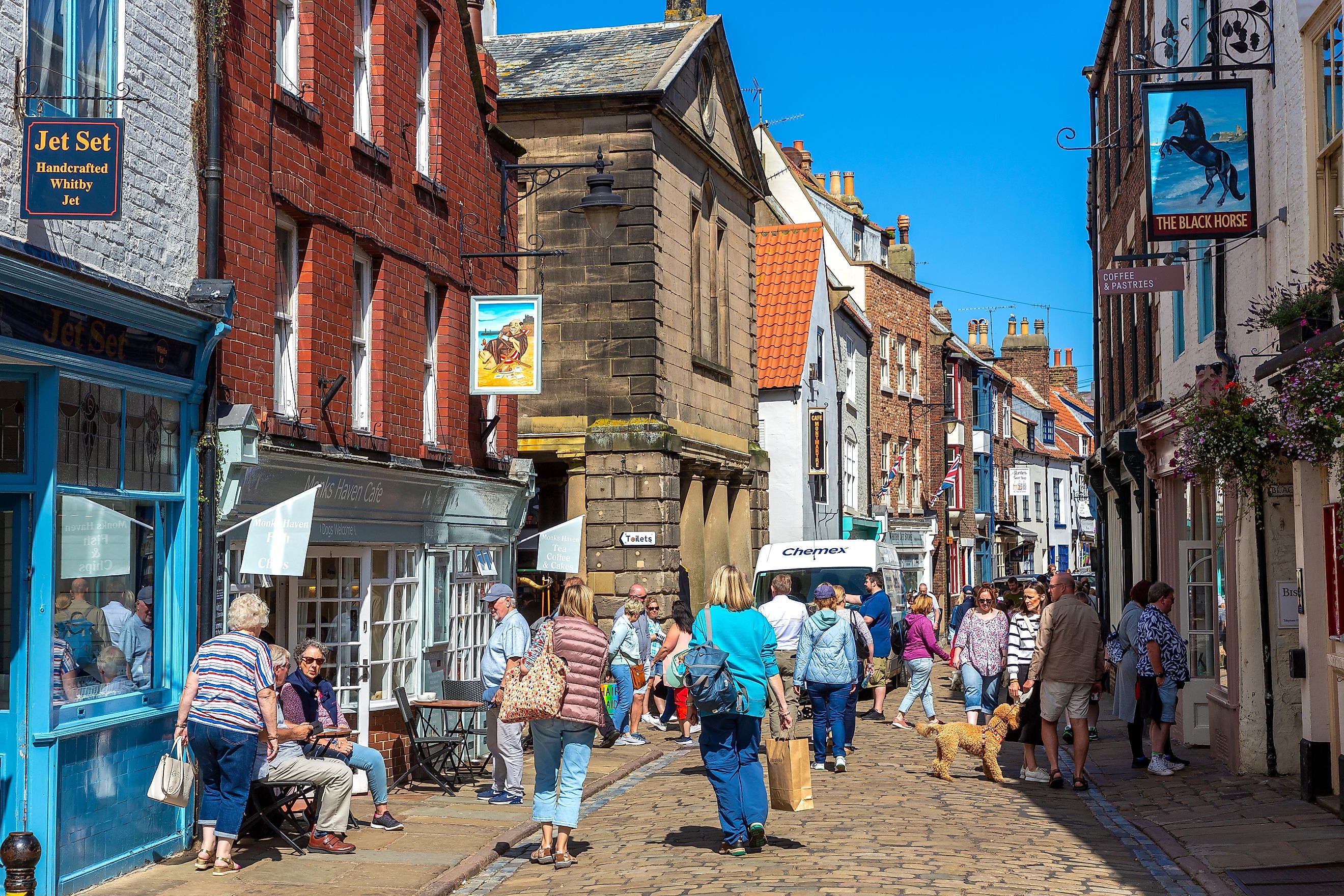
Another North Yorkshire market town, but this time on the coast, Whitby's Church Street signified a time when life was centered around the Abbey, as early as 1370. Some of the houses date back to the 15th century, when Church Street was called Kirkgate. Having maintained some of its over 300-year-old properties, Whitby still has its Old Seamen's Hospital from the 1670s in its decorative maritime design, which healed and educated seamen and their families. Have a pint on the banks of the River Esk at the dog-friendly pub The Fleece across the street from the Old Seamen's Hospital, and settle around the fireplace with a pork pie straight out of the oven. And off the north end of Church Street, there is the Greens Yard path that connects to the monastic ruins of Whitby Abbey, towering over the town since 1539.
Lavenham

Much of Lavenham today was built in the Tudor era, including the High Street, and thrived on the wealth of the wool industry. On its cobbled High Street, the owners of the orange-and-black timber-framed The Crooked House invite guests into this 1395 property for tours and seasonal black-tie dinners, its foundations built on the wool that also built Lavenham. Just a few doors down, The Parlour Lavenham dishes out delicious ice cream and sorbet, as well as other sweet treats like hot chocolate and truffles, and Timber Antiques inspires curiosity with its collection of books, ceramics, jewelry, and fine china sets for browsing in between a tour at The Crooked House and a bite at The Parlour Lavenham. The High Street is also lined with a few art galleries, such as the Lion House Gallery, which might be worth checking out to see some of the artwork behind this Suffolk town.
Stamford

The Stamford High Street is where Danish Vikings established their settlement here in Lincolnshire before a nunnery came into existence prior to 1250, later undergoing a number of renovations to become a major commercial street in the 18th century. Stamford also benefitted from the wool boom, like in Lavenham. The Grade II Listed Building of Stamford Library is a sight to behold on the High Street, its tan columns showing off the symmetrical Tuscan design next to a red post box and old-school telephone booth. Diagonally across, St Michael's Church also holds the title of Grade II Listed Building, rebuilt in the 1830s. The High Street is additionally lined with many boutiques, charity shops, and cafe chains, and even the reputable cheesemongers, Rennet & Rind, which has a mission of supporting British farmers.
Rye

Rye's Mermaid Street is one that always stands out. A steep cobbled street that helps passersby get their legs strong, Mermaid Street came to be through its social hub that is Mermaid Inn from 1156 onward. Mermaid Street acted as a central thoroughfare of Rye when it was known as Middle Street, during the time of the smuggling and fishing trade as part of the Cinque Ports Confederation. At the bottom of the hill, Mermaid Street Café is great for munching on a crab bap or indulging in Jude's ice cream, while watching the traffic at the confluence of Mermaid Street, The Mint, Wish Ward, and the Strand. And The House with Two Front Doors is an interesting fixture of Mermaid Street, honoring a time when literacy rates were low, so houses were named after exactly what they were or where they were placed. This one is now a bed and breakfast with beautiful period furnishings.
Burford

This Oxfordshire town was birthed from a Charter after the collapse of the feudal system, resulting in a High Street that was brought to life by the wool trade and saddlemaking through the last couple of centuries. Visitors can learn more about its past at the early 16th-century Burford Tolsey Museum on the High Street, and be sure to take advantage of The Cotswold Cheese Co. across the street for selecting farmhouse and artisan cheeses. Another highlight of the Burford High Street is The Priory Burford, both a hotel and a cafe with tearooms within its 17th-century brick walls, including two self-catering cottages for an extended stay to fully enjoy the Cotswolds. Take a gander down to the Lower High Street where the River Windrush Bridge, an official Grade II Listed Building, stands above the skinny River Windrush.
Chipping Campden

Another town in the Cotswolds, Chipping Campden's High Street was constructed by the area's affluent merchants between the 14th and 17th centuries, but planned in the 12th century. Many of the surviving buildings are from around 1840. But of the buildings that did survive, the National Trust's Market Hall is from as long ago as 1627, now an open, empty space to explore. The High Street is marked by other pieces of history, like the Grade I Listed Building that is the 14th-century Woolstaplers' Hall, where wool was once traded. And concerning commerce, on the Lower High Street, the Robert Welch Studio Shop is a highly-rated kitchenware store selling refined cutlery, knives, cookware, and even stainless steel fittings for one's bathroom. Toward the end of the High Street, switching onto Leysbourne, the Ernest Wilson Memorial Garden is a peaceful spot for sitting on a bench, surrounded by green grass and reflecting on one of the UK's greatest plant collectors.
Stratford-upon-Avon

Stratford-upon-Avon ensures its local hero, William Shakespeare, is never forgotten. Henley Street features Shakespeare's Birthplace, now a museum offering tours in the playwright's original home, and a statue of the man is just a few seconds away, overlooking the town's main thoroughfare. The accompanying Shakespeare Bookshop is located in this mixture of monuments, providing a wonderful way to celebrate Shakespeare's legacy through the gift of reading and books. If all this education and history is getting you hungry, stop into The Cornish Bakery on Henley Street for a sweet or savory baked good, while continuing an exploration into Shakespeare's roots and influence here, just minutes from the River Avon.
Castle Combe

Castle Combe was another town impacted by the wool trade, but was first heavily developed by the Romans. Many of the village's buildings from hundreds of years ago are still well-preserved, and the Castle Combe Bridge over the By Brook in the Wiltshire countryside is one of the most photographed streets in the UK. Going up The Street from the Castle Combe Bridge, visitors will find that The Market Cross has been watching over Castle Combe since the 14th century. Go to The Old Stables for a cozy sit-down coffee and snack, or walk all the way down The Street alongside By Brook to take in all the historic cottages and the natural beauty of Castle Combe, as seen on the highly photographed Water Lane.
Clovelly

Formed in the 13th century, Clovelly is a fishing town that has passed through a long line of noble families, and its High Street was made as the main route down to Clovelly Harbour for easy access to the Devon waters. Toward the bottom of the High Street, Cottage Tea Rooms Clovelly create a relaxing atmosphere, looking over Clovelly Harbour with a cream tea in hand. Book a tour at the Fisherman's Cottage & Kingsley Museum to learn about life in the 1930s for a local fisherman and his family, and spend a night at the nautical-themed The Red Lion Hotel to wake up to a gorgeous view of the blue ripples of Clovelly Bay in the Bristol Channel.
Dunster

The records say Dunster is as old as 700 AD, and named after the surrounding rocky hills on the Somerset coastline. The High Street here has proof that this is an old town, with the octagonal structure of the 17th-century English Heritage Yarn Market, a remnant from the time when Dunster was busy with wool. Also on the High Street, the Dunster Museum & Doll Collection is home to over 800 vintage dolls from all over the world, a project started by the late local Mollie Hardwick's family in the 1970s. Directly across, Cobblestones Dunster is a fantastic bistro for eating al fresco in their lush walled garden, perfect for when the sun is shining in the southwest of England and in between exploring some of the sights here in Dunster.
Main Streets That Spark Connection
England's small towns' main streets exhibit the relationship between the past and the present. Skipton Market has evolved over the years to suit consumer needs, as has Whitby Abbey, but for meeting religious needs. The Tudor era shines through in Lavenham's architectural quirks, and Stamford changed from being a Viking stronghold to a commercialized High Street. Old stories never die in Stratford-upon-Avon, and Castle Combe might be more popular on social media than it was for serving the wool trade. Rye's houses were named for the illiterate, but now function as tourist accommodations, and a former family home is now a museum in Clovelly. These main streets find new purposes as the times change.