8 Best Downtowns In England
England is home to some gorgeous downtowns, thanks to details like Elizabethan red-brick buildings and streets that still follow layouts established centuries ago. In Whitby, narrow lanes tumble toward a working harbour below the ruins of Whitby Abbey, first founded in 657. In Knaresborough, a Norman castle and the 1851 viaduct rise above the River Nidd beside a cobbled market square. If you are after downtowns with medieval streets and river views, discover the eight best downtowns in England.
Whitby

Whitby is a historic seaside town and civil parish in North Yorkshire. It has a downtown featuring a warren of narrow lanes tumbling down to a working harbour, amid dark-pantiled rooftops and fishermen's cottages. The old port town is clustered on the east side of the harbour where it breaches the forbidding cliff. Whitby Abbey, first founded around 657 AD, was once among the most important religious centres in the Anglo-Saxon world. Today, its silhouette above the cliffs is one of the most iconic in England. The old town and the coastal walk that continues up to Robin Hood's Bay are justly celebrated as essentially a clifftop trail of wild North Sea scenery.
Independent jet workshops still operate along Church Street, and a place like The Ebor Jetworks, recently featured on BBC Countryfile, is a cool place to watch talented artisans skillfully transforming the rough stone into finished pieces of jewellery. Captain James Cook, one of the most famous explorers in British maritime history, once apprenticed here under local shipowners, and the Captain Cook Memorial Museum occupies the 17th-century house where he lodged.
Wells, Somerset

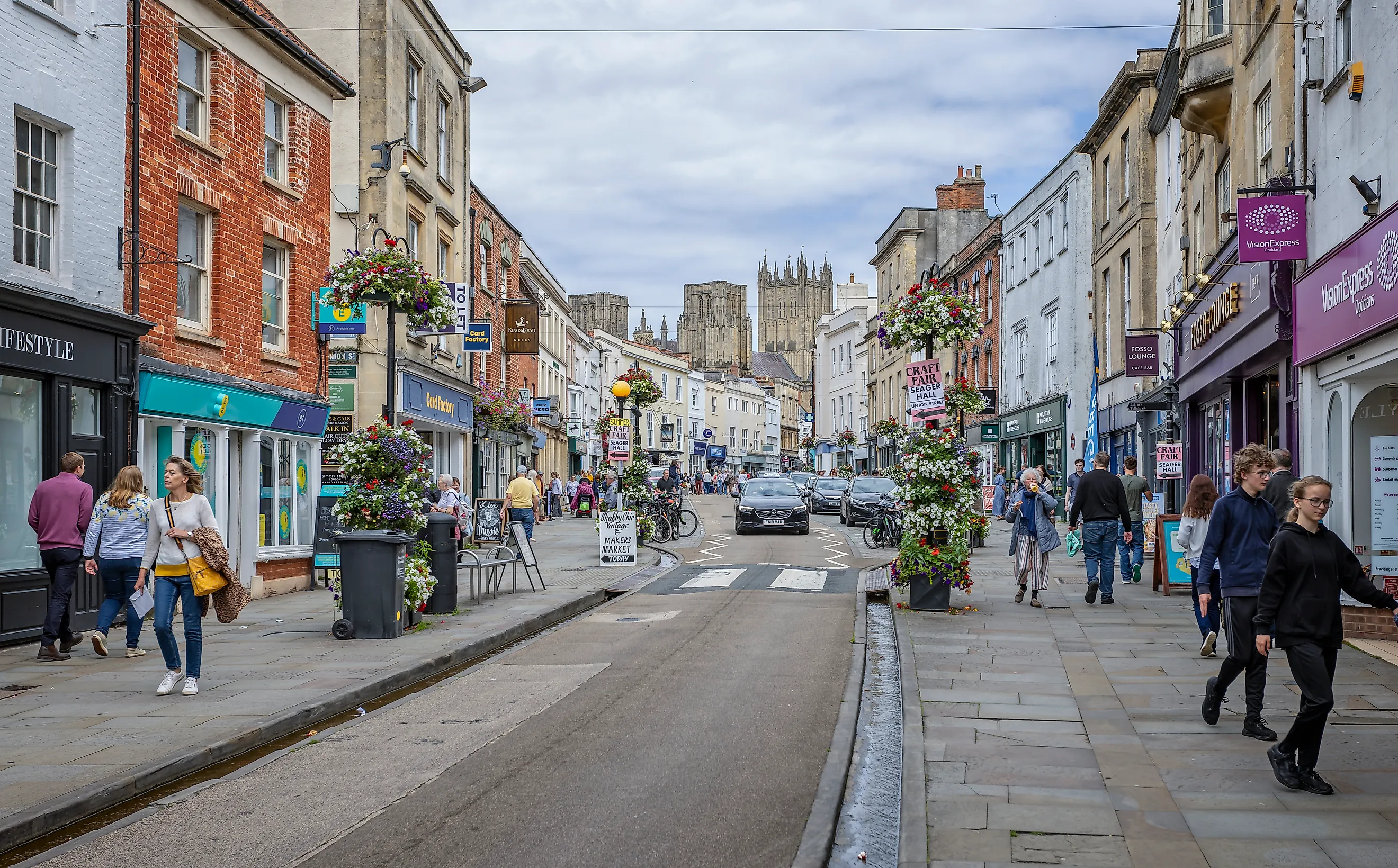
Wells often feels like a beautiful and intimate market town, especially with its quiet coaching inns, medieval almshouses, and a marketplace that has barely changed in centuries. Wells Cathedral, arguably the town's centrepiece, is widely regarded as among the finest examples of Early English Gothic architecture in the country. It was built between 1175 and 1490 and has been described as “the most poetic of the English Cathedrals.” It also features the famous Wells Clock, considered to be the second-oldest clock mechanism in Great Britain.
The famous swans of Wells live on the Moat at the Bishop's Palace, and have been trained to ring a bell on the gatehouse for food when hungry. The palace is adjacent to Wells Cathedral and has been home to the Bishops of Bath and Wells for over 800 years. Vicars' Close, a still-intact medieval residential street originally built in the 14th century, is considered one of the oldest purely residential streets in Europe. It is also believed to be the only complete medieval street left in England. Remember to grab a cup of warm coffee at Strangers with Coffee on Cuthbert Street, preferably at the outdoor covered seating area.
Knaresborough

With a cobbled square ringed by characterful stores and independent traders and a Norman-era castle constructed centuries ago on craggy cliffs overlooking the river, Knaresborough is certainly among the prettiest places in England. The town is perched dramatically above the River Nidd, which curves beneath the cliffs in a scene of incredible beauty. Essentially a market and spa town, you will admire a medieval marketplace that gives way to lovely Georgian townhouses and ancient inns, all stacked on an unmissable gorge. There's the riverside walk, widely regarded as among the finest in England; Knaresborough Viaduct, which offers breathtaking views of the surrounding countryside; and Knaresborough Castle, a stronghold of medieval kings on a site overlooking the River Nidd. Marigold Cafe & Boating offers delicious scones and unforgettable river views, while Mother Shipton's Cave is a historic place with a fascinating backstory and an amazing forest walk.
Ludlow

Ludlow is widely regarded as the finest town in Shropshire, and it earns that reputation. The medieval street plan remains, and Mill Street and Broad Street, leading down from the very centre to the Teme in the south, are particularly famous for their rich architectural heritage, with many fine Georgian buildings speckling the stretch. No wonder Sir Nikolaus Pevsner, who penned one of the greatest achievements of 20th-century architectural scholarship, described Broad Street as "one of the most memorable streets in England.”
Like Richmond, Ludlow has a big castle above a river and a quaint market town next to it. The walk down to the river, where there is a café in the former watermill by the bridge, is one of the loveliest short strolls you will ever experience. St Laurence's Church is the largest in the county, while the ruins of Ludlow Castle are among the most photogenic in the English Midlands. Remember to pop in for a drink at the Ludlow Brewing, which doubles as a contemporary venue for entertainment, including live music and comedy.
Stamford

An excellent stop if coming north up the A1 from London, Stamford's defining characteristic is its architecture, predominantly constructed from local Lincolnshire limestone, encompassing medieval timber-framed structures, five surviving parish churches, and abundant 17th- and 18th-century buildings. Burghley House & Park, just a hair out of town, is one of England's greatest Elizabethan houses. People often rave about its setting, especially for providing Stamford's most dramatic natural backdrop.
So, remember to carry a decent camera when touring the area. Meanwhile, The George of Stamford is certainly one of England's most celebrated coaching inns, with a galleried courtyard and panelled rooms making it a landmark in its own right. It competes with the Angel at Grantham for the “England's oldest surviving coaching inn” title. Unsurprisingly, it is frequently cited among England's finest historic hotels. For some elegant outdoor scenery and fresh, crisp air, The River Welland Walk & Meadows, which runs along the Welland between the stone bridges, offers one of the most quietly beautiful riverside walks in the East Midlands.
Bourton-on-the-Water

With the River Windrush flowing through the village, a tranquil waterway spanned by five low-arched, 18th-century stone bridges, Bourton-on-the-Water is probably the prettiest village in the whole of the Cotswolds area. The combination of the water, often clear and scenic, with the honeyed stone, the low bridges, and the weeping willows that hang down toward the water, always has a uniquely pleasing effect. Mill Bridge, right in the village centre, is the oldest of the five low-arched stone bridges. It is next to Bourton-on-the-Water War Memorial, erected to commemorate the 27 local villagers who died in World War I, as well as the Cotswold Motoring Museum & Toy Collection, which offers insights into the nuanced history of British car manufacturing. St Lawrence's Church, whose distinctive dome forms the backdrop to virtually every photograph taken from the village green, has a rich history dating back to the 8th century.
Haworth

Haworth is a village in the Worth Valley, set amid the mellow Pennines, a tourist destination known for its association with the Brontë sisters and the historic Keighley and Worth Valley Railway, which was featured in the 1970 movie The Railway Children. It is a well-known literary destination, especially for its association with the Brontë sisters, who wrote some of the most groundbreaking novels in English literature. You will find a steep and picturesque main street, lined with independent shops and traditional tea rooms, with a cosy but gothic atmosphere that makes it a popular destination for more than just literary fans. Visit St Michael and All Angels Church, which keeps the remains of all the Brontës in a vault except for Anne, then pass by the nearby Brontë Parsonage Museum, a fitting tribute to the Brontë family and their literary genius. Meanwhile, Cabinet of Curiosities is the go-to place for high-quality wax melts, candles, bath salts, and more.
Warwick

Warwick is a small but incredibly beautiful town, especially for its remarkably preserved medieval heritage and picturesque setting along the River Avon. It was a major fortified settlement from the early Middle Ages, and the most notable relic of this period is Warwick Castle, which has stood on the banks of the River Avon for more than a millennium. Its towers and ramparts dominate the town skyline and produce some of the most striking castle photography in England.
Lord Leycester Hospital, a group of medieval timber-framed buildings on High Street with origins in the 12th century and major later medieval additions, is one of England’s best-preserved examples of medieval courtyard architecture. Not to be outdone, the Beauchamp Chapel, built to house the tomb of Richard Beauchamp, 13th Earl of Warwick, is one of the finest pieces of Perpendicular Gothic in England. Meanwhile, St Nicholas Park is a popular place for a relaxing stroll in Warwick, while Jephson Gardens is in nearby Royal Leamington Spa.
So, whether you are standing on a low stone bridge watching the river slide beneath your feet, climbing a cobbled hill toward a ruined abbey on the skyline, or simply pushing open the door of a centuries-old coaching inn, some of England’s downtowns have earned their reputation as among the prettiest in the country. Next time you have a minute, these places are genuinely worthwhile destinations to keep in mind.