8 Fairy-Tale Small Towns In England
From the storybook worlds of Lewis Carroll, who wrote “Alice’s Adventures in Wonderland” during his time as a lecturer at Oxford University to the timeless tales of Beatrix Potter, like “The Tale of Peter Rabbit,” which was inspired by her home in England’s storied Lake District, England’s small fairy-tale towns feel inseparable from the landscapes that inspired them, giving travelers a chance to explore real places that seem lifted straight from the page. These eight fairy-tale towns across England invite travelers to wander cobbled streets, picture-perfect villages, and landscapes that feel every bit as magical as the stories that inspired them.
Burford, Oxfordshire

Burford is on the River Windrush in West Oxfordshire, often referred to as the gateway to the Cotswolds. Its sloping High Street (the British equivalent of America’s Main Street) is frequently called one of the most beautiful streets in England, as it runs downhill toward the river past honey-colored stone houses, tearooms, historic pubs, and the Church of St. John the Baptist, which welcomes over 75,000 visitors each year from around the world.
Burford’s High Street is home to England’s oldest chemist, Reavley Chemist, which opened as a village pub in 1734 before being leased as an apothecary, serving medicinal lotions and potions to the locals. Finally, what can be more magical than 160 acres of landscaped gardens where over 250 species roam, including rhinos, giraffes, lemurs, leopards, and lions, against the backdrop of a historic English manor at the Cotswold Wildlife Park and Gardens.
Robin Hood’s Bay, North Yorkshire

The whimsical-sounding town of Robin Hood’s Bay in North Yorkshire is a fishing village in the North York Moors National Park, complete with cobblestone streets, historic cottages, and breathtaking coastal views. For outdoor enthusiasts, Robin Hood’s Bay is part of the Cleveland Way National Trail. This 109-mile walking route follows a horseshoe direction through the North York Moors, passing through places like Robin Hood’s Bay and the seaside towns of Scarborough and Whitby, home to renowned Whitby Abbey, the inspiration for Bram Stoker’s “Dracula.”
The stuff of legend, the “moors” have long inspired tales of mystery and Gothic drama, from Emily Brontë’s “Wuthering Heights” to the exploits of Sherlock Holmes and his sidekick, Watson, making the area truly feel as if it has stepped out of a storybook. Visit the Robin Hood’s Bay Museum to learn how the bay was notorious as a smuggling hub in the 17th-19th centuries, then explore the beach and tide pools, full of colorful starfish and anemones.
Bibury, Gloucestershire

Called the most beautiful village in September 2025 by Forbes, Bibury is a small village on the River Coln, a tributary of the famous River Thames, in the magical Cotswolds region of England. Famous for Arlington Row, one of the most photographed cottage rows in the world, the cottages were originally built in 1380 as a monastic wool store before being converted into a row of weavers’ cottages in the 17th century. Today, all but one of the cottages are leased to private tenants, but visitors are welcome to visit the landmark respectfully.
The Bibury Trout Farm, founded in 1902, is England’s oldest working trout farm, breeding rainbow and brown trout. It is another local attraction in Bibury, where you can catch your own fish, play a round of Crazy Golf, or purchase a container of fish food to toss into the pools of jumping trout as you explore the farm’s extensive grounds. There’s also a small cafe onsite, where you can order a whole Bibury trout to enjoy on the premises with a Bibury pale ale.
Clovelly, Devon

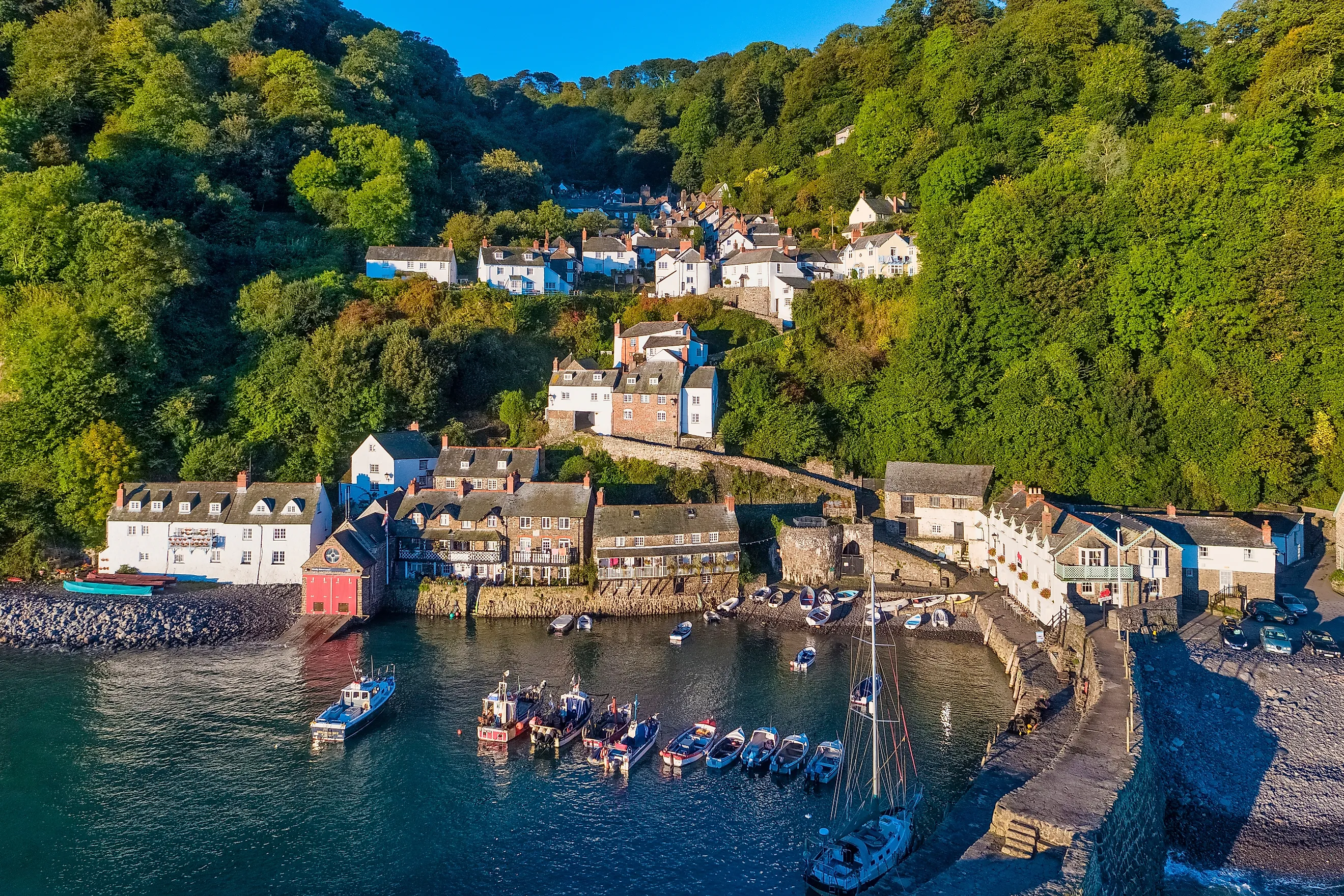
Big city dwellers will appreciate the car-free fishing village of Clovelly, Devon, with its cobbled lanes that drop steeply down a 400-foot cliff to the historic harbor on the Bristol Channel. Historically, donkeys were used to carry goods, fish, and supplies up and down the 400-foot descent from the village to the harbor. Still, today, the descendants of the much-loved donkeys are simply residents you can visit in the stables in the town, or become a Friend of the Clovelly Donkeys by sponsoring one. Wander through the village and explore other one-of-a-kind shops like Clovelly Pottery, where you can paint a pot and take it home, and the Clovelly Soap Co.
Like most of the villages in Devon, Clovelly is part of the South West Coast Path, England’s longest National Trail, a 630-mile marked path along spectacular clifftops from Minehead, Somerset, around Devon and Cornwall, to Poole Harbour, Dorset. Hiking enthusiasts can enjoy plotting a course along the path to the nearby towns of Hartland, Bideford, and Appledore, to explore more historic harbors and scenic coastal views of the North Atlantic Ocean.
Bourton-on-the-Water, Gloucestershire

Nicknamed the “Venice of the Cotswolds,” Bourton-on-the-Water is famous for the River Windrush that flows through the center of town, spanned by five arched bridges constructed from Cotswold stone dating from 1654 to 1911. The small village of about 4,000 residents is jam-packed with activities, including numerous cafés, tea rooms, pubs, and unique shops. One of the top attractions in Bourton-on-the-Water is the Model Village, a one-ninth-scale replica of the village, featuring miniature versions of all its buildings, including The Painted House, Victoria Hall, the War Memorial, and another secret location inside the model village, Miniature World.
Birdland Park & Gardens is nine acres of gardens and woodlands worth exploring along the River Windrush, and home to over 500 birds from magical owls, flamingos, pelicans, cranes, Humboldt penguins, and England’s only breeding group of King Penguins. For car enthusiasts, no visit to the picturesque riverside village is complete without a stop at the Cotswold Motoring Museum, where you’ll discover classic motoring memorabilia and no shortage of British cars, motorbikes, and caravans (the equivalent of an American mobile home, trailer, or RV).
Castle Combe, Wiltshire

Castle Combe sits within the Cotswolds National Landscapes (formerly called Areas of Outstanding Natural Beauty), designated in 1966 for its distinctive natural scenery, including rolling limestone hills and valleys, unspoiled rural character, and cultural value. It is often called the “prettiest village in England,” thanks to its natural stone cottages, a medieval Market Cross dating back to the 14th century when permission was required to hold a weekly market, and the Bybrooke River that meanders through the village before eventually joining the River Avon.
Although the castle is long gone, earthworks now mark its site above the village. Nearby, St. Andrew’s Church is a quiet architectural marvel from the 13th century, home to one of England’s oldest working clocks and a collection of beautifully preserved medieval details. Don’t miss the historic White Hart Inn, a 14th-century pub, known for its cozy fireplaces and traditional British pub food like ploughman’s lunch, and its cameos in numerous films, including Doctor Dolittle, Stardust, The Wolf Man, and War Horse.
Shaftesbury, Dorset

Shaftesbury is another picturesque English village with impossibly steep cobbled streets, thatched cottages, and buttressed precinct walls of Shaftesbury Abbey, the last abbey to be destroyed by Henry VIII in 1539 during his campaign to sever ties with the Catholic Church. The village claims one of the country’s most iconic views from Gold Hill, looking down a sloping, curved lane to Blackmore Vale, fictionalized in the writings of Thomas Hardy as “Wessex.” You can visit the Shaftesbury Abbey Museum & Gardens, wander through the excavated remains of the abbey in a medieval-inspired garden of herbs and fruit trees.
One of the best ways to explore Shaftesbury, which is part of the National Landscapes in Dorset, is to follow a series of eight information plaques around the town, highlighting different aspects of its rich history. Stop in at the traditional high street pub in the heart of town, The Mitre, a forest-inspired hideaway with fire pits, hearty seasonal food, and mulled drinks.
Chipping Campden, Gloucestershire

The quintessential market town, Chipping Campden, in the Cotswold district of Gloucestershire, is known for its High Street, which dates back to the 14th to 17th centuries. The town has a deep connection to the Arts & Crafts movement, after C.R. Ashbee relocated there from London, along with 50 guildsmen and their families. Today, arts and crafts-era buildings line the streets, reflecting the town’s historic prosperity from the wool trade, with the 1627-built Market Hall still serving as a bustling hub for locals. To learn more about the town’s artistic past, visit the Court Barn Museum.
The 15th-century Church of St. James is renowned as an example of a “wool” church, built with money from the flourishing wool trade, and inside you can see monuments to the wealthy wool merchants who funded it. Finally, from Chipping Campden, hiking enthusiasts can find the start of The Cotswold Way, a 102-mile walking trail from the center of town to Bath, England.
Fairy-Tale Towns of England: Charm, Culture, and Countryside
From Burford’s honey-colored High Street and Cotswold Wildlife Park to Robin Hood’s Bay with its cliffside cottages and literary inspirations, England’s small towns are living storybooks. Villages like Bibury, Clovelly, Bourton-on-the-Water, and Castle Combe showcase timeless architecture, riverside charm, and historic markets, while Shaftesbury and Chipping Campden highlight centuries of cultural heritage, from abbeys and wool churches to the Arts & Crafts movement. These eight fairy-tale small towns in England combine natural beauty, artistic legacy, and literary connections, offering travelers a real-life fairy-tale experience.