9 Most Walkable Town Centers In UK
Many of the UK's most appealing destinations are compact market towns where you can easily explore historic streets, independent shops, gardens, museums, and centuries-old landmarks on foot. In Conwy, a near-complete ring of 13th-century walls encloses the old town where a castle, an Elizabethan merchant's house, and the quayside all sit within a few hundred paces. Whitby stacks abbey ruins directly above its harbour, joined by 199 stone steps that funeral processions once climbed. Sherborne's abbey was founded in 705 and is within walking distance of two separate castles. In these nine UK town centres, every step leads to discovery.
Ludlow, Shropshire

Ludlow's market and its castle occupy the same open space. Stalls fill Castle Square several days a week, directly below the Norman fortress begun around 1086 above the River Teme. The streets leading off the square hold close to 500 listed buildings, five of them Grade I, including the Buttercross of 1746, which still shelters traders on market mornings.
St Laurence's, large enough to be known as the cathedral of the Marches, is reached through a narrow passageway off King Street, and its tower is open to anyone prepared to climb it. Broad Street then descends to Broadgate, the sole survivor of Ludlow's seven medieval gates. Past the gate, the riverside Bread Walk reaches Whitcliffe Common in about ten minutes.
Richmond, North Yorkshire

One of the largest cobbled marketplaces in England forms the centre of Richmond. An obelisk from 1771 stands where the medieval market cross once stood, and the Green Howards Museum occupies the old Trinity Church in the middle. Richmond Castle, begun in 1071 for the Breton lord Alan Rufus, rises off one side of the square, and its keep gives the widest view over Swaledale.
The Georgian Theatre Royal, built in 1788 and the oldest working theatre in Britain still in its original form, stands a minute off the market place. A signed town trail links the wynds, alleyways, and viewpoints around the centre. Below the castle, the Swale drops over a weir, and the riverside path continues to the ruins of Easby Abbey, about 35 minutes each way.
Conwy, Wales

Very little of Conwy sits outside its walls. Raised alongside the castle between 1283 and 1287 for Edward I, the circuit includes 21 towers and three original gateways over about 1.3 km, and long stretches of the wall-walk are open at no charge, giving rooftop-level views across the estuary to the Carneddau.
Inside the ring are Plas Mawr, the Elizabethan merchant's house Robert Wynn built between 1576 and 1585 on the High Street, and Aberconwy House, believed to be the oldest townhouse in Wales. Five minutes downhill on the quay stands the red-painted Quay House, billed as the smallest house in Britain. The fisherman who lived in it until 1900 was 1.91 metres tall.
Rye, East Sussex

Rye sits on a sandstone hill that was effectively an island until its harbour silted up, and the old town still follows the tight street plan that resulted. Ypres Tower, built in 1249 to withstand French raids and later used as a prison and a mortuary, stands at the southern edge, above a gun garden and a walled herb plot. Locals call it the Wipers Tower.
St Mary's faces it across a few hundred metres of cobbles, its bell tower open for the view over the rooftops towards the Channel. Outside, the Quarter Boys strike the quarter-hours rather than the hours. Between the two lie Church Square and Mermaid Street, a steep lane of 15th-century timber-framed houses with names such as The House Opposite. The 14th-century Landgate, the only one of the town's gates still standing, closes the circuit.
Whitby, North Yorkshire

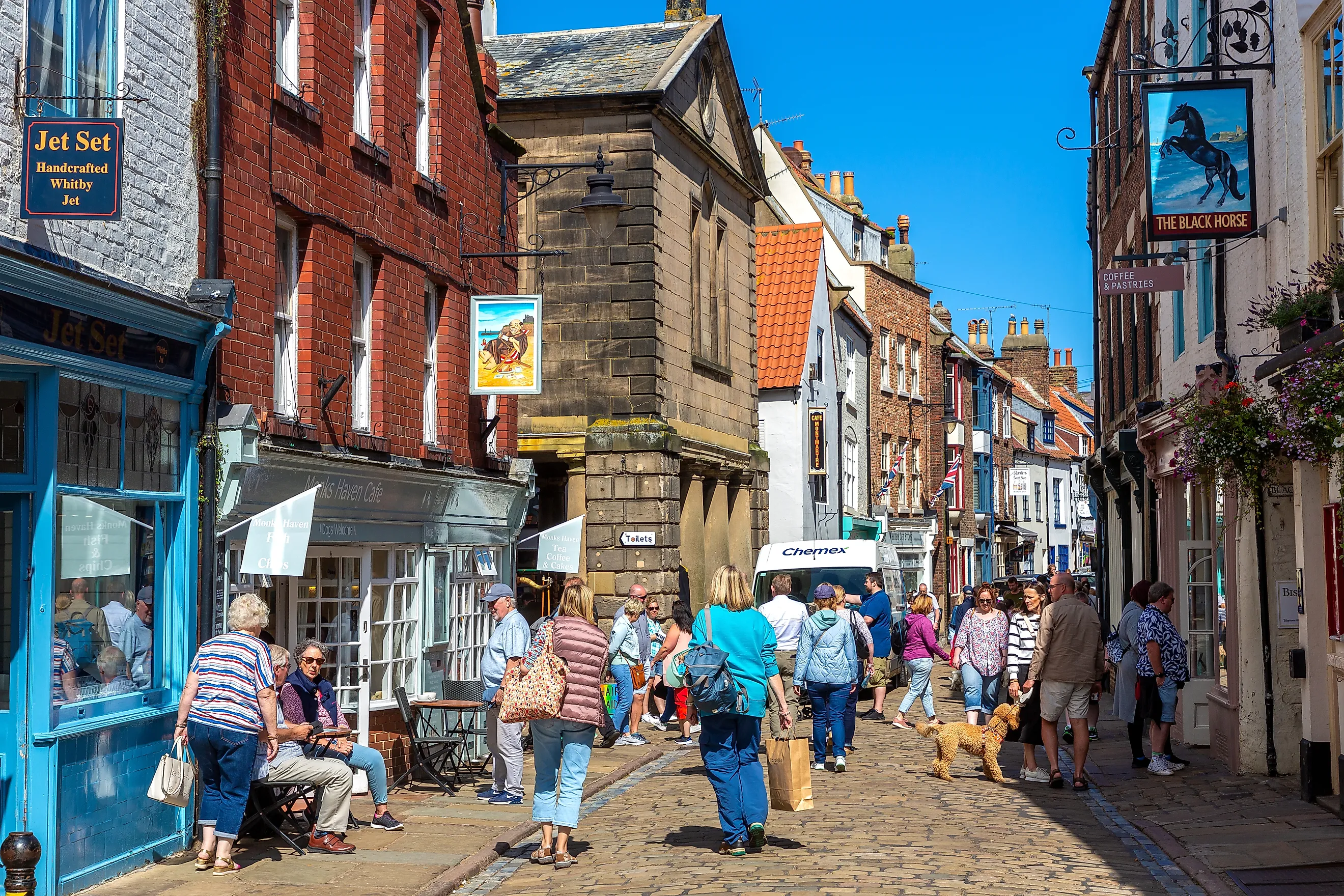
Whitby's two halves face each other across the harbour mouth, linked by a swing bridge that takes a minute to cross. The older east side holds Church Street and Grape Lane, where the Captain Cook Memorial Museum occupies the 17th-century house James Cook lodged in as an apprentice, alongside the workshops that once cut Whitby jet into Victorian mourning jewellery.
The 199 Steps climb from the head of Church Street to St Mary's churchyard and the ruins of Whitby Abbey, founded in 657 by the abbess Hild and home to Caedmon, the earliest English poet whose name survives. Properly the Church Stairs, they were timber until 1774 and carried funeral processions uphill to the parish burial ground, with benches set along the climb. West of the bridge, the seafront continues past the pier to Whitby Sands.
Llangollen, Wales

Four routes converge on Llangollen: the River Dee, the A5, the Llangollen Canal, and a standard-gauge heritage railway whose 1865 station stands on the north bank. Llangollen Bridge joins them, a Grade I structure counted among the Seven Wonders of Wales, carrying traffic since at least 1284. Cittaslow status followed in 2013, and the short grid of Castle Street and Parade Street shows why.
Wharf Hill climbs from the bridge to Llangollen Wharf, where horses still pull boats along the narrow feeder canal. The towpath from there runs 3 km west to Horseshoe Falls, Thomas Telford's 140-metre curved weir, along a stretch of canal made a UNESCO World Heritage Site in 2009. Back at river level, the Victoria Promenade of 1897 follows the Dee, and a signposted 45-minute climb reaches the 13th-century ruins of Castell Dinas Bran.
Sherborne, Dorset

Sherborne is built almost entirely from ochre hamstone quarried at Ham Hill in Somerset, which gives the whole centre a single colour in any light. The abbey, at its heart, began as St Aldhelm's cathedral in 705; the present building is mostly 15th-century and carries the earliest great fan vaulting in England, along with the heaviest peal of eight bells anywhere. Two Saxon kings, both older brothers of Alfred the Great, are buried inside.
Cheap Street climbs from the Conduit, a hexagonal stone washhouse the monks used in the cloisters until the dissolution of 1539, when the town moved it to the street's lower end. Both castles lie about 800 metres east: the 12th-century Old Castle, a bishop's palace wrecked in the Civil War, and the four-storey lodge Walter Raleigh began in 1594 after abandoning his attempt to repair it.
Pitlochry, Scotland

Pitlochry's unusually wide main street is a Victorian inheritance. The railway arrived in the 1860s and turned a Highland village into a holiday town, and Atholl Road still holds the hotels, outfitters, and cafes that came with it. Ten minutes downhill, the dam across the River Tummel was completed in 1951 and flooded the old Highland Games field to create Loch Faskally.
Built into that dam is a salmon ladder of 34 stepped pools with an underwater viewing window, where the counter usually logs more than 5,000 fish a season. A pedestrian suspension bridge crosses the Tummel to Pitlochry Festival Theatre, which has its own repertory company, and the Explorers Garden beside it grows specimens brought back by Scottish plant hunters. Blair Athol Distillery sits within walking distance at the eastern edge of town, and the shoreline circuit of Loch Faskally returns to the centre in about two hours.
Skipton, North Yorkshire

Known as the gateway to the Yorkshire Dales, Skipton takes its name from the Old English for sheep town, and the wool trade paid for nearly everything a visitor now walks between. Skipton Castle closes the top of the High Street, one of England's best-preserved medieval castles after more than 900 years. The yew in its courtyard was planted by Lady Anne Clifford in 1659. Holy Trinity Church stands beside it, its tower still marked by Civil War cannon fire.
The market covers the length of the High Street on Mondays, Wednesdays, Fridays, and Saturdays, under a charter King John granted in 1204. Behind the castle, Skipton Castle Woods follows Eller Beck and the Springs Branch canal on a 4 km circular path. The Leeds & Liverpool Canal, open here since 1770, offers a level towpath in either direction out of the centre.
The UK On Foot
What these centres share is a layout drawn up long before anyone owned a car, so the castle, the church, the market, and the river tend to sit within a few hundred metres of each other. Richmond fits a castle keep, a Georgian playhouse, and a riverside path to a ruined abbey into a single afternoon. Ludlow reaches open countryside ten minutes past its market square. Pitlochry is the outlier, a Victorian resort rather than a medieval town, though even there the wide main street was laid out for people who arrived by train and walked. Across England, Wales, and Scotland, the distance between the best things to see in these nine towns is measured in steps rather than kilometres.