Gorilla
Gorillas are the largest primates on Earth and one of the eight living species of great apes, including chimpanzees, bonobos, orangutans, and humans. Apes are distinguished from other primates by their complex brains, larger bodies, and lack of an external tail. Although Gorillas are the largest of the apes, they are primarily herbivorous. Often described as gentle giants, gorillas tend to be non-aggressive towards humans, avoiding conflict. When accustomed to human presence, they are more curious than hostile. Gorillas are social animals that live in family groups, or troops, of up to 30 individuals, led by a dominant silverback. They are highly intelligent and have complex emotions, they use tools, and in captivity, they have learned to communicate using some elements of sign language.
Classification
Gorillas are in the family Hominidae, or the great apes, and are closely related to humans, sharing 96-99% of their DNA. Gorillas belong to the genus Gorilla, which is classified into two distinct species: the western gorilla (Gorilla gorilla) and the eastern gorilla (Gorilla beringei). Each has two recognized subspecies. Mainly herbivores, all gorilla species and subspecies are found naturally in African tropical forests.
Species And Subspecies
Western Gorilla

The western lowland gorilla (Gorilla gorilla gorilla), a subspecies of the western gorilla, is the most populous and widespread of all gorillas, and can be found in central Africa, including Gabon, Cameroon, and the Republic of the Congo. Its preferred habitats are tropical rainforests and swamp forests. Although it is more numerous than other gorillas, the western lowland gorilla remains Critically Endangered due to poaching and habitat loss. The western lowland gorilla is the smallest of the subspecies, with adult males weighing 300-500 lbs (136-227 kg) and standing 5-6 ft (1.5-1.8 m) tall. They have short, coarse hair that is brownish-grey or reddish on the crown.
The Cross River gorilla (Gorilla gorilla diehli) is the rarer of the two western gorilla subspecies. It is classified as the most endangered great ape in Africa. Its habitat is a small region of the highland forest along the border of Nigeria and Cameroon, with a population of fewer than 300. They closely resemble western lowland gorillas, and the two subspecies were considered a single species until recently. The Cross River gorilla has slightly smaller skulls and teeth, and its fur is brownish-grey or black; it commonly has a reddish crest on its cone-shaped head. Like all gorilla populations, they are critically endangered due to habitat loss and hunting.
Eastern Gorilla

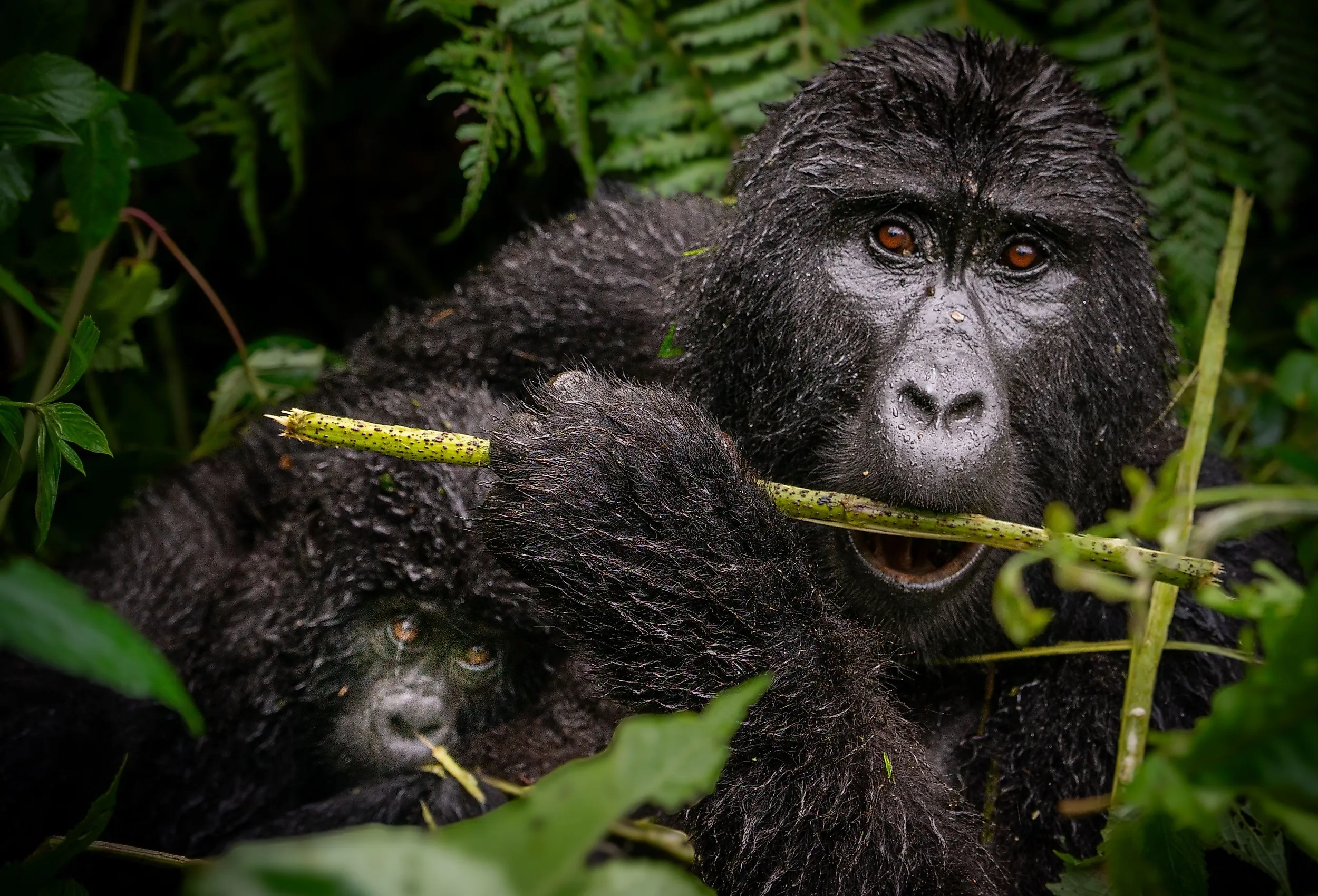
The mountain gorilla (Gorilla beringei beringei) is found in the high-altitude forests of the Virunga Mountains in Rwanda and Uganda, and the Bwindi Impenetrable National Park in southwestern Uganda. With a population of around 1,063 individuals, the mountain gorilla is listed as Endangered. Although still at risk, the mountain gorilla is the only of the four subspecies whose population is growing. The mountain gorilla has thicker, longer fur than other gorillas, as it is adapted to the colder temperatures of its high-altitude habitats, up to 13,000 feet. They are also the largest primate on Earth, with adult males weighing between 300 and 485 lbs (135-220 kg) and up to 6 feet in height.
The Eastern lowland gorilla (Gorilla beringei graueri) is native to the mountainous forests of the eastern Democratic Republic of the Congo. Because of civil unrest, poaching, and habitat loss, the Eastern lowland gorilla is critically endangered. The population has declined by over 50% since the mid-1990s. There are only a few thousand left in the wild. They have dark black coats, large hands, and stocky bodies. Males weigh around 309-453 lb (140-205.5 kg) while females weigh 200-220 lb (90-100 kg).
Range And Habitat

Gorillas are found in several habitats across equatorial Africa. The two species are separated by the Congo River, and their homes range from sea level to 14,000 feet. Their preferred habitat is dense, high-rainfall forests. As herbivores, they tend to be found in areas with abundant fruits available. Because all gorilla species and subspecies are endangered due to poaching, habitat destruction, and disease, gorilla populations are mostly restricted to national parks and other highly protected areas.
Diet

Primarily herbivorous, gorillas consume vast quantities of vegetation, including fruit, leaves, stems, bamboo shoots, pith, bark, and roots. To supplement their diets, they occasionally eat termites, ants, larvae, and snails. About 85% of the mountain gorilla diet comes from foliage, while western lowland gorillas eat a significant amount of fruit. Adult males can consume around 45 lbs of food per day, while adult females can eat 30 to 40 lbs per day.
Reproduction And Child Rearing

The reproductive rate for gorillas is relatively slow. Females generally give birth to a single infant every 4 to 6 years, and over a lifetime, the average female will produce only 3-6 offspring. Gestation lasts about 8.5 months, and, like humans, gorillas are born small and helpless, relying on their mothers for the first several years of life. Infants are generally weaned at age 3 or 4. Because of the long intervals between births, population recovery is very low. Likewise, infant mortality rates can be high, and only two-thirds of mountain gorillas and half of western gorillas reach weaning age.
Gorillas are polygamous, with the dominant silverback holding primary breeding rights over females in his troop. There is no primary mating season. Female gorillas reach maturity around age 8, but often do not start breeding until age 10 or later. When females mature and are ready to breed, they generally leave their mother’s troop and join another. Males mature at around 9, but it is not until they are over 15 that they become dominant and breed.
Behavior

As highly social animals, gorillas live in cohesive extended families or troops. Led by a dominant silverback male, they are remarkably gentle for their size and highly intelligent. Their days are spent foraging and resting, and they exhibit socially complex behaviors such as grooming and tool use. Although shy towards humans, gorillas, and in particular the silverback male, can use their enormous size and strength to defend their troop. This will involve dramatic chest-beating, roaring, and bluff charges if threatened. They will generally avoid confrontations with large predators and humans, but can be deadly if provoked.
Gorillas are generally non-territorial, but aggressive territoriality has been observed, particularly due to habitat loss and dwindling resources. They use a wide range of vocalizations; researchers have identified 16 to 20 distinct types. When young, gorillas are highly playful and will demonstrate tool usage at a young age through experimentation, such as using sticks to check water depths.
Importance To The World

Gorillas are an umbrella species, chosen for conservation because their protection will safeguard other, often smaller, species within their large habitat. As key consumers of vegetation, gorillas help maintain the ecological balance of tropical rainforests, which act as critical global carbon sinks. By consuming fruit and other vegetation, gorillas disperse seeds and create gaps in the canopy, helping maintain biodiversity. Protecting them safeguards entire ecosystems, supports local communities, and stabilizes climate patterns.
Gorillas are crucial for carbon sequestration; protecting gorilla habitats in the Congo Basin, the second-largest rainforest in the world, is crucial to fighting climate change. In human science, gorillas' genetic closeness can provide insight into human evolution, biology, and health. Ecotourism in countries such as Uganda, Rwanda, and the Democratic Republic of Congo helps local economies, and gorilla-based tourism incentivizes habitat conservation and the fight against poaching.
The growth of gorilla populations in the mountain gorillas stands as a symbol of conservation success, thereby encouraging further efforts with other species. Despite the success of the mountain gorillas, all gorilla species remain threatened. Their survival is critical to maintaining ecosystem balance and the health of the planet.