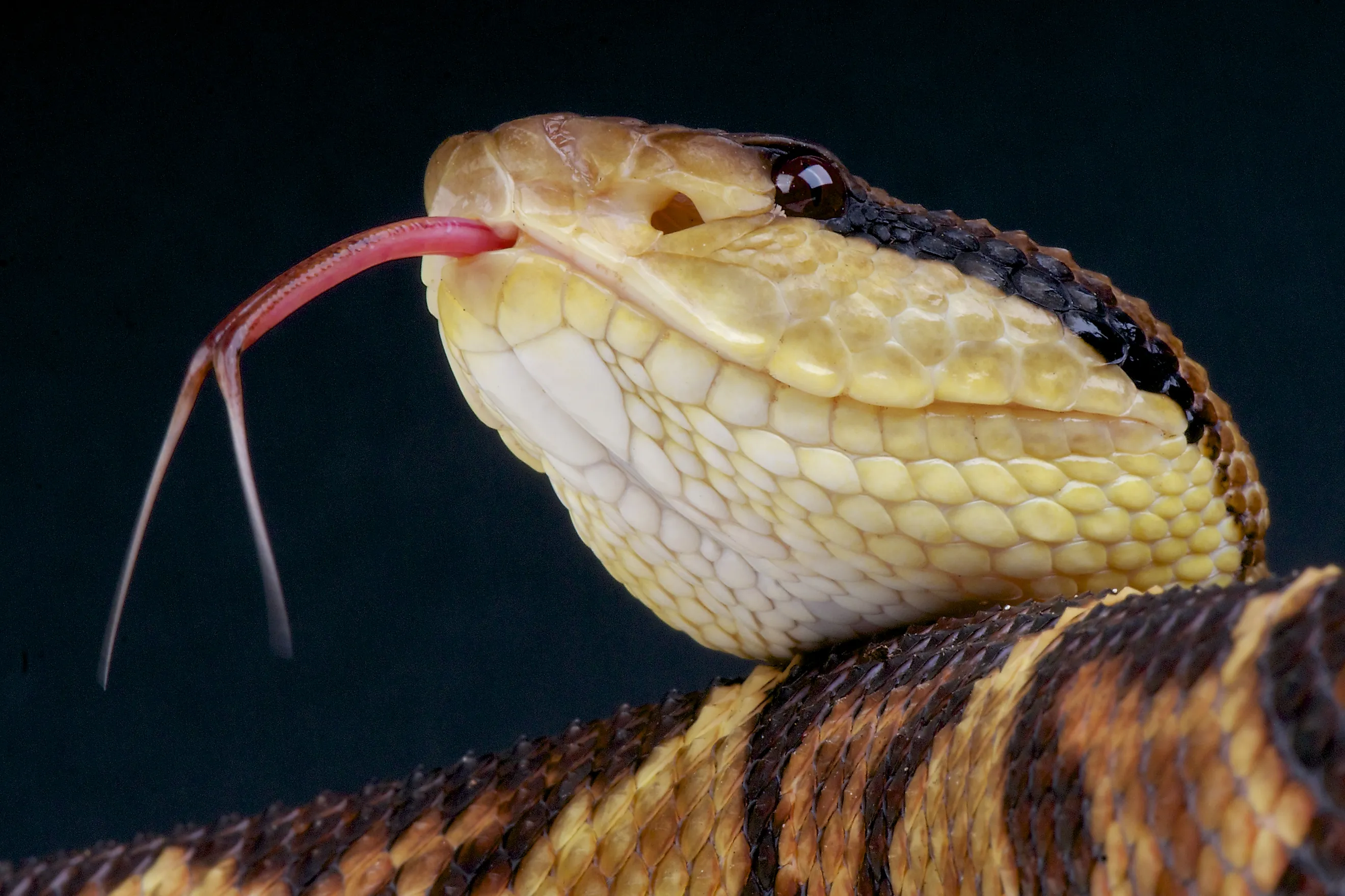
Bushmaster
The bushmaster (Lachesis) is a genus of pit vipers in the family Viperidae. The South American bushmaster (Lachesis muta) can attain lengths of up to 11 feet (nearly 3.5 meters), making it the longest pit viper in the world, and the second-longest venomous snake next to the king cobra (Ophiophagus hannah). Bushmasters can be found in the tropical rainforests of Central and South America, but due to their elusive nature, they are seldom encountered by people. The name Lachesis comes from Greek mythology and refers to one of the three Fates responsible for measuring the thread of life. Bushmasters can strike rapidly and deliver large quantities of venom, making them among the most powerful and potentially dangerous venomous snakes in the Americas.
Taxonomic Classification

Most modern authorities recognize four species of bushmaster: the South American Bushmaster; the Central American bushmaster (Lachesis stenophrys); the black-headed bushmaster (Lachesis melanocephala); and the Chocoan bushmaster (Lachesis acrochorda). The genus Lachesis was traditionally considered to contain only three species, but L. acrochorda was later recognized as a distinct fourth species and is generally considered more closely related to L. muta than to the Central American species L. stenophrys and L. melanocephala. The Atlantic forest bushmaster (Lachesis muta rhombeata) has historically been treated as a subspecies of L. muta, although its taxonomic status remains debated.
Physical Description

Adult bushmasters generally reach lengths of two to 6.6 to 9.8 feet (approximately 3 meters). Guinness World Records documented a South American bushmaster measuring 11.97 feet (3.65 meters), making it the longest recorded pit viper and the longest recorded venomous snake native to the Western Hemisphere.
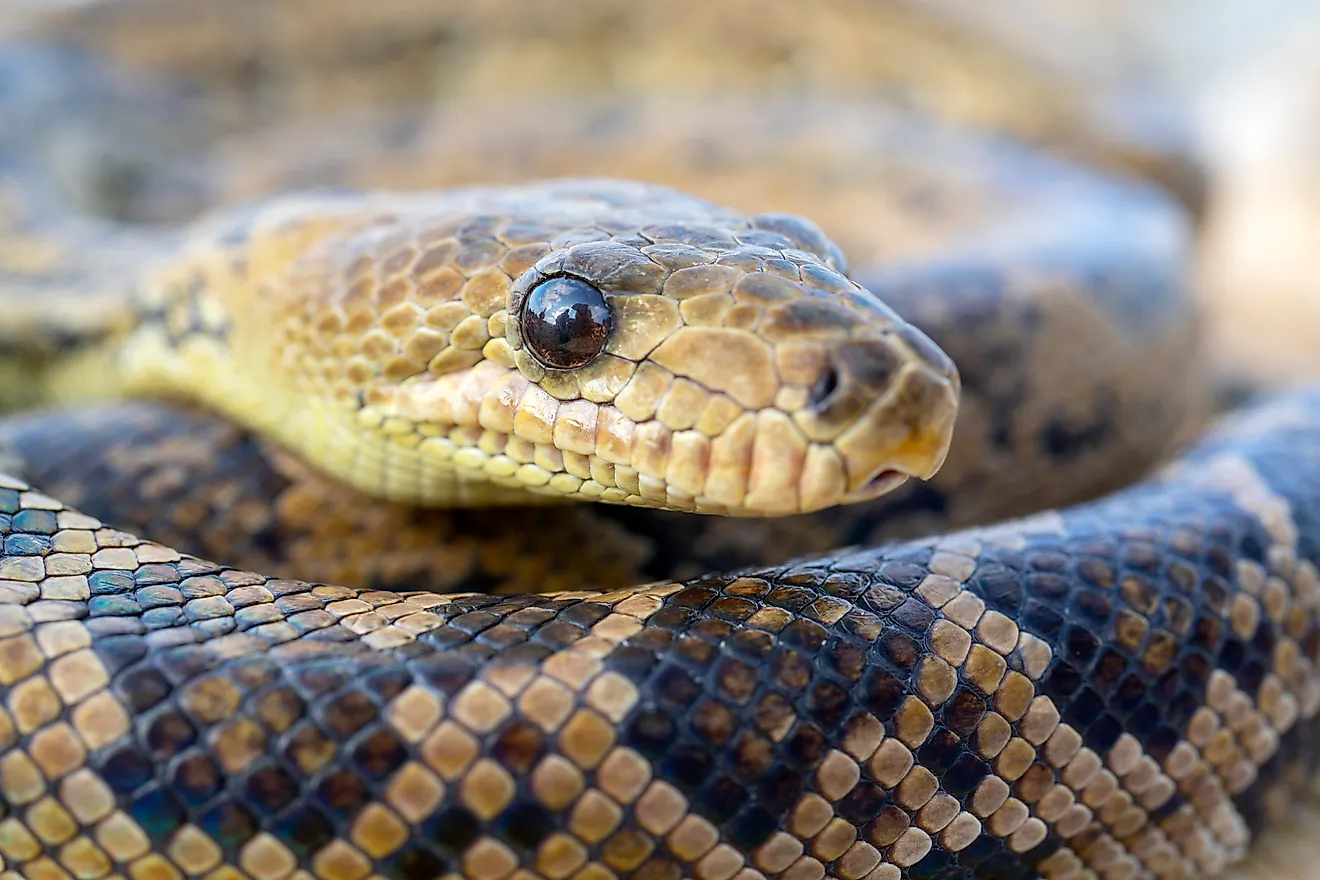
The body of bushmasters ranges from reddish-brown to tan and even pink, with very distinct dark, diamond-shaped markings down the back, often accompanied by yellowish edges, and light-colored bellies. They usually feature a dark stripe connecting their eye to the back corner of the mouth. Their scales are heavily keeled and knoblike, which is said to give the bushmaster’s skin a texture comparable to pineapples. Their tails end in a horn-like spine that vibrates when disturbed, similar to rattlesnakes, though without the sound.
Bushmasters are sexually dimorphic, with males reaching larger sizes than females.
Range and Habitat

Two species of bushmaster primarily occur in Central America, while two occur mainly in South America. The black-headed bushmaster is endemic to Costa Rica, inhabiting the Pacific slopes of southeastern Puntarenas from sea level to elevations of around 4,921 feet (1,500 meters). The Central American bushmaster has a much greater range, extending through the Atlantic lowlands of southern Nicaragua and Costa Rica, as well as the Pacific lowlands of central and eastern Panama. Its range further stretches into South America, occurring in the Pacific lowlands of Colombia, northwestern Ecuador, the Caribbean coast of northwestern Colombia, and inland regions along the Magdalena and Cauca River valleys.
In South America, the Chocoan Bushmaster inhabits southern Panama, northern Colombia, the Chocó region, and northwestern Ecuador. The South American bushmaster occupies the largest range of all four recognized species. It can be found in equatorial rainforests east of the Andes, with the majority of its range in northern Brazil. It can also be found in Colombia, eastern Ecuador, Peru, northern Bolivia, southern Venezuela, Guyana, Suriname, French Guiana, and the island of Trinidad.
Bushmasters primarily inhabit tropical moist forests with high annual rainfall and consistently warm temperatures. They are most commonly found at elevations below 3,281 feet (1,000 meters), although some species may occur at higher elevations.
Food

Like many vipers, bushmasters possess infrared heat-sensitive pits located between their eyes and nostrils that help them detect prey items, which in the wild usually consist of rodents and marsupials. As ambush predators, bushmasters may remain coiled and motionless for days or even weeks near fallen logs, tree buttresses, forest trails, or beneath fruiting trees while waiting for small mammals attracted by fallen fruit. If prey items are larger or capable of inflicting harm towards the bushmaster, they will strike quickly and release, injecting venom into their prey, then waiting for it to have an effect before they start eating head-first. Like many large ambush predators, bushmasters can survive on relatively few substantial meals each year.
Behavior and Reproduction

Bushmasters are nocturnal, with most of their activity taking place at dusk or after dark. They live solitary lives outside of breeding season. Male bushmasters searching for a mate typically become more crepuscular, meaning they are active during twilight hours. At this time, they will move through the forest floor in a search for a viable mate by following the scent trail of a female. During courtship, the male can either rub the female’s head and flick his tongue across her body, or partially invert himself to rub his back against the female or jerk his body against hers. If the female is receptive to this, mating may occur and last for over five hours.
Bushmasters are the only pit viper in the Americas to lay eggs rather than give birth to live young. The female will lay up to 20 eggs in hollow logs or abandoned mammal burrows and will coil around the clutch to protect it from predators until the eggs hatch two to three months later. During this time, the females will not eat. When the time spent developing eggs prior to laying is combined with incubation, females may go as long as seven months without eating. However, once the eggs hatch, the mother will leave them to fend for themselves.
Importance

Like other snakes, bushmasters help regulate populations of rodents and other small mammals within their ecosystems. Due to their large size, they may also prey upon relatively large mammalian prey compared to many other vipers. Despite their size, bushmasters are still vulnerable to predation. Collared peccaries (Dicotyles tajacu), pig-like mammals native to Central and South America, have been observed killing and occasionally feeding on snakes, including young bushmasters.
Compounds derived from snake venom have contributed to medical research and drug development. In 2018, researchers at the Ezequiel Dias Foundation in Belo Horizonte, Brazil, studied compounds isolated from bushmaster venom for their potential anti-cancer properties. Similar research continued in 2019 at the University of Chile, where scientists further investigated the possible anti-tumor effects of toxins derived from bushmaster venom. However, any venom-derived treatment would require many years of additional laboratory testing, clinical trials, and regulatory review before it could potentially be approved for medical use.
Threats

Bushmaster populations are believed to be declining in some areas due to deforestation and habitat loss. However, because bushmasters are shy, elusive, and difficult to observe in their natural habitat, accurately studying their behavior and monitoring wild populations remains challenging. represent some of the few long-term in-situ research and conservation efforts focused specifically on bushmasters, studying their spatial ecology, reproductive behavior, general behavior, and conservation needs. One positive is that, because bushmasters are sensitive to suboptimal environmental conditions, their presence in primary rainforests indicates a relatively intact and healthy ecosystem.