The 10 Hottest Cities in the United States
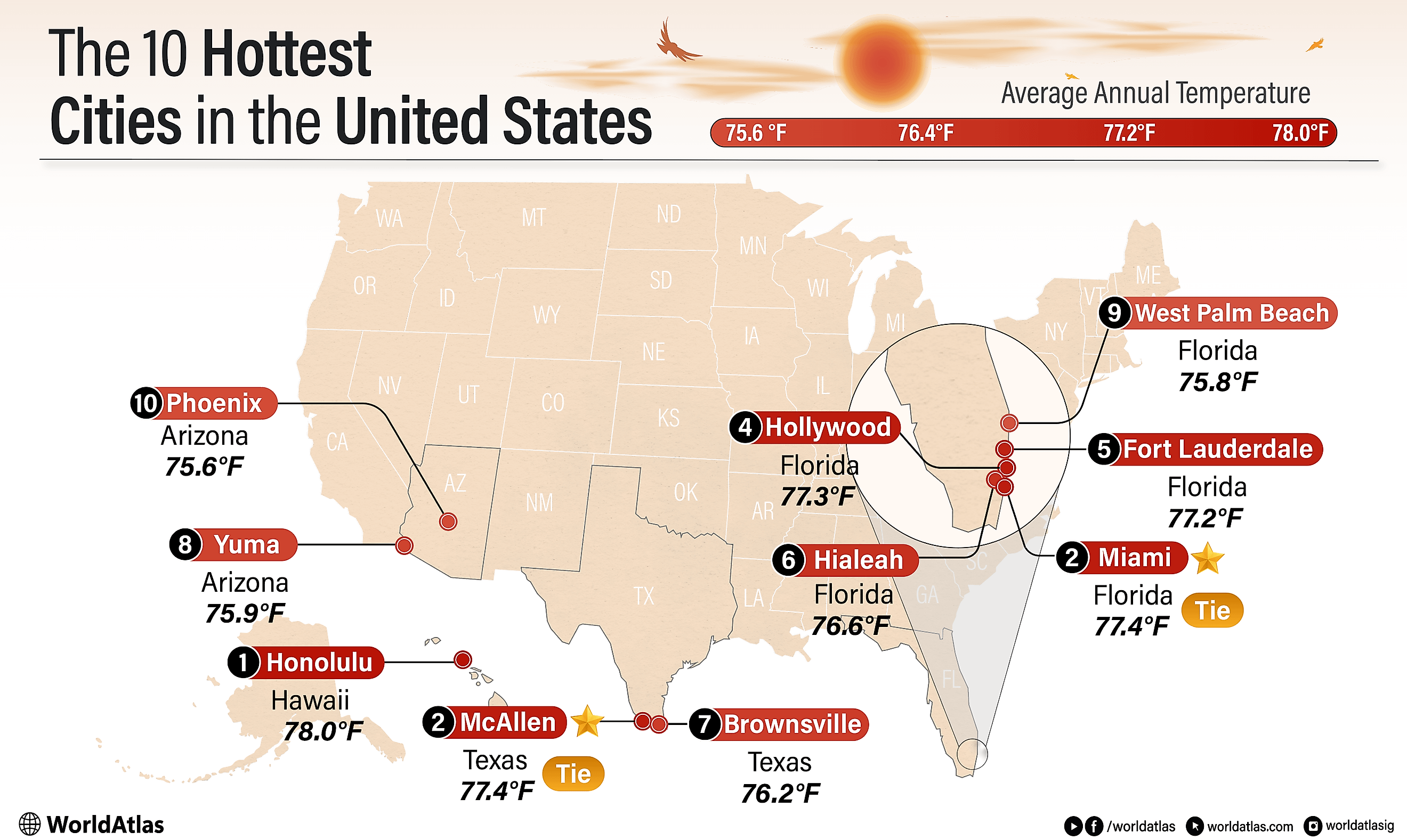
Hawaii's tropical climate, Gulf Coast humidity, and desert Southwest heat each produce pockets of consistently warm weather in the United States. The ten cities below are the hottest in America by annual average temperature. All carry populations above one hundred thousand residents. Average annual temperatures across the list run between 75.6°F in Phoenix and 78°F in Honolulu. The cities split roughly evenly between humid coastal heat and dry desert heat.
Rankings draw on the National Oceanic and Atmospheric Administration's 1991-2020 climate normals.
The 10 Hottest Cities in the United States
| Rank | City | State | Avg. Annual Temp. (°F) |
|---|---|---|---|
| 1 | Honolulu | Hawaii | 78 |
| 2 | Miami | Florida | 77.4 |
| 2 | McAllen | Texas | 77.4 |
| 4 | Hollywood | Florida | 77.3 |
| 5 | Fort Lauderdale | Florida | 77.2 |
| 6 | Hialeah | Florida | 76.6 |
| 7 | Brownsville | Texas | 76.2 |
| 8 | Yuma | Arizona | 75.9 |
| 9 | West Palm Beach | Florida | 75.8 |
| 10 | Phoenix | Arizona | 75.6 |
1. Honolulu, Hawaii (78°F)

The only US state in the tropics is also home to the hottest American city. Along with an average annual temperature of 78 degrees Fahrenheit, Honolulu offers a remarkably stable warm climate, with average lows rarely dropping below the high 60s and average highs rarely reaching the low 90s. Hawaii's location closer to the equator produces relatively little seasonal variation, while persistent northeasterly trade winds and the surrounding ocean help moderate temperatures. The result is a major American city where residents rarely feel a chill and rarely suffer from the oppressive temperatures found in many other cities on this list.
2. Miami, FL (77.4°F)

Although the official population sits under a half-million, Miami anchors a broader metro area of more than six million, making it an option for residents who want big-city living alongside consistently high temperatures. Miami combines high actual temperatures with persistently extreme humidity, with daily average dew points regularly above 70°F during the summer months and rarely dropping below the mid-60s in winter. The southernmost mainland Florida location is a primary contributor to the high ranking, as is the urban heat island effect from the dense development across the metro region.
2. McAllen, TX (77.4°F)

Tied for second is McAllen, Texas, located along the southern border with Mexico and not far from the Gulf. The location produces a combination of humid Gulf air and the dry heat of the interior. Even though winter offers more relief than some hot cities on this list, average high temperatures approach 100°F in the peak summer months and stay over 90°F in shoulder periods like May and September. The combination of high temperatures and high humidity can produce some of the more extreme and potentially dangerous conditions on the list.
4. Hollywood, FL (77.3°F)

Hollywood is part of the same broader Southeast Florida metro area as Miami and Fort Lauderdale and lands a high spot on this list for the same reasons. The town sits within easy reach of tropical air masses and gets a steady humidity load from the Atlantic Ocean, along with influences from the Gulf just a few dozen miles across the state. Average highs reach the 90s during summer, while winter offers little relief, with average lows barely below 60°F.
5. Fort Lauderdale, FL (77.2°F)

Just a tenth of a degree behind its southern neighbor, Fort Lauderdale gives heat lovers more big-city and high-end living options. Summers run high temperatures in the high 80s and low 90s, with winter average lows only briefly entering the 50s.
Although still part of the broader Southeast Florida metro area, Fort Lauderdale sits roughly 20 miles north of Miami, farther from the dense urban core. More of Fort Lauderdale sits directly on the Atlantic Ocean than Miami proper, which is set back from the ocean by barrier-island communities that absorb some of the sea breeze.
6. Hialeah, FL (76.6°F)

The dense community of Hialeah sits between heavily developed Miami to the east and the wilds of the Everglades to the west. This inland location distinguishes it from other South Florida cities on the list, temperature-wise. With less direct moderation from the Atlantic, parts of Hialeah cool slightly more during winter nights, a small but significant effect when comparing the hottest American cities. The town still keeps the regional climate signature: average high temperatures between the high 70s and low 90s depending on season, and average lows that rarely break 60°F.
7. Brownsville, TX (76.2°F)

Brownsville is another Texas border city located even closer to the humid Gulf than McAllen. Unlike McAllen, this proximity to the water keeps average winter lows in the low 50s rather than touching the high 40s. The Gulf also slightly moderates summer high temperatures, keeping them in the mid-90s rather than close to 100°F. The trade-off is higher humidity, with conditions usually muggy and often outright oppressive between mid-May and mid-September most years.
8. Yuma, AZ (75.9°F)

The first city on the list propelled there primarily by dry heat, Yuma sits in Arizona's far southwestern corner, bordering California and just miles from Mexico. From June through September, average daily highs top 100°F, peaking at 107°F in July. Daily highs over 110°F are fairly common, and the city reached an all-time record of 124°F on July 28, 1995. Yuma behaves like a typical desert city in many ways, with winter average lows in the high 40s, though humidity from the relatively nearby Gulf of California can keep summer lows from dropping below 80°F, even at night.
9. West Palm Beach, FL (75.8°F)

Near the northern edge of South Florida's densely developed coastal corridor sits the upscale town of West Palm Beach. The roughly 40-mile gap from Fort Lauderdale and 60-mile distance from Miami pulls the temperature down by a degree or two, but there is no way to call West Palm Beach anything other than hot. Summers run highs in the high 80s and low 90s, with nights rarely dropping below the mid-70s. Winters occasionally dip into the high 50s, though daytime highs persist in the mid-70s, keeping residents warm year-round.
10. Phoenix, AZ (75.6°F)

With over 1.6 million residents, Phoenix is the largest city on the hottest list, even though the metro area is somewhat smaller than South Florida's. The heat island effect from that scale of development, combined with the desert location, produces a climate in which high temperatures regularly cross 115°F during summer, with the official all-time record at 122°F set on June 26, 1990. On average, more than 20 days per year top 110°F, and average daily highs run 100°F or greater from June through September. Phoenix winters can disappoint those wanting hot weather year-round, however. The city was held to the bottom of the list by December and January temperatures that often top out below 70°F and can drop to the mid-40s or lower at night on average.
Warm Weather Isn't Hard to Find Across the United States
Despite the wide variation in climate across the country, there is no shortage of places where readers can find consistently high temperatures, high humidity, or both. For soaring temperatures and desert heat or the warm, steady character of tropical and subtropical environments, the ten cities above represent the top of the rankings.