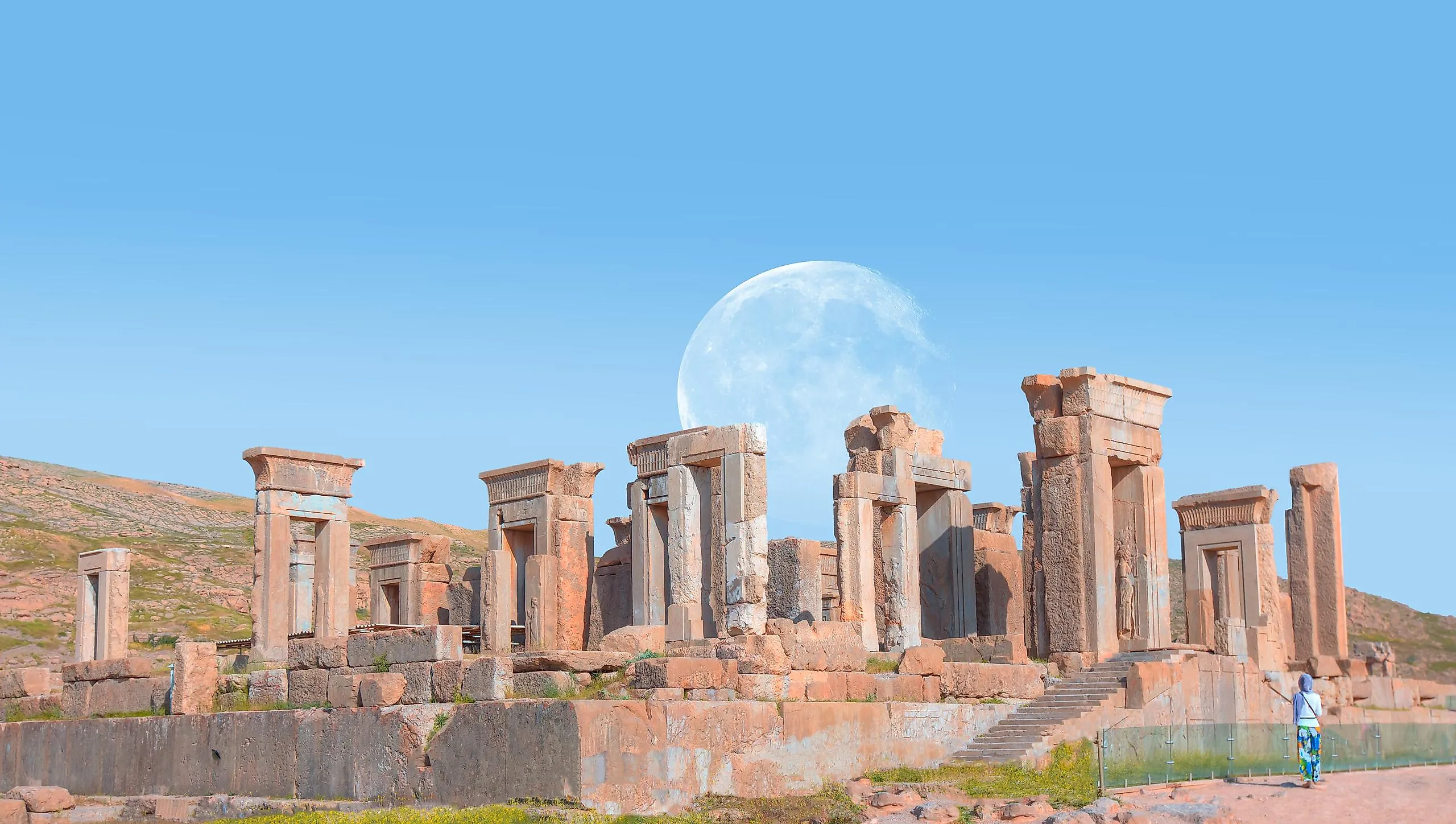
Why Did The Persian Empire Fall?
The Achaemenid Persian Empire was one of the most powerful ancient states for over two centuries. This makes its ultimate collapse in the 330s BCE even more interesting. How could such a formidable entity fall? The most obvious answer is that Alexander the Great conquered it, but this doesn't explain why or how it was defeated so quickly. Upon closer inspection, it becomes clear that an overreliance on strong kings, the lack of a clear succession system, an incredible Macedonian army, and Alexander's military prowess all contributed to its end.
It Relied Too Heavily On Strong Kings

Cyrus the Great founded the Achaemenid Persian Empire in the mid-6th century BCE. Under him and his successors, it expanded into the largest empire of its time. As such, it encompassed a diverse array of peoples with different wants and needs. This required a sophisticated governance and administrative system to maintain order. The king held ultimate authority, but provinces were governed by governors, called satraps, who collected taxes and enforced royal authority. Roads and other infrastructure also helped the Persian army travel quickly from one place to another to put down rebellions and repel invasions. Finally, the Persians allowed locals to maintain their religions and customs, and local elites retained their positions.
This system needed a strong king to function. Leaders like Cyrus the Great and Darius I enforced order and cooperation through their adept handling of satraps, aristocrats, and military leaders. Other kings weren't as successful. Darius III, who ruled Persia when Alexander the Great invaded, was one such example. He had to contend with provincial elites and governors siding with Alexander in pursuit of their own interests. In one notable example, a senior Persian commander, Mazaeus, surrendered Babylon and was rewarded with its governorship. All this allowed the Macedonian king to conquer territory without even having to fight for it.
It Lacked A Clear Succession System

The Persian Empire's succession system was problematic. While there were strong preferences (the king's firstborn son was often a favorite to succeed him), the lack of a formal process paved the way for internal conflict. This was acute in the years leading up to Alexander's invasion. Artaxerxes III reigned from 358 to 338 BCE before his assassination. Artaxerxes IV ruled for the next two years before also being killed. This left Darius III just two years to consolidate power and bolster legitimacy before Alexander invaded in 334 BCE. What would have been a difficult task for the greatest leaders in Persian history was basically impossible for Darius III. A brave soldier and average administrator, he was no match for Alexander's military brilliance. Lacking time to garner full domestic support further hindered him.
Philip II Built One Of The Best Armies In The World

Much is often written about the Persian Empire's weaknesses. While it certainly had problems, the Macedonians were a formidable opponent that few ancient armies could match. The foundation of this strength was built by Alexander's father, Philip II. He was King of Macedonia from 359 to 336 BCE and transformed it from a "backward" state on the periphery of the Greek world into the regional hegemon.
Army reforms provided the backbone of this transformation. First, Philip replaced the traditional Greek spears with the sarissa, a massive two-handed pike measuring 13 to 21 feet long. This let the Macedonians hold their enemy in place. Second, he used cavalry to smash through the pinned-down opponent using the hammer-and-anvil technique. Finally, Philip created a professional, standing army. While the Persians had an elite corps of professional soldiers, they also relied on thousands of conscripted levies from across the empire. This meant that the average Macedonian troop outmatched the average Persian one.
Alexander The Great Was A Formidable General

Alexander the Great was the final, and arguably most important, reason why the Achaemenid Persian Empire fell so quickly. Although he inherited one of the best armies in world history, his adept military mind let him use it to its full potential. Consider the Battle of Issus in 333 BCE. The Macedonians numbered about 40,000, whereas modern estimates put the Persian army at up to about 100,000 troops. The battle took place on a narrow coastal plain between the mountains and the sea, after Darius moved his army behind Alexander's line of march. The narrow ground negated the Persian numerical advantage, since they could send only a limited number of troops onto the battlefield at once. This allowed Alexander to use the hammer-and-anvil technique to smash through the Persian left flank.
The Battle of Gaugamela in 331 BCE was the decisive engagement of the campaign. It was also Alexander's masterpiece. The Macedonians were again massively outnumbered, and this time Darius chose to fight on a wide-open plain to leverage his numerical advantage. Realizing that a head-on assault would be suicide, Alexander instead advanced diagonally towards the Persian left flank. This left Darius with an impossible decision: risk being outflanked or create a gap in his battle lines by shifting his defenders. Darius chose the second option, and Alexander charged directly at the Persian king when the gap emerged. Darius was forced to flee, and the Persian army collapsed. The Macedonians then occupied the Persian capitals over the next year.
Impact And Legacy

The Persian Empire fell for several reasons. Its system required strong kings, and Darius III was not one. The lack of a clear succession system further weakened his domestic power, making him even more vulnerable to Alexander's invasion. Philip II's reforms also made the Macedonian army formidable, to the point where few ancient armies could match it. Finally, Alexander fully leveraged the army's strengths through his tactical and strategic brilliance. Crucially, even though his conquest marked the end of the Achaemenid Persian Empire, Persian civilization didn't disappear. Alexander was a self-styled cosmopolitan leader who adopted many Persian traditions. This ensured that Persian culture survived, paving the way for the Parthian and Sasanian Empires.