The Busiest Airports In The World
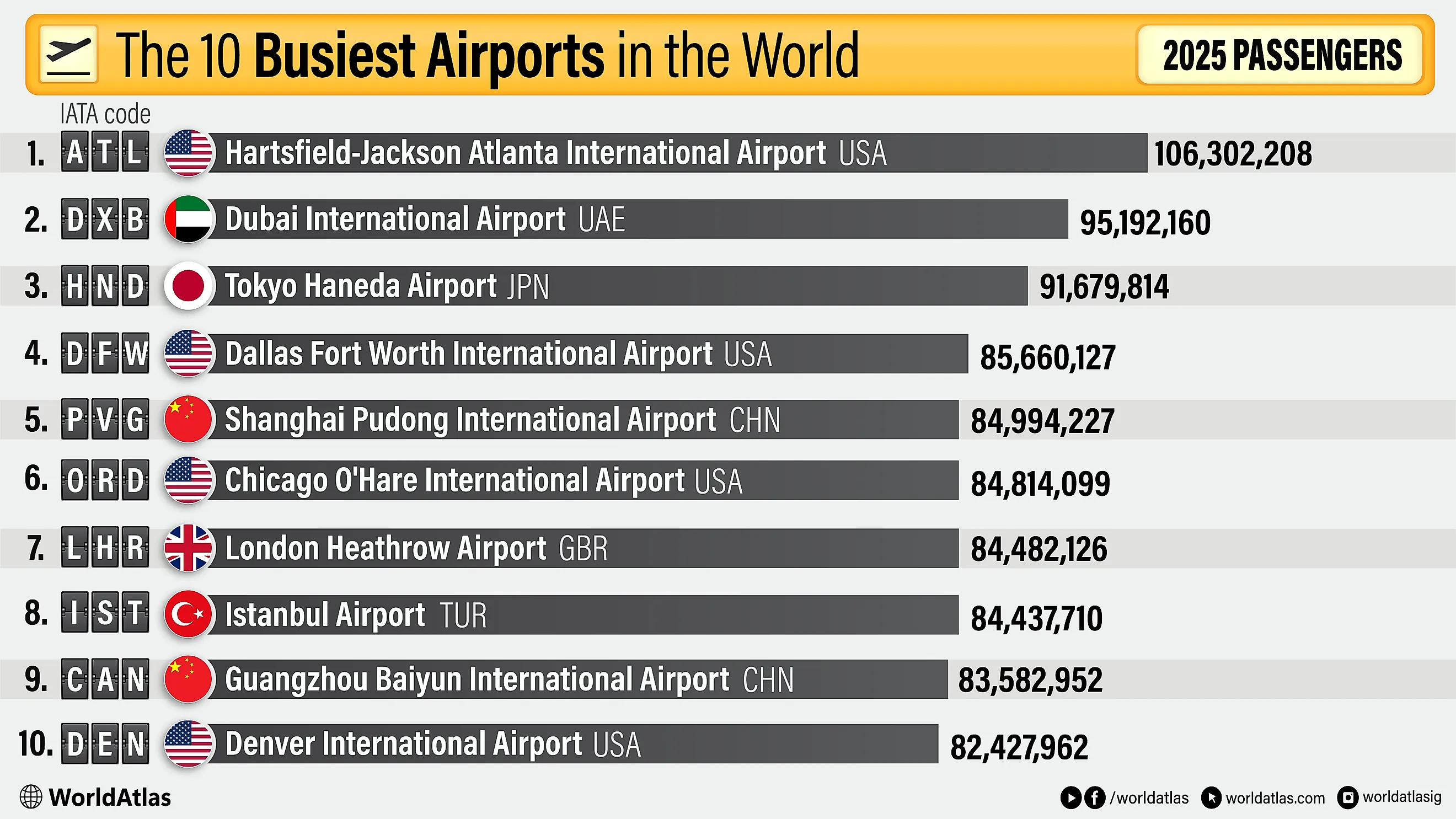
The world's busiest airports aren't just travel hubs. They're pressure points in the global economy, pushing millions of people through crowded terminals, tight layovers, and flight networks that never really sleep. In 2025, Atlanta took the top spot yet again, clearing 106 million passengers. But look further down the list and you'll see the aviation map shifting under your feet, with Dubai, Tokyo, Shanghai, Istanbul, Guangzhou, and other mega-hubs showing just how hard global travel has come roaring back across the Middle East and Asia.
Below are the 10 busiest airports in the world, ranked by total passenger traffic.
The 10 Busiest Airports In The World
| Rank | Airport | Country | 2025 Passengers |
|---|---|---|---|
| 1 | Hartsfield-Jackson Atlanta International Airport (ATL) | United States | 106,302,208 |
| 2 | Dubai International Airport (DXB) | UAE | 95,192,160 |
| 3 | Tokyo Haneda Airport (HND) | Japan | 91,679,814 |
| 4 | Dallas/Fort Worth International Airport (DFW) | United States | 85,660,127 |
| 5 | Shanghai Pudong International Airport (PVG) | China | 84,994,227 |
| 6 | Chicago O’Hare International Airport (ORD) | United States | 84,814,099 |
| 7 | London Heathrow Airport (LHR) | United Kingdom | 84,482,126 |
| 8 | Istanbul Airport (IST) | Turkey | 84,437,710 |
| 9 | Guangzhou Baiyun International Airport (CAN) | China | 83,582,952 |
| 10 | Denver International Airport (DEN) | United States | 82,427,962 |
1. Hartsfield-Jackson Atlanta International Airport

Atlanta is still the busiest airport on the planet, with 106,302,208 passengers passing through in 2025. The reason comes down to one word: connections. Sitting in the Southeast, Atlanta is a natural waypoint for flights crisscrossing the country, and most of its traffic is domestic, though it holds its own internationally too. Between the layout, the airline operations, and the sheer frequency of flights, millions of people cycle through every month. For a huge chunk of them, Atlanta isn't where they're going at all; it's just where they swap planes. That role as America's great middle ground is what keeps ATL on top, year after year.
2. Dubai International Airport

Dubai came in second worldwide with 95,192,160 passengers in 2025, and its story is almost the opposite of Atlanta's. Where the big US airports lean on domestic flyers, Dubai runs on international traffic. It's one of the great long-haul gateways, stitching together Europe, Asia, Africa, the Middle East, and the Americas through a single hub. Geography does a lot of the heavy lifting here. Parked between East and West, Dubai is hard to beat for travelers piecing together intercontinental trips. Add in the city's pull as a destination for tourism, business, and conferences, and you get terminals in near-constant motion. DXB's climb says a lot about the strength of the UAE's aviation sector, and about how much modern travel still hinges on a good transfer hub.
3. Tokyo Haneda Airport

Tokyo Haneda landed in third with 91,679,814 passengers in 2025, cementing its place among the heavyweights of Asia and the world. Haneda serves the Tokyo metro area, one of the biggest urban economies anywhere, and demand pours in from both domestic and international flyers. What travelers love most is how close it sits to central Tokyo, a real convenience for business trips, tourists, and locals alike. It's been a domestic powerhouse for decades, but its international reach has grown a lot in recent years. The strong 2025 numbers also track with the wider travel rebound across Japan and the Asia-Pacific. With slick transport links, massive passenger volumes, and a front-row seat to one of the world's most visited cities, Haneda is a global force.
4. Dallas/Fort Worth International Airport

Dallas/Fort Worth took fourth place with 85,660,127 passengers in 2025. DFW punches above its weight thanks to a central location, a sprawling footprint, and a domestic route network that reaches just about everywhere. It ties together the South, the Midwest, both coasts, and a slate of international markets, which makes it a busy transfer point for people who aren't actually from North Texas at all. Its size lets it juggle huge flight volumes across multiple terminals and a long list of destinations. The booming region around it helps too, with business travel, tourism, and a fast-growing population all feeding the numbers. DFW is proof that the big American hubs still carry serious weight on the world stage.
5. Shanghai Pudong International Airport

Shanghai Pudong came in fifth with 84,994,227 passengers in 2025, a big comeback for one of China's most important international gateways. Pudong serves Shanghai, a financial, commercial, and manufacturing center wired into the rest of Asia and the world. It's a key link between China and long-haul markets abroad, while still carrying plenty of domestic and regional traffic. Its jump up the rankings mirrors the broader recovery of Chinese aviation, with more international routes coming online and demand for trips in and out of the country picking back up. Shanghai's clout gives Pudong a deep well of business flyers, tourists, cargo-linked travel, and connecting passengers to draw on. As China's international market keeps rebuilding, expect PVG to stay near the top, and under close watch.
6. Chicago O’Hare International Airport

Chicago O'Hare placed sixth in 2025, moving 84,814,099 passengers. O'Hare has been one of aviation's defining airports for ages, thanks to its spot in the middle of the country and its role as a giant connecting hub. It ties major U.S. cities to destinations across Europe, Asia, Latin America, and beyond. It's also famous for the sheer number of aircraft movements it handles, so it's not just busy with passengers but with takeoffs and landings too. Chicago's standing as a business, convention, and tourism city keeps demand steady. For a lot of flyers, O'Hare is the place you change planes, whether you're hopping between U.S. regions or jumping from a domestic flight to an international one. That keeps it locked firmly in the global top 10.
7. London Heathrow Airport

London Heathrow came in seventh with 84,482,126 passengers in 2025. Heathrow is the UK's main door to the world and one of Europe's most important long-haul airports. Its strength flows straight from London itself, a global center for finance, culture, tourism, education, government, and business. Unlike airports that live and die on domestic traffic, Heathrow is all about international reach, connecting Britain to major cities across North America, Europe, Asia, Africa, and the Middle East. Inbound tourists, outbound Brits, and a steady stream of premium business routes all keep it humming. What makes its passenger total all the more impressive is how little runway space it has to work with. Even with fierce competition from rival European hubs, Heathrow stays one of the most influential airports on earth.
8. Istanbul Airport

Istanbul Airport ranked eighth with 84,437,710 passengers in 2025, locking in its status as one of the fastest-rising hubs in the world. Its trump card is location. Istanbul sits at the meeting point of Europe, Asia, the Middle East, and Africa, which makes it a natural pit stop for anyone hopping between continents. It was built for scale from day one, with sprawling terminals, plenty of room to grow, and a route network designed around international connections. The city's own appeal as a tourist draw, business center, and cultural crossroads adds even more fuel. The airport's rapid growth is really Turkey's aviation ambitions made concrete. With heavy connecting traffic and a wide international reach, Istanbul has muscled its way into the world's elite in record time.
9. Guangzhou Baiyun International Airport

Guangzhou Baiyun took ninth in 2025 with 83,582,952 passengers. It's one of China's most important aviation centers and the main gateway to the country's south. Guangzhou is a commercial and manufacturing powerhouse, and its airport carries the mix that comes with that: business trips, domestic tourism, international connections, and travel zipping around the region. Baiyun's strong showing reflects the recovery of China's aviation market and the sheer scale of demand inside the country. With a huge population and a growing middle class, China generates enormous passenger volumes, especially on routes between its big cities. It helps that Guangzhou sits next to the Pearl River Delta, one of the most economically dynamic corners of the world. As international travel keeps strengthening, CAN should stay a major player in global traffic.
10. Denver International Airport

Denver rounded out the top 10 with 82,427,962 passengers in 2025. Its ranking comes down to its job as a major domestic hub and its perch right in the middle of the country. Denver links travelers bouncing between the West Coast, Midwest, South, and East Coast, which makes it a handy connecting point for all kinds of routes. It also serves a metro area that keeps growing fast and a tourism region that pulls people in for business, skiing, the outdoors, and conventions. The airport's enormous footprint leaves plenty of room for runways, terminals, and whatever expansion comes next, all of which keeps the passenger counts high. Denver isn't the international player that Dubai or Heathrow is, but its domestic muscle is immense. DEN is a reminder of just how much weight internal U.S. air travel still throws around in the global rankings.
The Big Picture
The 2025 rankings point to three clear trends. First, U.S. airports stay strong on the back of massive domestic travel. Second, Dubai keeps owning the global international connectivity game. Third, Asia-Pacific airports are climbing fast as China, Japan, and other markets bounce back. Add it up and the world's airport map is starting to even out. The legacy hubs like Atlanta, London, and Chicago still matter plenty, but more and more of the growth is coming from the Middle East and Asia.