Why Is the Sun Yellow?
From our first box of crayons, we learn to color the sun yellow, right next to the blue sky and the green grass. It is one of the earliest facts a child is taught about the world, and it is wrong; the sun is, in fact, white. Every astronaut who has left the atmosphere has seen it that way, a blank white disc against black space, and every photograph from orbit confirms it. The yellow is something Earth's air does to the light on its way to your eye, and the same trick is behind why the sky is blue, why sunsets burn red, and why scientists file the sun under the misleading label "yellow dwarf star." Read on to learn more about this common misconception and what makes the myth so convincing.
Gases and Particles Cause Light to Scatter

Light travels in a straight line unless it bangs into something in its path. Earth's atmosphere has high concentrations of nitrogen and oxygen (both gases), as well as particles like dust and pollution. When the sun's rays encounter these gaseous molecules or particles, the light separates into all of the colors that make up white light. These include all the colors of the rainbow, which are then dispersed in all directions. How much they scatter depends on their wavelengths. Colors with shorter wavelengths, like blue and violet, scatter more, leaving the colors with longer wavelengths, like yellow, orange, and red, closer and more visible.
The Sun's Position Makes a Difference

When you think about it, the sun does not always look yellow to us. Sunrises and sunsets, for example, display varying shades of red and orange. This is because the sun is lower in the sky, closer to the horizon, and its rays have farther to travel in the earth's atmosphere. The colors with shorter wavelengths, like blue and violet, are scattered away, leaving the reds, oranges, and some yellow. In contrast, in the middle of the day when the sun is higher in the sky, its rays travel through less atmosphere, so fewer of the shorter wavelengths are filtered out, and the sun appears closer to its true white than it does near the horizon. Seen from above the atmosphere, with no scattering at all, that direct light is simply white.
How Our Eyes Perceive Colors Also Matters

Since violet and blue have the shortest wavelengths, they scatter more than other colors. That is why they are the colors that most often fill the sky. However, our eyes see some colors better than others. We are much more sensitive to the color blue than to violet, making us perceive the color blue more. This answers the related question of why the sky is blue. However, blue is not the color our eyes are most sensitive to; we are most sensitive to yellow and green hues, especially when they are neon. That's why school buses are painted bright yellow, and safety vests that construction workers wear have reflective green strips.
Why the Sun is called a Yellow Dwarf Star

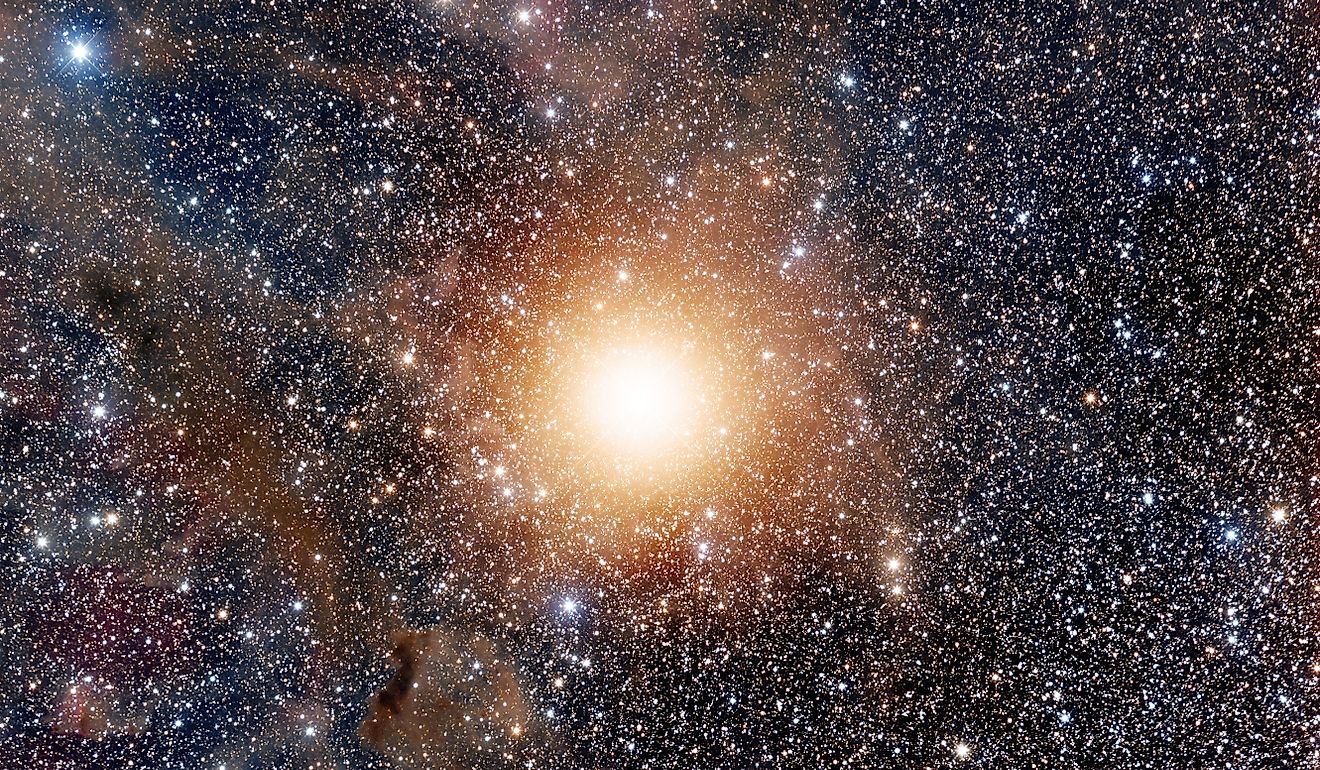
With a diameter of approximately 865,000 miles, the sun is 100 times wider than Earth. Yet, it is only an average-sized star. Scientists have found stars 100 times larger than our sun. In stellar terms, a dwarf star is one still fusing hydrogen on the main sequence, as opposed to the swollen giants and supergiants that stars become later in life. Because the sun sits in that ordinary main-sequence range rather than among the giants, it is classified as a dwarf star.
The yellow classification is a bit more complex, since we know that the sun is actually white. As it turns out, "yellow" dwarf stars can be either yellow or white. What these stars have in common is their size. They are all between 0.84 and 1.15 times the mass of our star, the sun. So the term "yellow dwarf star" really just indicates "medium-sized star."
The Bottom Line

The short answer to why the sun is yellow is that, actually, it is not yellow; it is white. Space exploration has produced vivid photographs of the sun glimmering bright white against the stark, black backdrop of the universe. When the sun's white light bumps into gases and particles in our atmosphere, it shatters into the individual colors of the rainbow, which have different wavelengths. The colors with the shortest wavelengths, like violet and blue, are scattered the farthest throughout our atmosphere, leaving us to see the sun as yellow. While artists, weather forecasters, and children alike continue to color the sun yellow, now you know the truth. The sun is actually a brilliant, glistening, hot ball of white light.