Why Can't We See the Edge of the Universe?
The universe has no confirmed edge that any telescope has found, and the leading scientific consensus holds that no edge exists at all. What science can describe is an observational horizon: the maximum distance from which light has had enough time to reach Earth since the universe began. Beyond that horizon, space almost certainly continues, and if an edge to the universe were to exist, cosmological constraints would make that boundary fundamentally unobservable.
Four separate reasons explain why an edge, even if real, could never be seen. Space itself has been stretching bigger since the universe began, carrying distant objects farther away with every passing second. An ancient wall of light marks the earliest moment anything became detectable at all, sealing off everything before it. Light travels fast, but it still takes time to cross a universe that keeps expanding while that light is in transit. And beyond all of that, a mysterious force called dark energy is stretching space faster and faster, sealing off more of the universe forever.
Together each cosmic restraint defines not just why the edge has not been seen, but why it cannot be.
The Big Bang Started the Clock

The Big Bang, currently the most widely accepted theory among scientists explaining the start of the universe, occurred about 13.8 billion years ago. At that instant, everything, all of space, time, and matter, started expanding from an incredibly hot, tightly packed point. That single starting moment matters because it set a stopwatch running. As space expanded, it carried galaxies farther apart, a process that continues today and is one reason that, even if the universe had a physical edge, it could never be seen.
The Speed of Light Sets a Limit on What Can Be Seen

The most fundamental barrier to seeing beyond the observable horizon of the universe is that light is not instantaneous. It travels at a fixed speed of approximately 186,282 miles per second (299,792,458 meters per second). That's fast enough to circle the entire Earth seven and a half times in a single second. But, even the speed of light has a limit, and the universe has only existed for a finite amount of time. The scientific community's current best estimate for that age is 13.8 billion years.
Because light takes time to travel, every observation is a glimpse into the past. The light arriving from a galaxy one billion light-years away left that galaxy one billion years ago. The most distant individual galaxies ever detected by the James Webb Space Telescope sent their light toward Earth when the universe was still in its earliest stages of structure formation. This galaxy is JADES-Gs-z14-0, confirmed in 2024 by an international team. That galaxy's light has been traveling toward Earth for about 13.5 billion years.
No instrument can receive information faster than light delivers it, which means the observable universe has a hard outer boundary. This is not a physical wall, but a temporal one. Beyond a certain distance in space, there has simply not been enough time for light to make the journey. What exists beyond the seeable horizon is entirely beyond observable detection.
Cosmic Microwave Background: The Second Barrier

In addition to the limits imposed by the speed of light, there is a second barrier. This one is absolute regardless of how powerful future instruments become. The farthest back any telescope has ever looked is not at a galaxy. It is a faint, structured glow of microwave radiation that covers space uniformly in every direction, known as the cosmic microwave background, or CMB. This radiation marks the oldest light that physically exists as a detectable signal in the universe. It forms an observational horizon that no instrument can penetrate.
Current measurements of the cosmic microwave background, most recently by the Planck satellite and the Atacama Cosmology Telescope, show that the universe is geometrically flat on the largest measurable scales. This would mean the universe has no boundary and no center. Every point in it is equivalent to every other point, and the distances between all points are increasing uniformly. They are not expanding outward toward some frontier, but stretching in place, the way every point on an infinite sheet of paper would move away from every other point if the sheet were being stretched simultaneously in all directions.
The Big Bang model describes the early universe as a violently hot, crushing soup of superheated plasma. For the first 380,000 years after the universe began, the cosmos was so energetic that electrons and protons could not combine into neutral atoms. In that state, photons, particles of light, were constantly scattering off free electrons, unable to travel in straight lines. This environment functioned like a blinding, ultra-dense fog that completely scatters the headlights of a car, rendering the early universe entirely opaque. When the universe cooled enough for neutral hydrogen to form, the cosmic fog cleared, and light broke free. Photons streamed freely for the first time, and that release of ancient light is what is detected today as the CMB.
What this means for the edge question is that beyond the CMB, earlier in time and farther in distance, there is nothing to detect. Not because space does not exist there, but because the physics of that era prevented any signal from escaping. The CMB sits at the absolute observational horizon. It is the earliest moment the universe became transparent, and there is not an instrument, at any wavelength, that can look past it.
Space Itself is Expanding: The Third Limit

The universe is not a giant, empty room that galaxies fly through. Space itself is expanding, and that expansion has been underway since the beginning. As a result, the distance between any two galaxies keeps growing. For some galaxies, light still eventually crosses that widening gap and reaches our telescopes, just later than it would in a static universe. But for the most distant galaxies, the gap widens faster than light can cross it, meaning their light will never arrive at all.
A common comparison is raisin bread rising in an oven. The raisins do not move through the dough, but instead the dough expands between them, carrying every raisin farther from the other regardless of direction. In this analogy, the dough is space and the raisins are galaxies. No galaxy is at the center of the expansion. Every galaxy is moving away from every other galaxy simply because the space between them is stretching.
Einstein's theory of relativity says that nothing with mass can move through space faster than the speed of light. However, there is no speed limit on how fast space itself can stretch. Because of this, galaxies beyond a threshold known as the Hubble distance, about 14 billion light-years away, are being carried away from Earth faster than light can travel. This means the space between Earth and those galaxies is stretching faster than light can cross it.
This fact, that space itself has no speed limit to its expansion, is also the reason the observable universe is much bigger than its age would suggest. The volume of space has expanded so drastically over the 13.8 billion years this light has been traveling that the objects emitting it are no longer nearby. While that light traveled toward Earth, space expanded so dramatically around it that those objects now sit about 46.5 billion light-years away in every direction. That observable universe, the sphere within which any light could theoretically have reached Earth, has an estimated radius of 46.5 billion light-years. This gives the entire observable bubble a total diameter of approximately 93 billion light-years.
If you could drive a car straight into space at 65 miles per hour, it would take you about six months to reach the Moon. Yet, if you stepped into a spaceship traveling at the speed of light for 93 billion years, you would still never find a physical brick wall or cosmic drop-off. The leading scientific consensus is mind-boggling: the universe has no edge at all.
Dark Energy's Accelerating Force: The Fourth Limit

The mystery deepens because the universe is not just expanding, it is also accelerating. Dark energy is the name scientists give to a mysterious, repulsive form of energy that appears to fill all of space and push it apart, rather than pulling it together the way gravity does. The existence of dark energy is causing the expansion of the universe to accelerate over time, stretching the space between galaxies faster and faster until the most distant ones are carried beyond the cosmological event horizon. This is the point past which no signal they emit can ever reach Earth.
In the late 1990s, two independent research teams using NASA's Hubble Space Telescope studied distant type Ia supernovae, a class of stellar explosion reliable enough to serve as a cosmic distance marker. They found that the universe's expansion is not decelerating as gravity would suggest. Instead, it is accelerating. The force responsible is dark energy. It accounts for approximately 68 percent of the total energy content of the universe according to current models. Its fundamental nature remains one of the most significant unsolved problems in physics. NASA describes the discovery as having fundamentally changed cosmology's understanding of the universe's fate.
What makes dark energy especially consequential for the edge question is not merely that it exists, but what it does over time. Current modeling supports that dark energy causes the rate of expansion to compound, meaning the universe is not just expanding, but expanding ever more rapidly with each passing era.
This accelerating stretch of the universe creates an observational boundary, the cosmological event horizon, currently estimated at roughly 17 billion light-years away. Beyond that distance, dark energy is driving the expansion of space faster than light can travel across it.
Any light emitted from beyond that threshold today will never reach Earth. Not because anything is physically blocking it, but because the space it needs to cross is being stretched out faster than light can travel. This is dark energy operating as a kind of one-way valve on the observable universe. Matter and radiation on the far side of that horizon are not gone, but the channel through which any signal from them could arrive is closed permanently.
The Observable Horizon is Different Depending on Your Position in the Universe
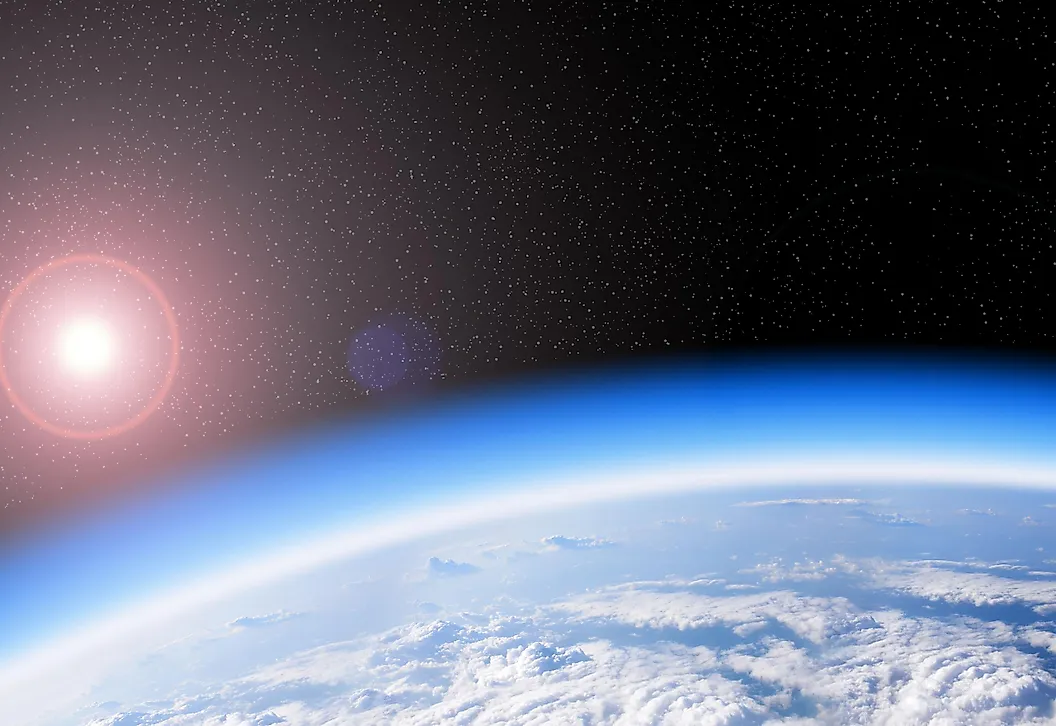
If an edge of the universe were to exist, the reason it could not be seen is not only because of distance, time, or accelerating expansion driven by dark energy. It is also because the concept of a single, universal edge does not exist.
The observable universe, the space from which light has had time to reach Earth, is not a fixed object that looks the same way for every observer. It is observer-dependent. Every point in the universe has its own observable region, centered on its own location, extending at an accelerating rate 46.5 billion light-years in every direction from that specific point.
A hypothetical observer in a galaxy 10 billion light-years from Earth would have a completely different 93 billion-light-year bubble of observable space centered on their own position. They would have their own particle horizon CMB boundary, meaning that observer would see galaxies that are completely invisible from Earth, while Earth instruments could detect galaxies that are forever hidden from them. Neither observer is closer to an edge. Neither occupies a more central or more peripheral position. No observer, anywhere in the universe, would be able to see past their own horizon to see what lies beyond.
The Universe's Edge: An Infinitely Concealed Boundary
If a true edge of the universe exists, it cannot be seen due to cosmological constraints, each one absolute on its own terms.
Light travels at a fixed speed, and the universe has existed for a finite time. This means there is a hard ceiling on how far back in time, and therefore how far out in space, any observation can reach. Space has been expanding throughout the entire journey of any traveling light. Which is why the observable universe spans 93 billion light-years despite being only 13.8 billion years old, and why the most distant detectable objects are now far beyond the distances their light has traveled.
A wall of ancient radiation marks the furthest point any signal can come from, because before 380,000 years after the universe began, the cosmos was too opaque for light to travel at all. Accelerating expansion driven by dark energy is actively carrying more of the cosmos past a point of no return, ensuring that the observable universe is shrinking rather than growing. And much of what exists will never be detected from Earth's position. Finally, the concept of a single edge of the universe does not exist as different positions within the universe have their own finite observational boundaries.
Ultimately, if a hard boundary of the universe were to exist, the laws of physics simply would not permit the universe's edge to be seen. It would remain a boundary ever concealed from observation.