The State Parks With Mineral Springs
Not every remarkable spring is hot, and not every hot spring is found in a national park. Across the United States, several official state parks protect mineral springs that couldn't be more different from one another. Montana protects a spring that releases more than 156 million gallons of water every day, Wyoming lets visitors soak for free in naturally heated 127°F mineral water, while one New York state park is famous for naturally carbonated mineral water that bubbles to the surface on its own. What connects these state parks is geology. As groundwater moves through underground rock, it dissolves minerals before returning to the surface as a mineral spring. Whether visitors can swim, soak, or simply admire them depends on the park, but each offers a completely different window into the processes happening beneath our feet.
Giant Springs State Park, Montana

Every day, more than 156 million gallons of water surge out of the ground at Giant Springs State Park, making it one of the largest freshwater springs in the United States. The spring isn't geothermal, but it is remarkably consistent. Rain and snow that fell in the Little Belt Mountains slowly seep into the Madison Aquifer, where the groundwater spends about 26 years moving through underground limestone before emerging near Great Falls at a constant 54°F (12°C) year-round. The spring was first documented by the Lewis and Clark Expedition in 1805 and remains the centerpiece of one of Montana's most visited state parks.
Unlike some of the parks on this list, swimming and bathing are not permitted at Giant Springs, helping protect the spring's exceptionally clear water and sensitive aquatic habitat. Instead, visitors can cross pedestrian bridges overlooking the spring basin, walk the Rivers Edge Trail along the Missouri River, visit the adjacent Montana Fish Technology Center, or stop at the nearby Lewis and Clark Interpretive Center. The park is also home to the Roe River, once recognized by Guinness World Records as the world's shortest river before the category was retired. As of 2026, non-residents pay $8 per vehicle for day use, while Montana residents who participate in the state parks vehicle registration program enter without an additional fee.
Hot Springs State Park, Wyoming

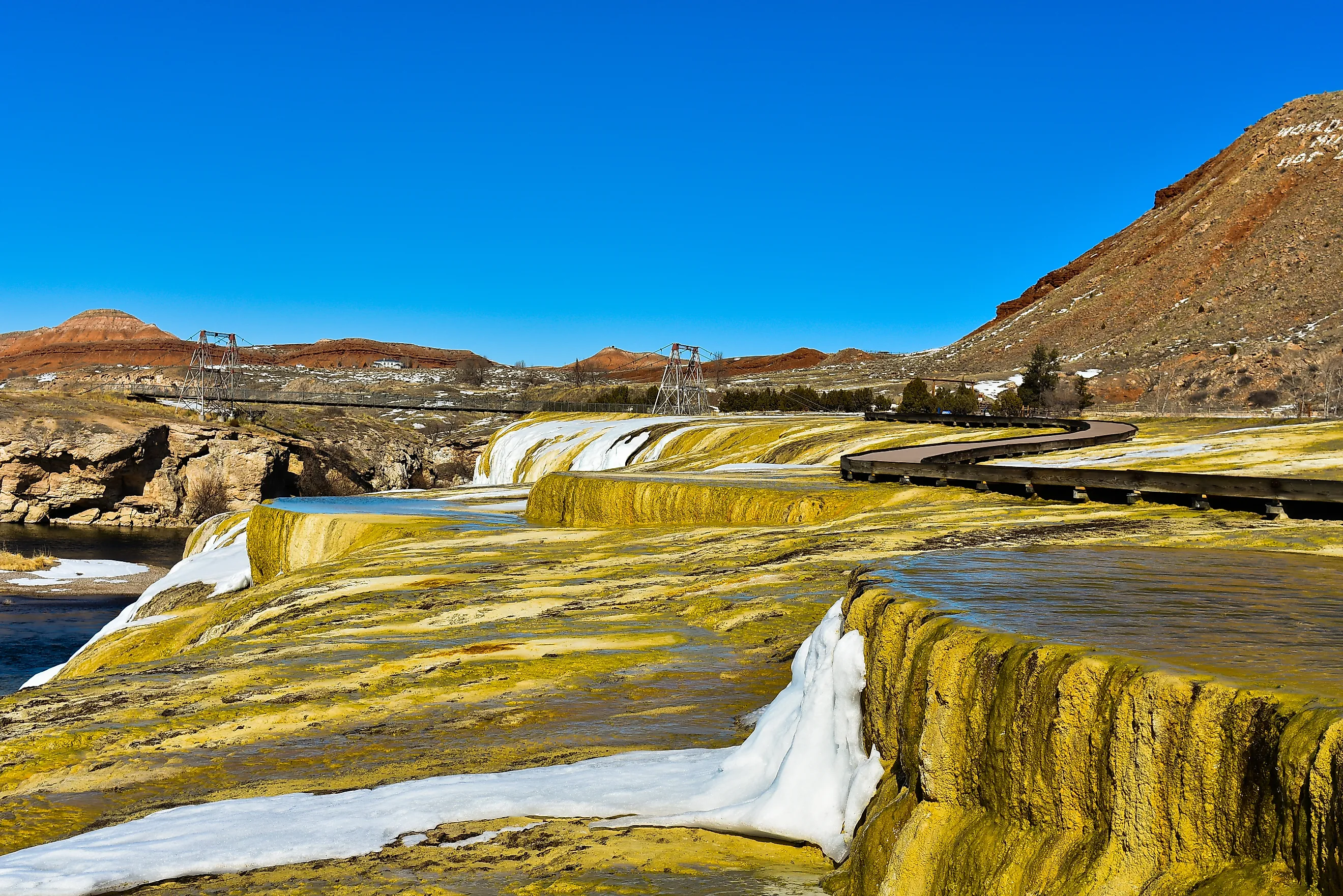
The shimmering water emerging at Hot Springs State Park begins its journey deep underground before reaching the surface at a constant 127°F (53°C). By the time it spills over the park's colorful Rainbow Terraces, it has become saturated with dissolved minerals that slowly build layers of white, orange, and tan travertine. The spring has drawn people here for centuries. The Eastern Shoshone and Northern Arapaho considered the area sacred, and when the land was ceded to the United States in 1896, the agreement required that the mineral waters remain free for public use forever.
Today, Hot Springs State Park is Wyoming's oldest state park and one of the few places in the country where visitors can still soak in naturally heated mineral water without paying admission. Unlike Giant Springs, bathing is encouraged here, but only in designated facilities. The mineral water is cooled from its natural 127°F to approximately 104°F (40°C) before entering the State Bath House, where visitors receive free therapeutic soaks. Towel and swimsuit rentals are available for a small fee. Soaking in the natural spring itself is prohibited for safety reasons. Beyond the bathhouse, visitors can walk more than 6 miles of trails, cross the Bighorn River, and view the park's resident bison herd.
Berkeley Springs State Park, West Virginia

Long before it became one of America's smallest state parks, people were traveling to Berkeley Springs specifically for its water. Indigenous peoples regarded the warm mineral springs as a place of healing centuries before European settlement, and by the 1700s, visitors were arriving from across the colonies. This includes none other than George Washington, who first visited as a teenager in 1748 and later helped establish the town of Bath around the springs.
The spring flows at a constant 74.3°F (23.5°C), producing roughly 2,000 gallons of clear mineral water every minute, naturally enriched as groundwater moves through the surrounding limestone before emerging in the center of town. Guests can reserve a soak in the historic Old Roman Bath House, where private tubs are filled directly from the spring and heated to 102°F, cool off in the spring-fed outdoor pool during the summer, or simply wade in the free public spring that flows through the West Virginia park year-round at its natural temperature.
Today, Berkeley Springs State Park protects the same mineral water that made the town famous, and visitors can experience it free of charge. However, the Roman Baths and other spa services like hot stone massages are available by reservation and for an additional fee.
Indian Springs State Park, Georgia

By the early 1800s, the area now known as Indian Springs State Park had grown into one of the South's most popular resort destinations, and today it protects what Georgia calls one of the oldest state parks in the nation. The park's natural artesian mineral spring continues to flow through the historic CCC-built Spring House, where visitors can still sample the sulfur-rich water free of charge. As groundwater rises under natural pressure, it dissolves minerals from the surrounding rock, giving the spring its distinctive taste and unmistakable sulfur smell.
For centuries, the Muscogee (Creek) regarded the spring as a place of healing, collecting its naturally flowing mineral water centuries before European settlers arrived. Today, bathing in the mineral spring itself is not permitted. Instead, visitors fill bottles directly from the spring before exploring the park's 528 acres, which include Chief McIntosh Lake and more than 4 miles of hiking and biking trails.
Saratoga Spa State Park, New York

Unlike most mineral springs, the water at Saratoga Spa State Park arrives at the surface naturally carbonated. As groundwater rises through deep underground faults, it absorbs dissolved minerals and carbon dioxide before emerging as effervescent mineral water that has attracted visitors to Saratoga Springs for more than two centuries. The area's naturally sparkling springs transformed the city into one of America's premier spa destinations during the 1800s, and today the 2,379-acre state park preserves many of those historic springs alongside bathhouses, trails, and one of the country's best-known mineral spa complexes.
Unlike Hot Springs State Park, where visitors soak in naturally heated water, Saratoga's springs emerge cold, typically around 50-55°F (10-13°C). Several remain accessible for tasting, including the famous Geyser Island Spouter, where naturally pressurized mineral water continuously sprays into the air, and the Orenda Spring, whose high mineral content leaves striking orange deposits around its stone basin. Visitors can also book and pay for mineral baths at the historic Roosevelt Baths & Spa.
De Leon Springs State Park, Florida

Approximately 17 million gallons of water surge out of the headspring at De Leon Springs State Park every single day, creating a visible "boil" where groundwater rises through the limestone before flowing into Spring Garden Run. The water reaches the surface at a constant 72°F (22°C) after filtering through Florida's vast Floridian Aquifer.
Long before the park took its current name, the Mayaca people called the spring Acuera, or "Healing Waters." Later, the spring powered an eighteenth-century sugar plantation and a Civil War grist mill and attracted visitors such as famed naturalist John James Audubon, who described the spring in his journal during an 1831 visit.
Swimming is one of De Leon Springs' biggest attractions. Visitors can cool off directly in the spring's clear water, kayak or paddle the spring run, join guided eco-tours, or stop at the historic Old Spanish Sugar Mill Grill & Griddle House. The park also preserves archaeological sites dating back thousands of years, including a remarkably preserved dugout canoe recovered from the spring. In 2026, admission is $6 per vehicle (2-8 people), $4 per single-occupant vehicle, and $2 per pedestrian or bicyclist.
Grover Hot Springs State Park, California

Unlike the steaming terraces of Wyoming or the carbonated springs of Saratoga, Grover Hot Springs State Park sits high in California's Sierra Nevada, where six natural mineral springs emerge at the base of the mountains before feeding a soaking pool surrounded by trees and alpine meadows. The springs are naturally heated as groundwater circulates deep underground through fractures in the Earth's crust, dissolving minerals before returning to the surface. Located at an elevation of nearly 5,900 feet, the park offers a very different mineral spring experience from the desert and prairie landscapes in other U.S. state parks.
Visitors can soak in the park's mineral water, though not directly at the spring. Instead, the water is piped into a developed mineral pool where temperatures are maintained for safe bathing. As of 2026, California charges an $8 day-use vehicle fee, while admission to the mineral pool is $10 for adults and $5 for children. Seasonal operations and pool availability can vary, so visitors should be sure to check California State Parks before planning a trip.
Gaviota State Park, California

Most people come to Gaviota State Park for its rugged Pacific coastline, historic pier, and uncrowded beach. Fewer realize that hidden in the park's backcountry is one of California's natural sulfur hot springs. Reached by a short hike of about half a mile from the trailhead, the springs emerge from the hillside at temperatures that have historically approached 100°F (38°C) before collecting in a series of small soaking pools. As the groundwater rises through underground rock, it dissolves sulfur and other naturally occurring minerals, giving the water its distinctive smell and qualifying it as a true mineral spring.
Unlike developed bathhouses in state parks elsewhere across the U.S., Gaviota offers a much more rustic experience surrounded by oak woodland and coastal canyon scenery. Visitors who reach the springs find a natural pool with water levels and temperatures that can vary with seasonal rainfall and drought conditions. California charges a $10 day-use vehicle fee, although hikers entering on foot do not pay the vehicle entrance fee. Before visiting, California State Parks recommends checking current trail conditions, as storms, erosion, or wildfire recovery efforts can periodically affect access to the hot springs.
America's Many Mineral Springs
Whether it's soaking in Wyoming's naturally heated waters, sampling sulfur-rich spring water in Georgia, watching carbonated water bubble up in Saratoga Springs, or standing beside one of the country's largest freshwater springs in Montana, these state parks showcase just how varied mineral springs can be across America. Some actually invite visitors into the water. Others simply invite them to appreciate the remarkable geology that brought these springs to the surface. Either way, they prove to be one of the best tourist attractions in U.S. state parks.