The Most Snake Infested Rivers In North Carolina
North Carolina is home to 40 different species of snakes, but some of them are more adapted to rivers and wetlands than others. There are four species of nonvenomous water snakes, and one species of venomous cottonmouth, which are often confused for each other due to similar appearances and habitat preferences. Some species even have specialized teeth for consuming crayfish. The Cape Fear, Neuse, Tar-Pamlico, and lower Roanoke Rivers provide extensive wetland habitats where these snakes hunt, bask, and reproduce.
Cape Fear River

The Cape Fear River is part of the largest river basin entirely within North Carolina, covering approximately 9,000 square miles, an area comparable to New Jersey. The river is formed by the confluence of the Deep and Haw Rivers and flows approximately 202 miles (325 kilometers) across the Piedmont and Coastal Plain before reaching the Atlantic Ocean.
Along its lower reaches and tributaries, the river system supports extensive bald cypress swamps, bottomland hardwood forests, and freshwater marshes. Farther downstream, tidal freshwater wetlands give way to brackish and saltwater habitats.
Several specialized snakes inhabit the Cape Fear River Basin, including the Carolina swamp snake (Seminatrix pygaea paludis), glossy crayfish snake (Liodytes rigida), and common rainbow snake (Farancia erytrogramma). These nonvenomous species inhabit swamps, ponds, and slow-moving waterways with abundant vegetation and submerged debris. The glossy crayfish snake is particularly unusual, possessing stout, chisel-like teeth that help it grip hard-shelled crayfish.
Neuse River

The Neuse River is the longest river entirely within North Carolina, flowing approximately 250 miles (402 kilometers) from the Piedmont to Pamlico Sound. Along its lower reaches, the river passes through extensive bottomland hardwood forests, cypress swamps, and wetlands that provide habitat for several semiaquatic snake species.
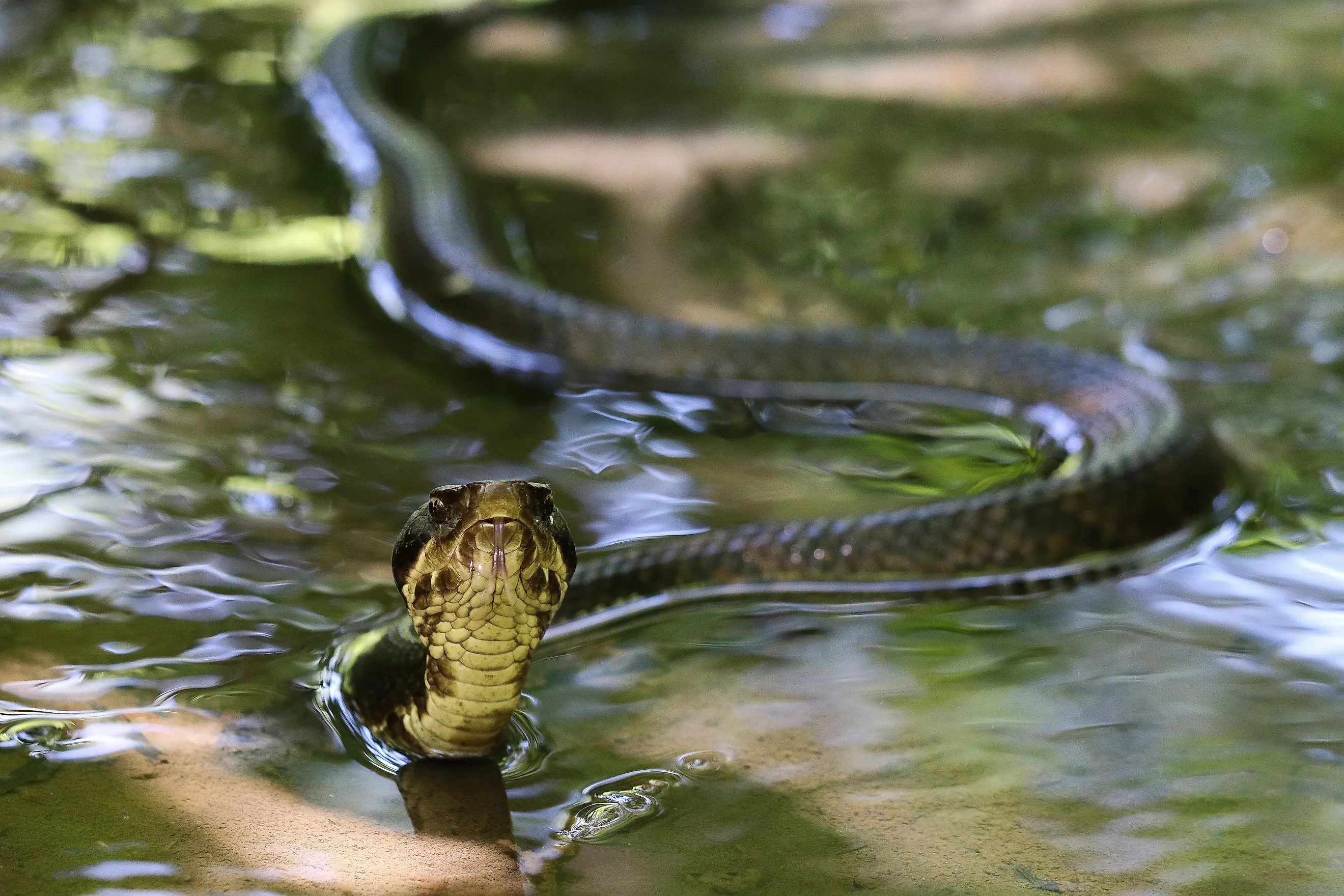
Two snakes found in the Neuse River's Coastal Plain are often mistaken for one another. The brown water snake (Nerodia taxispilota) and cottonmouth (Agkistrodon piscivorus) are both heavy-bodied snakes with dark coloration, although only the cottonmouth is venomous. Brown water snakes have distinctive square-shaped blotches along their backs, while cottonmouths typically have dark crossbands that may become difficult to distinguish as they age.
Both species spend considerable time near water, often basking on logs, branches, or vegetation along riverbanks. Brown water snakes are particularly associated with large rivers and streams, where they feed primarily on fish, including catfish. Cottonmouths have a broader diet that includes fish, amphibians, crayfish, and other small animals. Both inhabit the lower Neuse River and its surrounding wetlands, although cottonmouths are less associated with the river's upper Piedmont reaches.
Tar-Pamlico River

The Tar-Pamlico River system consists of two ecologically distinct stretches of the same river. The Tar River originates in the Piedmont near Roxboro and flows southeast through the Coastal Plain. Near Washington, it widens and becomes the tidal Pamlico River, eventually emptying into Pamlico Sound. The basin covers more than 6,000 square miles of forests, wetlands, agricultural land, and waterways.
The system's freshwater swamps and slow-moving tributaries provide habitat for several snakes that prey on fish, amphibians, and crayfish. Among them is the glossy crayfish snake, which specializes in catching crayfish, including those with hardened shells. The Carolina swamp snake also inhabits vegetated wetlands, feeding on small fish, tadpoles, leeches, and salamander larvae.
Near Pamlico Sound, brackish marshes and tidal creeks provide habitat for the Carolina water snake (Nerodia sipedon williamengelsi), a distinctive form of the northern water snake. Unlike its relatives found across much of North Carolina, this subspecies is associated primarily with coastal marshes and tidal waters around Pamlico Sound. It is listed as a Species of Special Concern in the state.
Lower Roanoke River

The Roanoke River rises in Virginia's Blue Ridge Mountains and flows approximately 410 miles (660 kilometers) before emptying into Albemarle Sound in North Carolina. Its lower reaches pass through extensive bottomland hardwood forests and cypress-tupelo wetlands, including the Roanoke River National Wildlife Refuge.
Herpetofauna inventories conducted in the lower Roanoke River region since 1996 had identified 18 snake species by 2013. These include several nonvenomous water snakes, such as the northern water snake (Nerodia sipedon), brown water snake, banded water snake (Nerodia fasciata), and red-bellied water snake (Nerodia erythrogaster).
The region also supports three venomous snakes: the cottonmouth, copperhead, (Agkistrodon contortrix), and ttimber rattlesnake (Crotalus horridus). Cottonmouths are particularly associated with wetland habitats, while copperheads and timber rattlesnakes are more frequently encountered in adjoining forested areas and drier ground. Timber rattlesnakes are listed as a Species of Special Concern in North Carolina.
The extensive floodplain provides suitable habitat for aquatic snakes, with fallen trees, submerged vegetation, and slow-moving backwaters offering shelter and hunting opportunities. The diversity of habitats helps explain why so many snake species have been documented along this portion of the river.
North Carolina's Specialized River Snakes
North Carolina's rivers support an assortment of snakes adapted to life in and around water. Some, like the glossy crayfish snake, are specialized hunters, while others, like the cottonmouth, consume a wide variety of aquatic and terrestrial prey.
Although cottonmouths and harmless water snakes are frequently confused, most snakes avoid confrontation when given sufficient space. Cottonmouths are venomous and should never be approached or handled, but encounters rarely result in bites when the animals are left undisturbed.
The Cape Fear, Neuse, Tar-Pamlico, and lower Roanoke Rivers offer extensive habitats for these species, particularly in their swampy Coastal Plain stretches. The same dense vegetation and submerged debris that make the rivers difficult to explore also provide shelter for snakes that may remain completely hidden just a few feet from the shoreline.