Where Salamanders Go When Ponds Freeze
When ponds freeze in winter, some salamanders are already tucked away underground, while others remain in the water beneath the ice. Salamanders are amphibians, but not all species divide their time between land and water. Mudpuppies and lesser sirens spend their entire lives underwater, even during the coldest months. Spotted salamanders, meanwhile, live primarily on land and return to ponds to breed. Eastern newts may winter on land or underwater, depending on their stage of life and environmental conditions. Here's how these unique species survive the winter freeze.
Living Underwater Through Winter

A layer of ice does on a pond might actually still have unfrozen water beneath. Freshwater is densest at about 39°F, so water at that temperature sinks while colder water stays near the top and eventually freezes. The deeper water can remain liquid, providing aquatic salamanders with a winter habitat. However, shallow ponds can sometimes freeze all the way to the bottom, leaving little or no unfrozen water for animals to inhabit.
Mudpuppies (Necturus maculosus) spend their entire lives in lakes, rivers, and streams across the eastern and central United States. They never leave the water and retain their external gills as adults. Mudpuppies usually remain active during winter, moving along the bottom of lakes and rivers in search of prey like aquatic insects, worms, and crayfish. As long as the water remains unfrozen and contains enough dissolved oxygen, they can continue living under the ice. However, oxygen levels can drop beneath a layer of ice, especially if snow blocks sunlight or decaying plant matter uses up oxygen.
Meanwhile, lesser sirens (Siren intermedia) are aquatic salamanders that also spend their entire lives in water. They live in ponds, marshes, swamps, and other slow-moving bodies of water across parts of the eastern and central United States and into northeastern Mexico. Their long, eel-like bodies have tiny front legs but no hind legs, and they retain external gills throughout their lives. When ponds freeze, lesser sirens can survive in the unfrozen water below the ice, often sheltering among submerged vegetation and bottom mud. Their activity slows as water temperatures fall, and they may spend extended periods concealed in these protected areas. Lesser sirens are also capable of surviving drought by burrowing into mud and forming a protective mucus cocoon, although this adaptation primarily protects them from drying out rather than freezing.
Eastern newts (Notophthalmus viridescens) winter on land or underwater, depending on their stage of life and local conditions. Juveniles, known as red efts, are bright orange or reddish, with black-bordered red spots, while aquatic adults are olive green or brownish with yellow bellies. Red efts shelter beneath logs, rocks, and fallen leaves in damp forests. During winter, they hide in protected spaces, sometimes below ground, where they can avoid freezing temperatures and drying out. During their aquatic adult stage, eastern newts live in ponds, lakes, and slow-moving water. When ice forms on the surface, aquatic adults can stay in the unfrozen water below, where colder temperatures generally slow their metabolism. Some even remain active beneath the ice.
Hiding Underground Until Spring

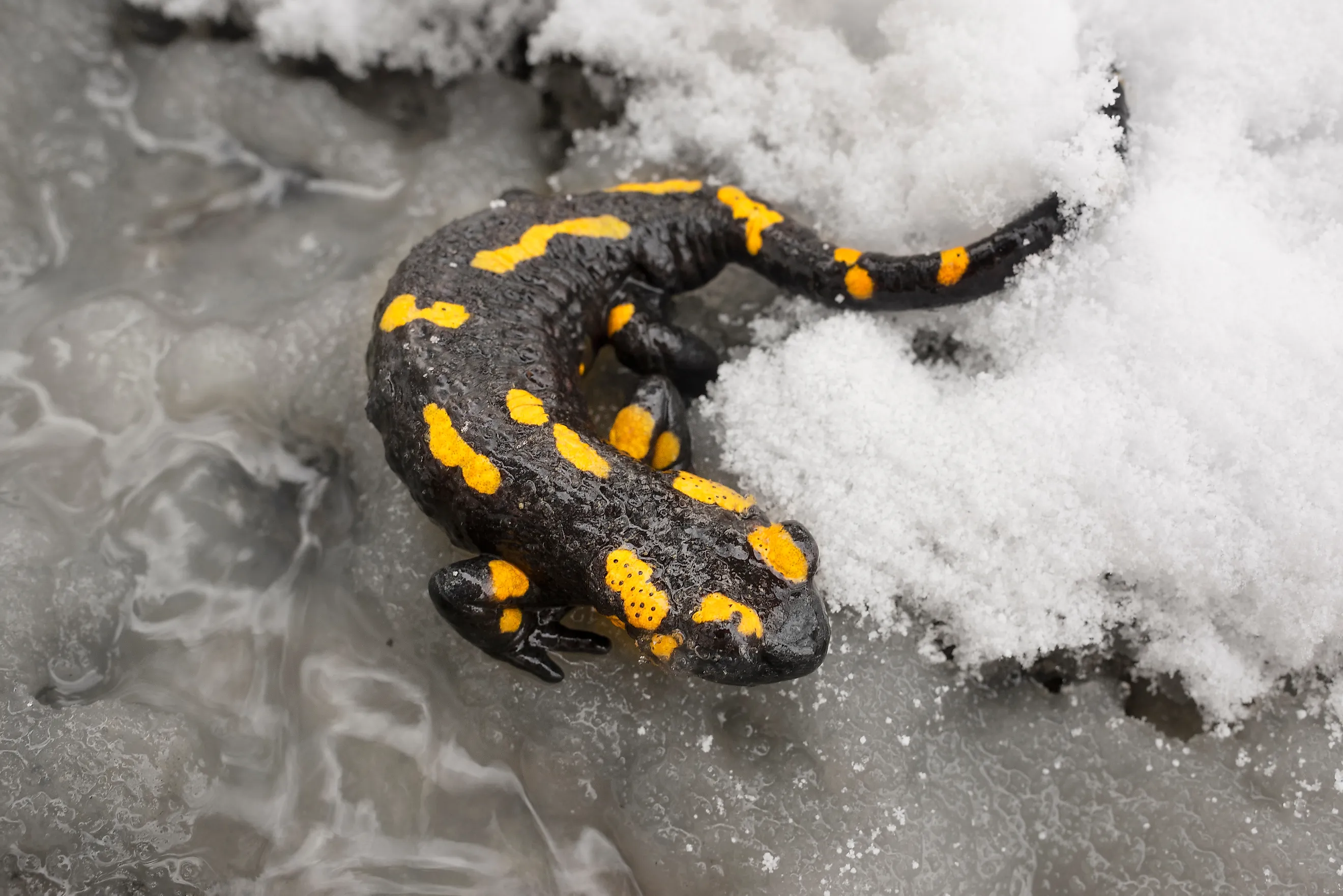
Spotted salamanders (Ambystoma maculatum) are usually nowhere near their breeding ponds when winter arrives. They have already retreated into the forest, where they shelter in abandoned burrows and other underground spaces. Below the frost line, temperatures can remain above freezing even when snow and ice cover the surface. Spotted salamanders live across the eastern United States and stay hidden underground for most of the year, emerging to breed in ponds when conditions are right. They generally prefer shallow, fish-free woodland ponds, including temporary vernal pools, where their eggs and larvae face fewer aquatic predators.
Eastern tiger salamanders (Ambystoma tigrinum) also spend most of their lives underground. They live in grasslands, woodlands, and other habitats near breeding ponds. They may dig into suitable soil or use burrows made by other animals, sometimes staying out of sight for months at a time. When winter arrives, their underground shelters provide protection from freezing temperatures. Like spotted salamanders, they generally return to ponds during wetter, milder weather to breed.
Do Salamanders Hibernate?

As cold-blooded creatures, salamanders cannot regulate their body temperature the way mammals do. When the weather gets colder, their bodies cool down too. Their metabolism slows, and they need less food and energy.
Many salamanders wintering on land experience a state of reduced activity often called brumation. It resembles hibernation, although the term is commonly used to describe winter inactivity in cold-blooded animals. A salamander in brumation may remain hidden for weeks or months, but it is not necessarily asleep the entire time. Some salamanders become active during warmer spells, especially when the ground is damp and temperatures rise above freezing. Others remain sheltered until spring.
Temperature is not the only concern. Salamanders have thin, permeable skin that allows water and gases to pass through it. They can lose moisture through their skin, so their winter hiding places need to protect them from drying out as well as freezing. A damp underground burrow or crevice can provide both. Even when the air above ground is bitterly cold and dry, the soil below may remain moist.
Salamanders can tolerate cold temperatures, but most cannot survive having their bodies freeze. Ice forming inside their tissues can damage cells and organs, which is why finding a protected winter shelter is so important. While a few salamander species outside North America have evolved remarkable freeze tolerance, most species found in the United States survive by avoiding freezing conditions altogether.
Many other species survive winter in streams and forests rather than ponds. Hellbenders (Cryptobranchus alleganiensis), North America's largest salamanders, spend their lives in cool, fast-flowing streams in the Appalachian Mountains and parts of the Midwest. Even in freezing weather, they shelter beneath rocks in the streambed, where the flowing water generally remains unfrozen. In forests throughout the Northeast and Appalachian region, eastern red-backed salamanders (Plethodon cinereus) retreat into underground crevices and soil as temperatures fall. Both avoid the worst of the winter cold without depending on ponds for shelter.
When Do Salamanders Become Active Again?

There is no single time when salamanders come out of their winter shelters. The timing depends on species, local climate, and weather conditions. Some begin moving before winter ends, while others stay underground until spring. A few warm days do not necessarily mean winter is over. Salamanders that emerge during a thaw may go back underground if freezing temperatures return.
Spotted salamanders , for example, usually emerge when temperatures rise and rainy nights return. In colder northern areas, this generally happens in spring, as the ground begins to thaw. Farther south, they may come out during mild winter weather, sometimes traveling by the hundreds to vernal pools and woodland ponds to breed. These seasonal migrations are often among the few opportunities to see spotted salamanders above ground, as they spend most of their lives concealed in the soil.
Aquatic salamanders may follow a different schedule. Mudpuppies can remain active throughout winter, while adult eastern newts may continue swimming and feeding beneath the ice. For these species, the arrival of warmer weather generally increases activity rather than marking the end of a complete winter dormancy.
Frozen Ponds Are Not Really Empty
A frozen pond may look deserted, but mudpuppies could be hunting along the bottom, lesser sirens sheltering among submerged vegetation, or adult newts moving through the cold water. Meanwhile, spotted salamanders are tucked away in underground burrows in the surrounding woods, waiting for suitable weather to return. Although their winter habitats differ, these salamanders survive the cold by finding places where they can avoid freezing, conserve energy, and remain protected until warmer conditions return.