US States With the Most Snake Species
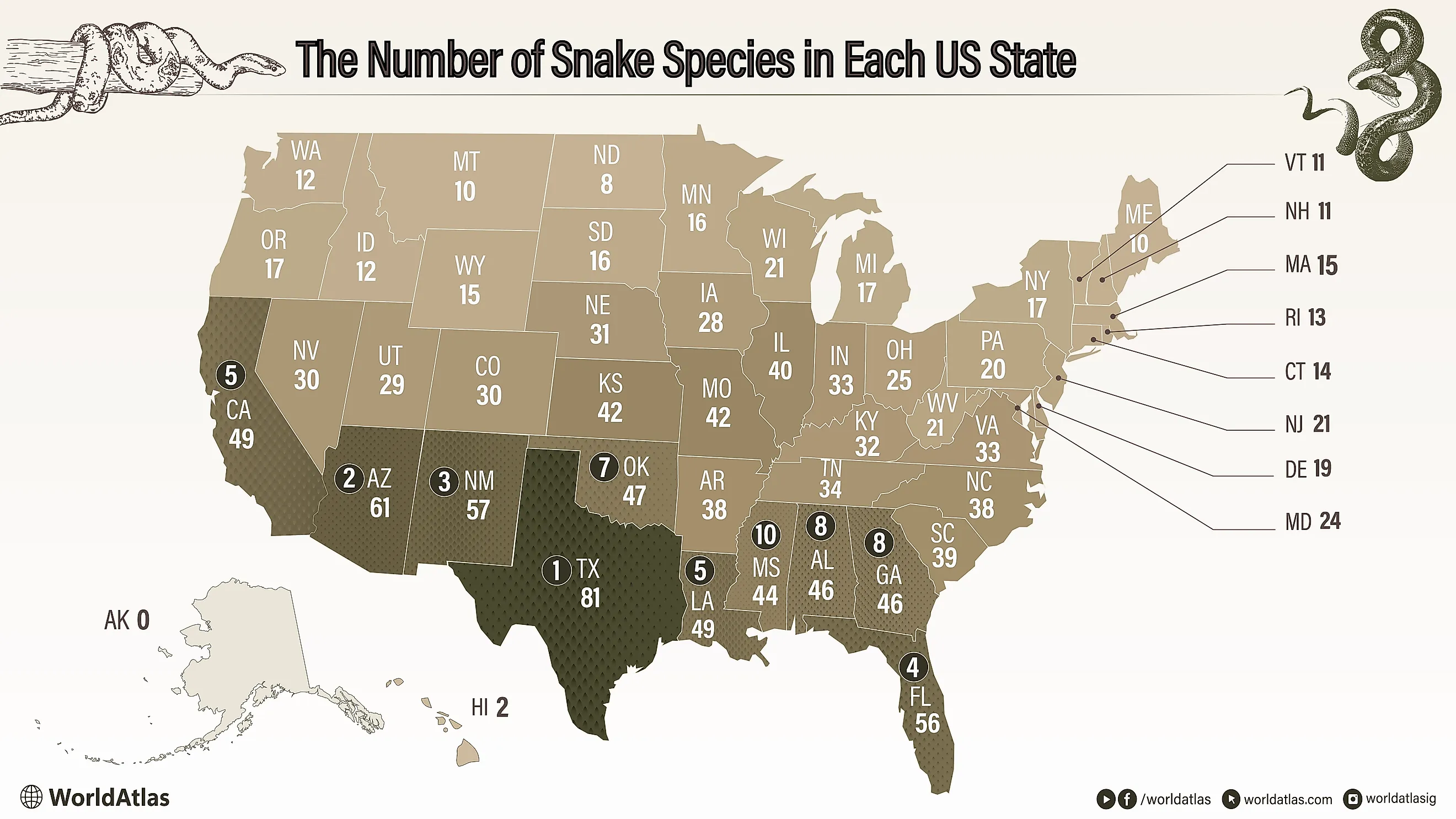
Alaska has no wild snakes at all, according to the Alaska Department of Fish and Game, and North Dakota has eight species. Texas has 81. The states with the most snake species line the country's southern edge, and eight of the top 10 touch either the Mexican border or the Gulf Coast. Reptiles depend on outside heat to regulate their body temperature, and reptile diversity rises toward warmer, lower latitudes and runs especially high in North American deserts.
Within those southern states, the counts climb highest where one kind of country runs into another. Desert grassland gives way to pine-oak woodland in the mountains of southeastern Arizona, and longleaf pine sandhills drop to blackwater creeks in south Georgia. At those meeting points a single park can hold dozens of snake species, and the rattlesnake on a mountain can be a different species from the one in the valley below it.
1. Texas: 81 Species

Texas reaches from the Chihuahuan Desert to the pine forests along the Louisiana line. Big Bend National Park, on the Rio Grande in far West Texas, records 31 snake species, and several of them divide the park by elevation. The Baird's rat snake lives only in the Chisos Mountains, while the Trans-Pecos rat snake prefers desert and scrub below 5,000 feet. The rock rattlesnake lives in both places and looks different in each, grayish in the low desert and maroon in the Chisos.
Several of the state's 10 rattlesnake species live only in the west. The banded rock rattlesnake lives only in the extreme western tip, the Mojave rattlesnake only in extreme West Texas, and the mottled rock rattlesnake in the region's mountains. The western diamondback ranges across all but the easternmost part of Texas, and the Sweetwater Rattlesnake Roundup, which dates to 1958, is built around it.
The eastern edge of the state brings a different set. In 2006, U.S. Forest Service herpetologist Craig Rudolph estimated that about 30 snake species live in the Pineywoods of East Texas, including five venomous ones: the timber rattlesnake, pigmy rattlesnake, copperhead, cottonmouth, and coral snake. Texas timber rattlesnakes stay in wooded bottomlands in the eastern third of the state, and cottonmouths keep to swamps and slow waterways across the eastern half. Texas Parks and Wildlife counts 15 potentially dangerous snake species or subspecies statewide.
2. Arizona: 61 Species

Arizona has 13 rattlesnake species, more than any other state, according to the Arizona Game and Fish Department, and one of them, the Arizona ridge-nosed rattlesnake, has been the state reptile since 1986. Much of the state's snake variety sits in the southeastern corner, where isolated mountain ranges known as sky islands rise from desert and grassland. A 2005 U.S. Forest Service paper counted 47 snake species in the U.S. sky islands of southeastern Arizona and southwestern New Mexico, known as the Madrean Archipelago, and the valleys around them, and linked that richness to deserts, grasslands, and mountains converging in one area. Seventeen of the region's reptile and amphibian species are Mexican forms that barely enter the United States.
A 1992 amphibian and reptile checklist for Chiricahua National Monument, in one of those ranges, places its five venomous snakes in different habitats. The Mojave rattlesnake and the western coral snake were recorded in grassland, the twin-spotted rattlesnake in forest, the rock rattlesnake in woodland and forest, and the black-tailed rattlesnake in nearly every habitat from grassland up to forest. Near Tucson, the sidewinder keeps to sandy Sonoran Desert in Saguaro National Park, while the Arizona black rattlesnake lives in the park's Rincon Mountains above 4,500 feet.
3. New Mexico: 57 Species

New Mexico's share of the sky islands lies in the Bootheel, the part of Hidalgo County that extends south along the Arizona line. Chihuahuan semi-desert grassland covers about 64 percent of the Bootheel, and the Animas and Peloncillo Mountains rise out of it into evergreen woodland and chaparral. The New Mexico ridge-nosed rattlesnake, a federally listed subspecies, lives in these two ranges at high elevations, in pine-oak woodland and pine-fir forest. Beyond them it occurs only in neighboring Arizona and northern Mexico. The tiger rattlesnake has been confirmed in New Mexico only a few times, all in the Peloncillos. They are two of about nine rattlesnake species in the state, by the Department of Game and Fish's count, a group that includes the western diamondback, the largest and most common, and the prairie rattlesnake, found in all 33 counties.
4. Florida: 56 Species

The southern tip of the Florida peninsula is the setting for the Florida Python Challenge, which drew 934 people from 30 states and Canada in 2025. Over 10 days they removed a record 294 Burmese pythons from South Florida, and the top hunter, Taylor Stanberry, took out 60 by herself. Pythons were first observed in the Everglades in 1979 and not again until 1995, after which sightings rose sharply, and they now breed in the swamps of Big Cypress National Preserve.
On the drier ground of the Miami-Dade mainland and down the Florida Keys from Key Largo to Key West lives a native snake found nowhere outside Florida, the rim rock crowned snake. The state's venomous natives, according to UF/IFAS Extension, are the eastern coral snake, eastern copperhead, cottonmouth, eastern diamondback, timber rattlesnake, and dusky pygmy rattlesnake.
5. California: 49 Species

On the Pacific side, Anza-Borrego Desert State Park climbs from desert near the Salton Sea, barely above sea level, to cold mountaintops in the west. More than 70 species of snakes, lizards, and amphibians live in the park, including red diamond, southwestern speckled, and Southern Pacific rattlesnakes. They are three of California's seven rattlesnake species. The western diamondback and the sidewinder, which keeps to open sand, stay in the southern deserts, and the red diamond ranges from the Colorado Desert to the south coast. North into the Mojave Desert, the Mojave rattlesnake takes over, and the Panamint rattlesnake lives mainly in rocky areas of the northern and eastern Mojave. The western rattlesnake covers the rest of the state.
Two of California's garter snakes live nowhere else. The giant garter snake, a threatened species, lives in rice fields and the remaining wetlands of the Central Valley. The San Francisco garter snake, listed as endangered in 1967, survives in scattered groups near ponds, creeks, and marshes on the San Francisco Peninsula, mostly along the San Mateo County coast.
5. Louisiana: 49 Species

The Louisiana pinesnake, a federally threatened species, needs open longleaf pine with plenty of pocket gophers, its main prey. On the Catahoula Ranger District of Kisatchie National Forest, in central Louisiana, restored longleaf pine is where young pinesnakes raised at four zoos are released, about 100 a year. By 2023, about 400 had gone out, and roughly 100 were estimated to be living at the site.
Louisiana's wildlife department lists the eastern copperhead, northern cottonmouth, eastern diamond-backed rattlesnake, timber rattlesnake, pygmy rattlesnake, and harlequin coralsnake as the venomous species in its snake field guide. In south-central Louisiana, the Atchafalaya Basin holds the largest contiguous river swamp in the country, with almost a million acres of bottomland hardwoods, bayous, and backwater lakes. East of the Mississippi River, in the Florida Parishes, the rainbow snake, glossy black with three red stripes and up to 60 inches long, spends most of its time in the water or hidden in stream banks.
7. Oklahoma: 47 Species

Oklahoma's timber rattlesnakes live in the forested eastern half of the state, where the copperhead is also a common venomous snake. Cottonmouths stay in the eastern third and along the southern border as far west as Comanche County, and the mud snake lives in swampy country in the southeast. Farther west, the forest gives way to prairie, and the prairie rattlesnake becomes the rattlesnake of western Oklahoma. The western diamondback is most common in the south and west, though its range reaches as far northeast as Tulsa, Cherokee, and Adair counties.
Bull snakes are common on the prairies and also turn up in wooded country, and in western Oklahoma some garter snakes live only near permanent water. The western massasauga and western pygmy rattlesnake complete the state's five rattlesnake species, and with the copperhead and cottonmouth they bring Oklahoma's venomous total to seven. Coral snakes live just across the Red River in Texas, yet no authentic record of one has ever been reported in Oklahoma.
8. Alabama: 46 Species

Releases of captive-bred eastern indigo snakes into the longleaf pine of Conecuh National Forest, on the Florida line, are bringing back a snake that had not been seen in Alabama since the 1950s. The 26 snakes released in July 2017 made up the fifth major release of an 11-year project aiming for 300, and after 40 more went out in 2024, the total reached 284.
An Auburn University researcher radio-tracked 38 of the released snakes and found that gopher tortoise burrows ranked highest among their shelters. From spring through fall, the indigos preferred open-canopy longleaf pine, which depends on prescribed burning to stay open. The indigo itself is harmless to people. Alabama's six venomous snakes, as listed by Alabama Extension, are the eastern diamondback, timber, and pygmy rattlesnakes, the copperhead, the cottonmouth, and the coral snake.
8. Georgia: 46 Species

Early surveys at the Orianne Indigo Snake Preserve in southeastern Georgia documented 21 snake species on 2,530 acres of Coastal Plain, on the east side of Horse Creek, a blackwater tributary of the Ocmulgee River. The eastern coachwhip, scarlet snake, eastern indigo, Florida pine snake, and southeastern crowned snake were found in the sandhills, and the list also includes the cottonmouth, which the state associates with swamp-like habitat, along with eastern diamondbacks, coral snakes, hognose snakes, kingsnakes, and rough green snakes.
The seven venomous snakes on the Georgia Department of Natural Resources list are the copperhead, the northern and Florida cottonmouths, the eastern diamondback, the timber rattlesnake, the pigmy rattlesnake, and the eastern coral snake. In the Georgia mountains, copperheads are particularly common on rocky, wooded hillsides, and timber rattlesnakes follow wooded stream corridors and small, isolated mountains. Eastern diamondbacks favor open longleaf pine uplands on the Coastal Plain, and the Okefenokee Swamp, at the headwaters of the Suwannee and St. Marys rivers, holds timber rattlesnakes, eastern indigo snakes, and many kinds of watersnakes.
10. Mississippi: 44 Species

Mississippi's six venomous snakes cover most of the state, and their ranges thin out in two places, the Delta in the northwest and the immediate Gulf Coast. Pigmy rattlesnakes range over most of Mississippi, though records are lacking from the Delta. Canebrake rattlesnakes live in forests and river bottoms everywhere except the immediate Gulf Coast, and copperheads are absent from the immediate coast and the barrier islands. Cottonmouths use virtually every aquatic habitat in the state.
The sandy pinewoods of the southeastern counties are where Mississippi's coral snakes live, and the eastern diamondback once lived in the southern longleaf pine forests, though it is gone from most of that former range. The black pine snake, listed as threatened in 2015, uses the same upland longleaf with sandy soil and grassy ground cover, and most of its protected habitat lies in De Soto National Forest, part of a critical habitat designation covering nine south Mississippi counties and one in Alabama.
The edges that raise a state's count are also the lines where individual snakes stop. Oklahoma's timber rattlesnakes stay in the eastern forests, California's western rattlesnake covers the state except the southern deserts, and Mississippi's copperheads stop short of the immediate Gulf Coast. Where two kinds of ground sit close together, as the Chisos Mountains do above the Big Bend desert, the snakes of both sides end up in one park, and Big Bend's list reaches 31 species. Most of those neighbors are harmless to people. Florida, Alabama, and Mississippi each have six venomous species and Georgia has seven, out of the dozens each state holds, and the CDC estimates that 7,000 to 8,000 people are bitten by venomous snakes in the United States each year and that about five die.