The Largest Snakes In The World
When people picture a giant snake, they usually picture something that does not quite exist: one 20-foot monster that holds every record at once. In reality the title splits in two. The longest snake on Earth is the reticulated python, which can stretch past 6 meters (20 feet). The heaviest is the green anaconda, a muscle-bound swamp dweller that can top 97 kilograms (215 pounds), roughly a grown man's weight poured into living rope. Almost all of these record-holders are non-venomous constrictors from the python (Pythonidae) and boa (Boidae) families, with a few venomous heavyweights crashing the party. And the roster keeps shifting: in 2024 alone, scientists split both the green anaconda and the king cobra into multiple species. Here are the giants, grouped by the records they hold.
The Reticulated Python: The Longest Snake Alive

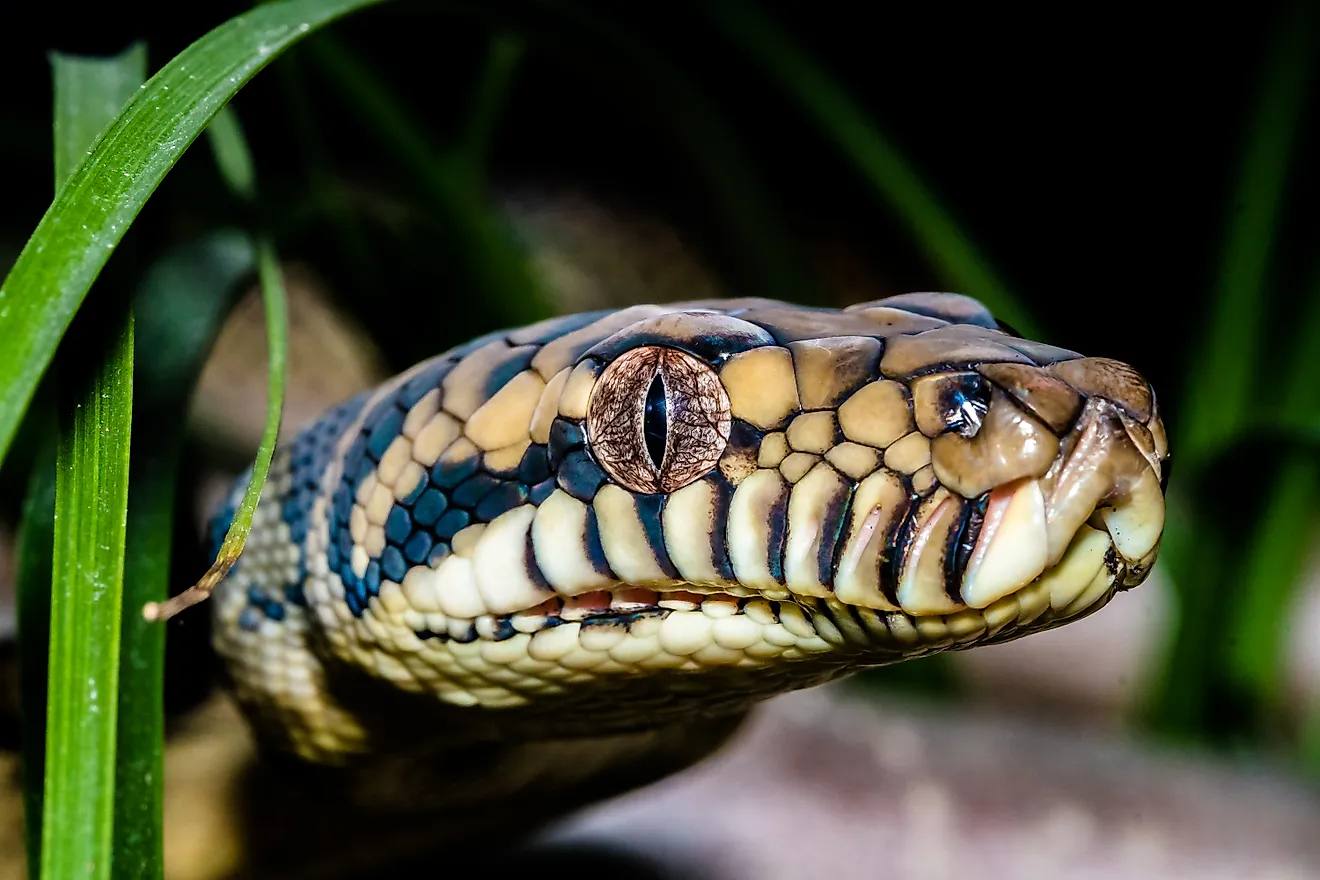
No snake on Earth gets longer. The reticulated python (Malayopython reticulatus, moved out of the genus Python in a 2014 reshuffle) regularly clears 5 meters, and the largest reliably measured individual, sedated and stretched out in Balikpapan, Indonesia, came in at 6.95 meters (22.8 feet) and 59 kilograms (130 pounds). The name comes from the net-like pattern running down its back, which sounds decorative until you realize it is near-perfect camouflage on a dappled forest floor. This is an ambush hunter and a constrictor, not a venom user: it waits, grabs, and squeezes, and its menu runs to rodents, pigs, deer, primates, and the occasional stray dog at a village edge. It lives in the rainforests, grasslands, and woodlands of South and Southeast Asia, and the IUCN lists it as Least Concern, which is to say it is getting along fine without our help.
The King Cobra: The Longest Venomous Snake

Now for the venom. The king cobra (Ophiophagus hannah) is the longest venomous snake in the world, averaging 3 to 4 meters with a record specimen at 5.85 meters (19.2 feet). Its genus name, Ophiophagus, literally means snake-eater, and that is not a figure of speech: king cobras hunt and swallow other snakes, including rat snakes, smaller pythons, and other venomous species. A single bite delivers enough neurotoxin to kill around 20 people, or drop an adult elephant. Here is the twist that rewrote the textbooks: in 2024, researchers split the king cobra into four separate species, among them a Western Ghats form (Ophiophagus kaalinga) and a Luzon Island form (Ophiophagus salvatana), after concluding the snake had been quietly hiding its diversity for nearly two centuries. The IUCN still lists it as Vulnerable and has not yet reassessed the new four-way arrangement. Deforestation continues to shrink its forests across South and Southeast Asia.
The Yellow Sea Snake: The Longest Sea Snake

Most sea snakes are short. The yellow sea snake (Hydrophis spiralis) is the exception, generally considered the longest of them all at up to 3 meters (9.8 feet), though most individuals pulled from the water measure under 2. It is a venomous elapid, a relative of the cobras, built for open water rather than the reef: it cruises muddy and sandy sea floors, has been recorded around 50 meters down, and feeds almost entirely on eels it pries from their burrows. It turns up across the northern Indian Ocean and parts of Southeast Asia, out to New Caledonia, the Philippines, and New Guinea. The IUCN lists it as Least Concern.
The Green Anaconda: The Heaviest Snake on the Planet

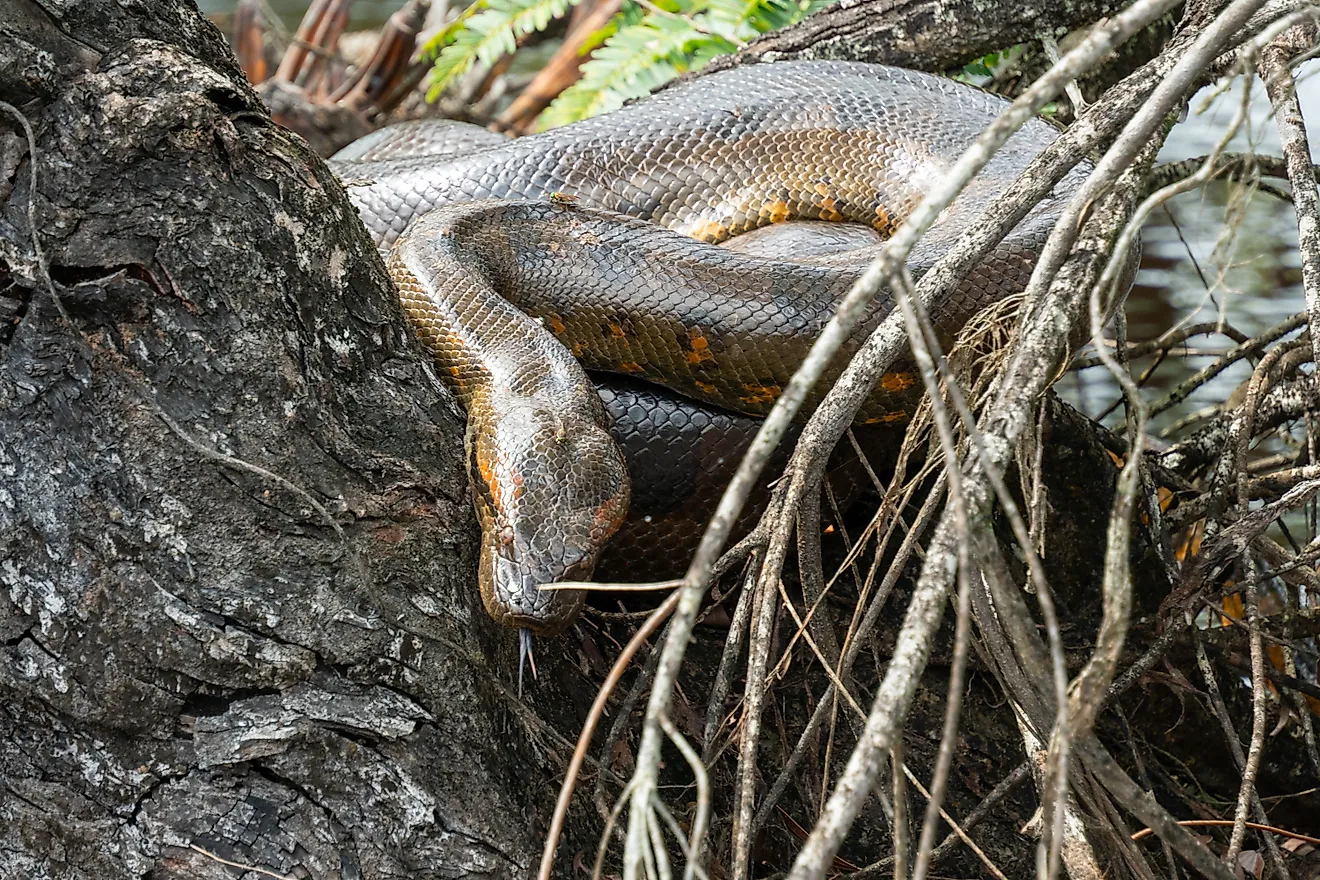
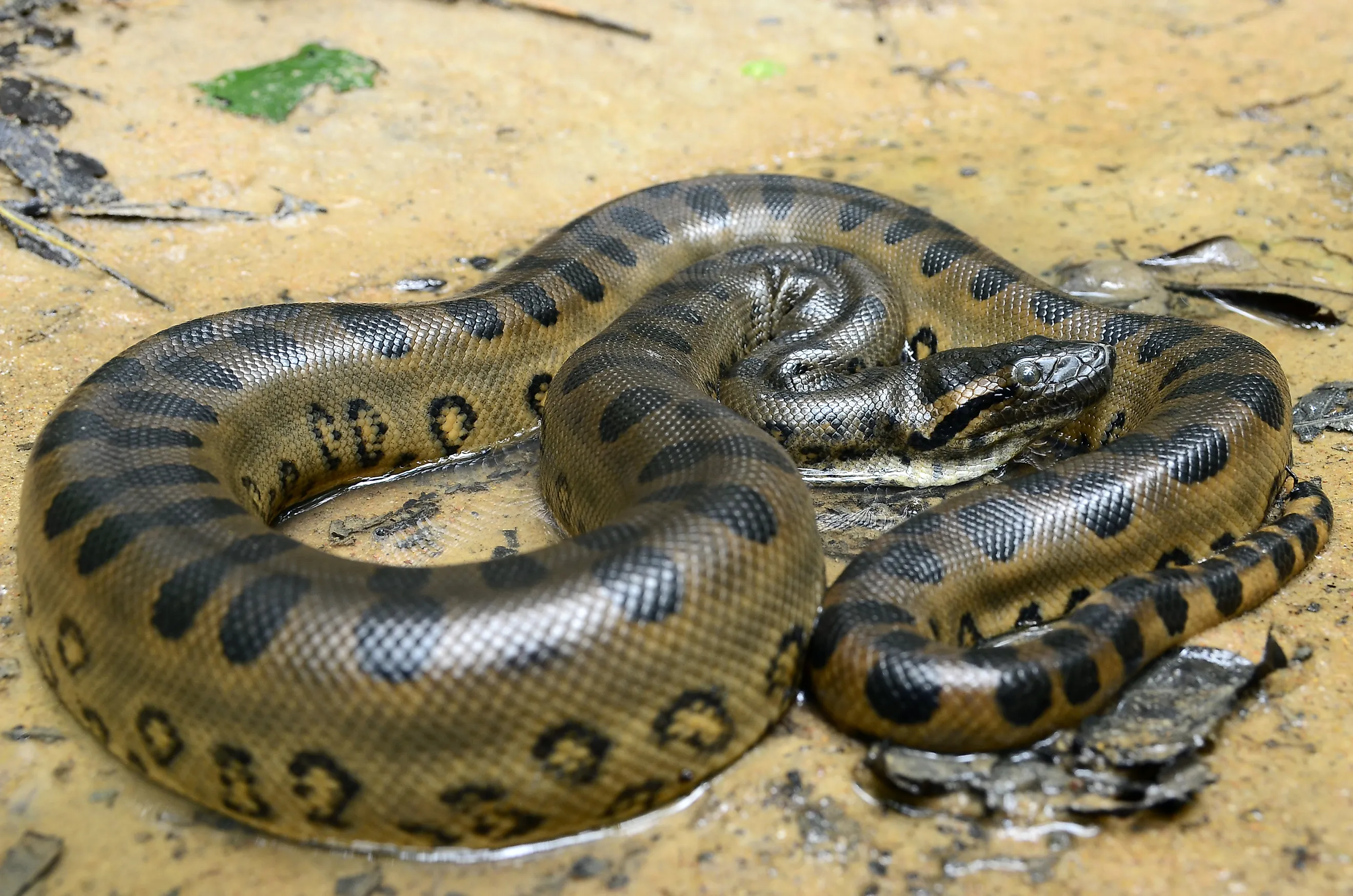
If the reticulated python wins on length, the green anaconda (Eunectes murinus) wins on sheer mass, and it is not close. The heaviest verified individual measured 5.2 meters (17 feet) and weighed a staggering 97.5 kilograms (215 pounds), and females routinely dwarf the males. This is a water snake, sluggish and clumsy on land but deadly in the slow rivers and flooded grasslands of the Amazon and Orinoco basins, where it ambushes capybaras, caimans, deer, turtles, and birds, and where the occasional big cat learns the hard way not to drink at the wrong spot. In February 2024, a team announced that the green anaconda is really two species: the southern green anaconda keeps the name E. murinus, while the northern populations were proposed as a new species, Eunectes akayima. Other taxonomists have pushed back hard on the split, so treat it as the leading edge of a live argument rather than a settled fact. Oddly for such a famous animal, the IUCN has never formally assessed the green anaconda at all.
The Eastern Diamondback Rattlesnake: America's Heavyweight Viper

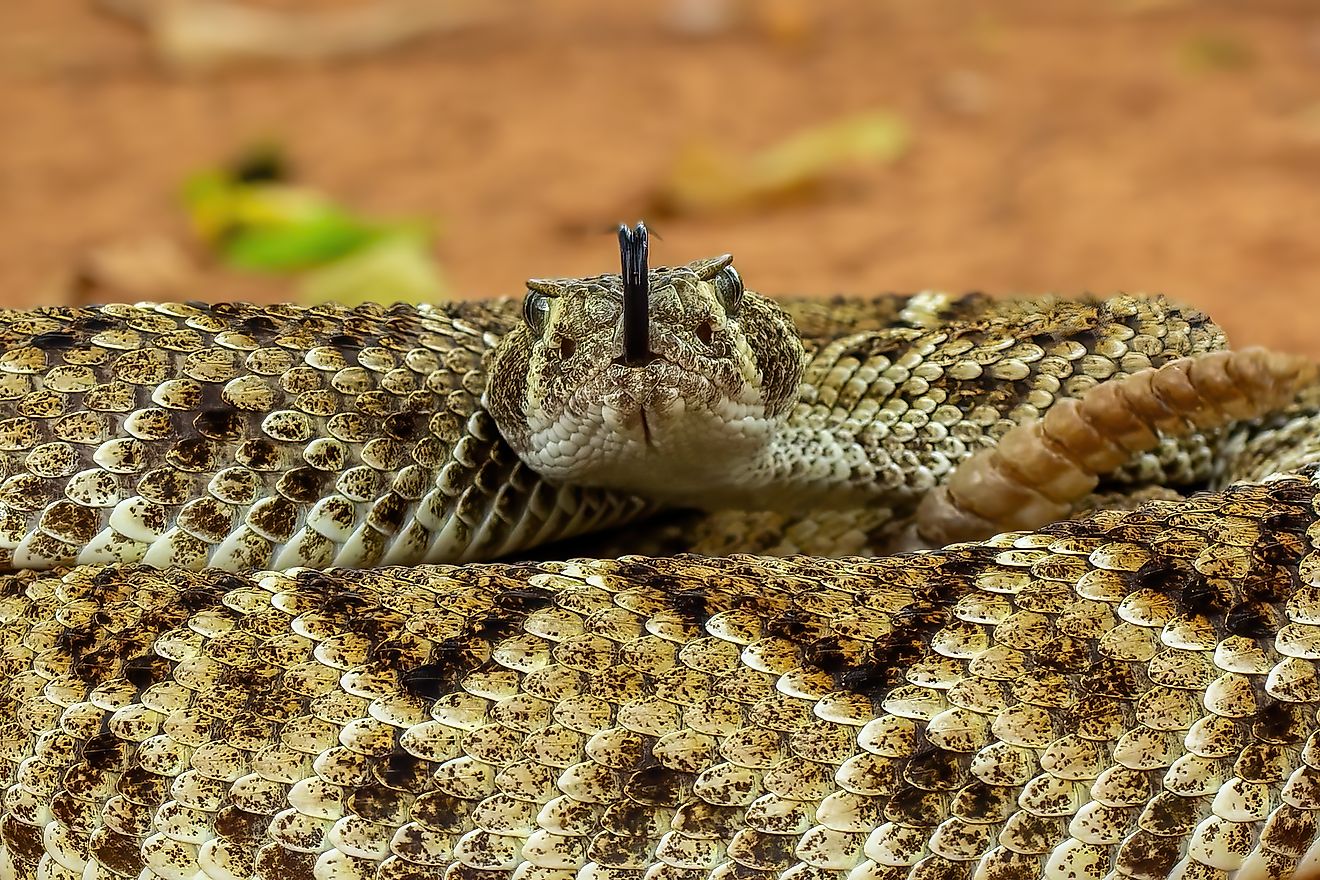
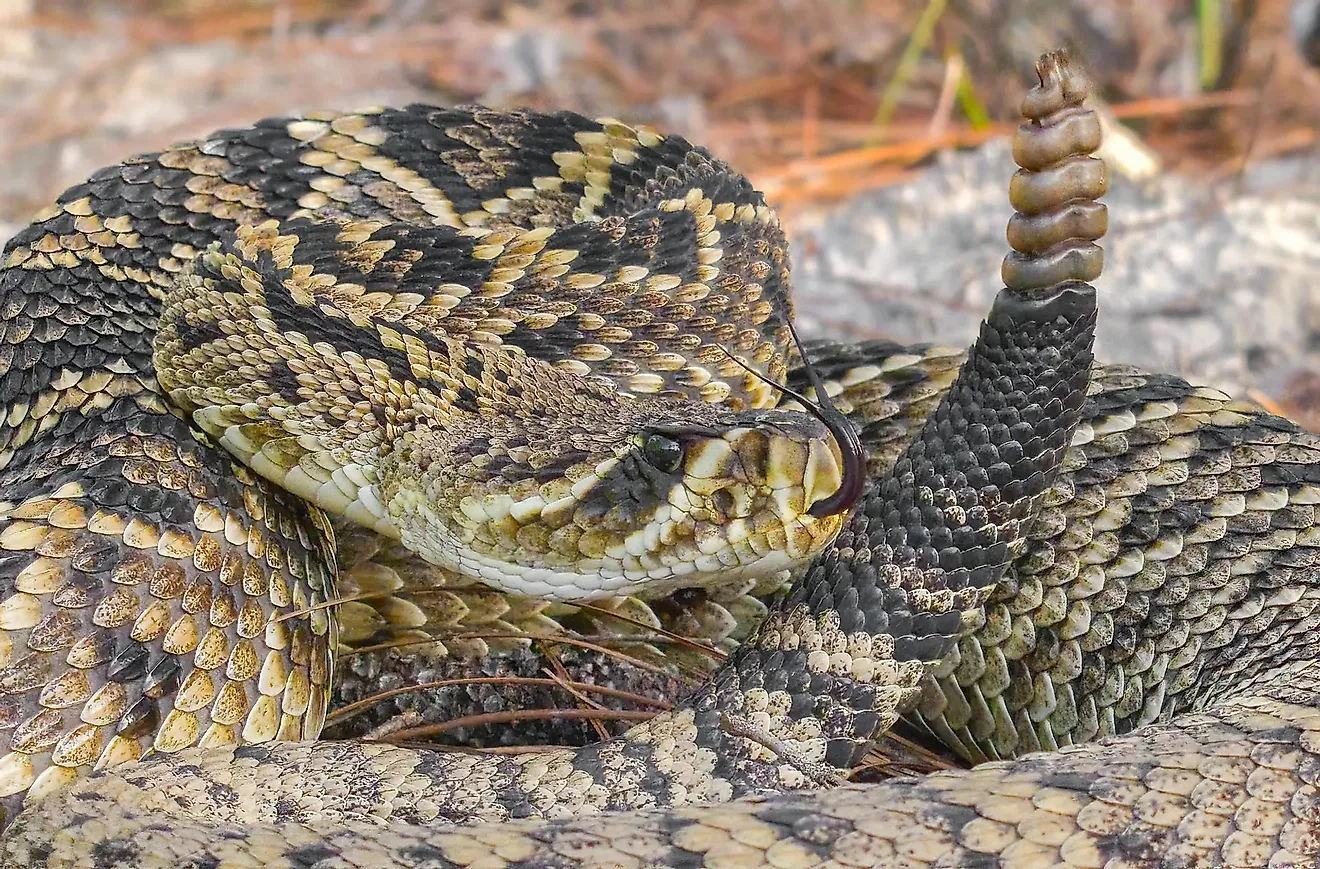
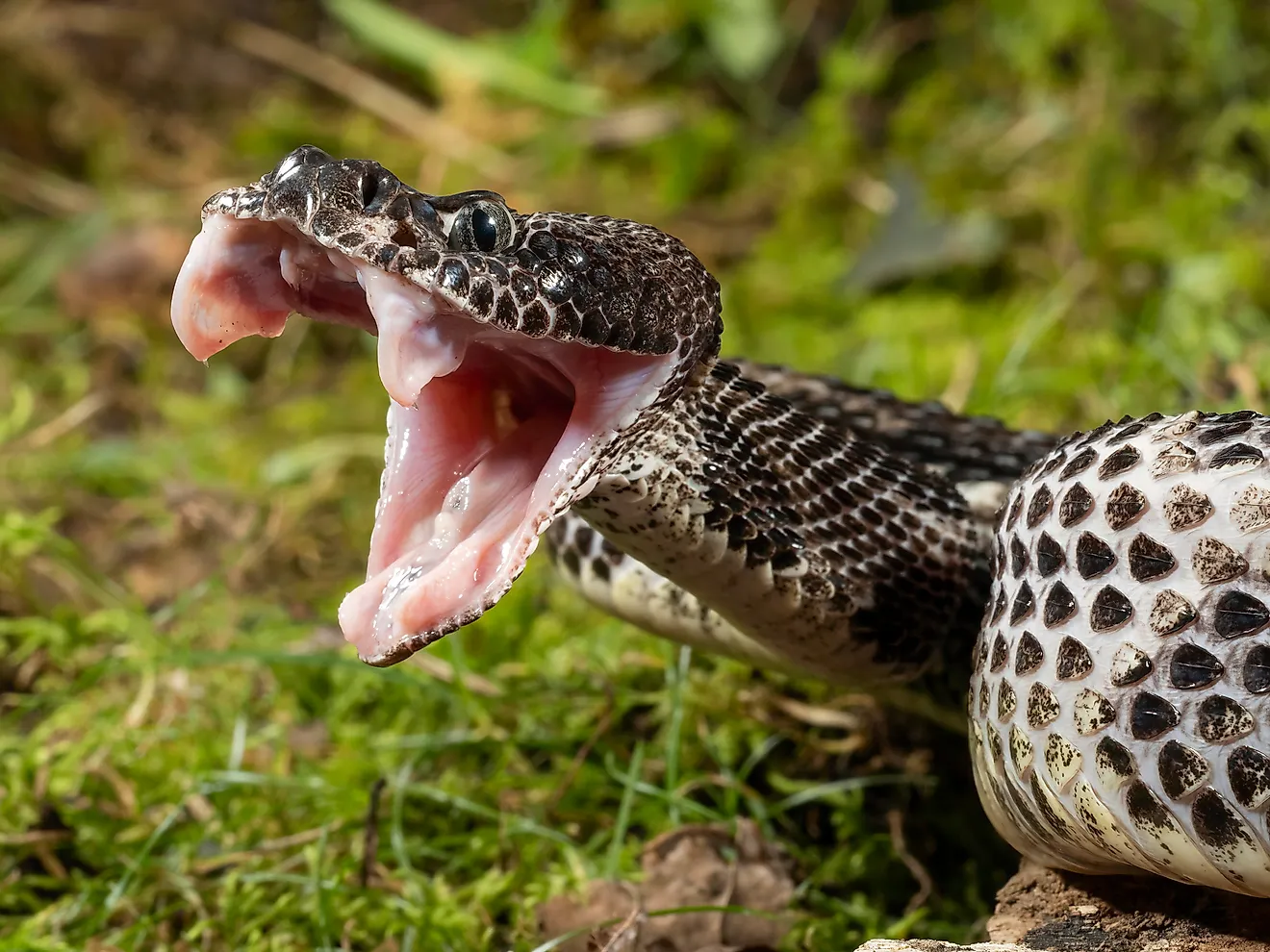
The eastern diamondback rattlesnake (Crotalus adamanteus) is the largest rattlesnake in the world and one of the heaviest venomous snakes anywhere. A famous specimen shot in 1946 measured 2.4 meters (7.9 feet) and weighed 15.4 kilograms (34 pounds), though it has company at the top of the venomous weight class: the longer, leaner king cobra and the shorter but even chunkier Gaboon viper both push into the same range. Most adults run a more modest 1.5 to 1.8 meters. It hunts rabbits, rats, squirrels, and birds through the pine flatwoods, scrub, and coastal forests of the southeastern United States, striking with hinged fangs and tissue-destroying venom. The IUCN lists it as Least Concern, but its numbers have slid as its longleaf pine habitat has been carved up, and it has been the subject of repeated petitions for federal protection.
More Giants Worth Knowing
The record-holders get the headlines, but plenty of other snakes belong in the heavyweight division.
Burmese Python

The Burmese python (Python bivittatus) grows to around 5 meters (16 feet) in the wild, with females outsizing males, and its brown-blotched skin has made it a favorite in both the pet and leather trades. That popularity backfired badly. Released and escaped pets established a breeding population in Florida's Everglades, where the species has no natural predators and has helped erase much of the region's native mammal life. In its home range across South and Southeast Asia, where it is actually in decline, the IUCN lists it as Vulnerable. Until 2009 it was lumped in with the Indian python as a subspecies.
African Rock Python

Africa's largest snake, the African rock python (Python sebae), is a thick, powerfully built constrictor that averages roughly 3 to 5 meters and has been measured at about 6 meters (20 feet). Some authorities rank it as the second-heaviest living snake after the green anaconda, with exceptional individuals topping 90 kilograms (200 pounds). It takes large rodents, antelope, and other sizable mammals by constriction across a wide spread of sub-Saharan habitats. Its southern relative, the southern African rock python (Python natalensis), is now recognized as a separate species. The IUCN lists P. sebae as Near Threatened.
Indian Python

The Indian python (Python molurus) is a pale, blotched constrictor of the Indian subcontinent. Old size claims were muddied by stretched skins and confusion with the Burmese python, but the longest scientifically recorded individual, collected in Pakistan, reached 4.6 meters (15 feet) and 52 kilograms (114 pounds); most are closer to 3 meters. If it feels familiar, that is because it is Kaa, the hypnotic python from Rudyard Kipling's The Jungle Book. The IUCN lists it as Near Threatened, with numbers falling because of habitat loss and the skin trade.
Amethystine (Scrub) Python

The amethystine or scrub python (Simalia amethistina, formerly placed in Morelia) is the largest native snake in Australia and Papua New Guinea, named for the milky, amethyst-like sheen its scales throw in the right light. Typical adults run about 2 to 4 meters, occasionally longer. Unlike most giant snakes, the heavier sex here is clearly the female, at around 15 kilograms (33 pounds), while the slimmer males average closer to 5 kilograms (11 pounds); exceptional individuals have topped 30 kilograms. It eats birds, bats, rats, and possums, and the largest specimens ambush wallabies and cuscus at the water's edge. The Australian population has been split off as its own species, the Australian scrub python (Simalia kinghorni). The IUCN lists the amethystine python as Least Concern.
Yellow Anaconda

The yellow anaconda (Eunectes notaeus) is the green anaconda's smaller, greenish-yellow relative, overlaid with dark blotches and growing to roughly 3.3 to 4.4 meters (11 to 14 feet) and 25 to 30 kilograms (55 to 66 pounds). As with its larger cousin, the females are the giants. It haunts the marshes, swamps, and slow waterways of south-central South America, especially the Pantanal wetlands, hunting fish, turtles, and small mammals. It is listed under Appendix II of CITES, which regulates the trade in its prized skin. The same 2024 anaconda study proposed folding two close relatives into this species, another sign that anaconda taxonomy is far from settled.
Boa Constrictor

The boa constrictor (Boa constrictor) is the snake whose name became a verb. Heavy-bodied and marked with saddle-shaped patterns, it grows to about 4 meters (13 feet) and 27 kilograms (60 pounds), with size tracking the local prey supply. It is mostly a ground dweller, at home in rainforests and even semi-desert scrub across Central and South America, where it takes birds, rodents, and mid-sized mammals. Like the anacondas, it is listed under CITES Appendix II.
Cuban Boa

The Cuban boa (Chilabothrus angulifer) is the largest snake on Cuba, reaching about 4.8 meters (16 feet) and 27 kilograms (60 pounds). Its best trick is how it hunts: Cuban boas gather at cave mouths at dusk and pluck bats out of the air as the colony streams out, and they have been seen coordinating their positions to box the bats in, making them one of the very few snakes known to hunt in anything like a group. Found only in Cuba and a few neighboring islands, and pressed by habitat loss, it is listed as Near Threatened.
Papuan Python

The Papuan python (Apodora papuana) rounds out the list at up to 5 meters (16 feet) and about 22.5 kilograms (50 pounds). Usually an olive-green snake, it can shift its color toward black or mustard when it is agitated, a genuinely unusual ability for a python. It is a nocturnal, ground-living hunter of small mammals on the island of New Guinea, and it will eat other snakes when the chance comes. The IUCN lists it as Least Concern.
So, How Big Do Snakes Really Get?
The honest answer is that there is no single largest snake, because length and weight crown different champions. The reticulated python wins the tape measure; the green anaconda wins the scale. Everything else is a matter of how you value the trade-off between a long, lean ambusher and a short, dense powerhouse. What is changing fastest is not the snakes but the names we give them: with both the green anaconda and the king cobra split into multiple species in 2024, the list of the world's largest snakes is being quietly rewritten even as the animals themselves keep doing exactly what they always have.