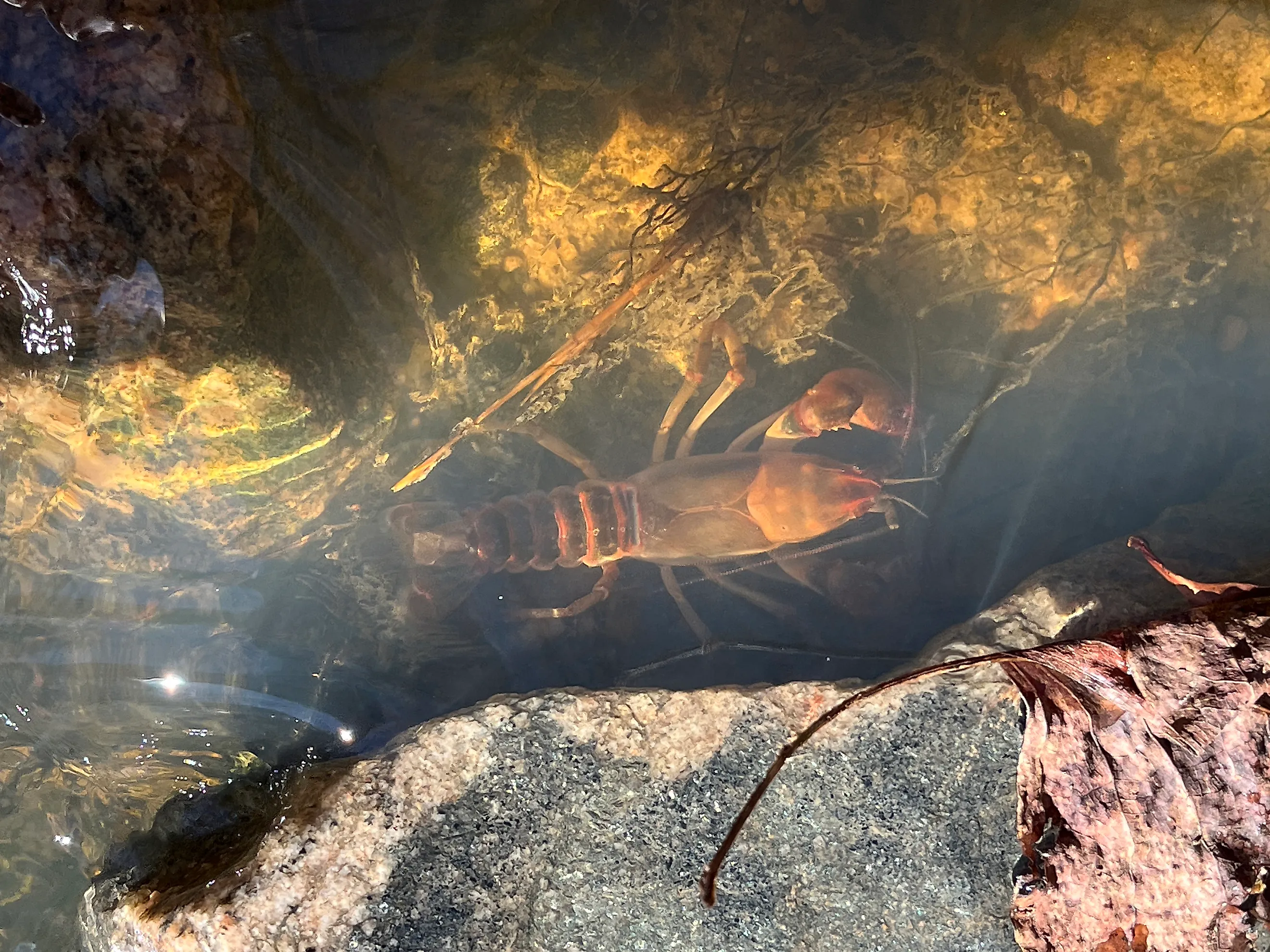
Where Crayfish Go In The Winter
By early November, the crayfish that turn up under flipped creek rocks all summer are much harder to find, though many of them have not gone far. As the water cools toward 50°F, crayfish slow down and settle into a spot that stays wet and sheltered until spring. For a creek crayfish, that usually means a gap in the gravel of the streambed or a burrow dug into the bank. Lake crayfish make a longer trip. Each autumn, the signal crayfish of Lake Tahoe walk off the shallow shelf along the shoreline and spend winter and spring roughly 330 feet down, away from the storms that kill a high share of the crayfish left in the shallows. Some females make their winter move carrying a clutch of eggs fastened beneath the tail, and those eggs will not hatch until spring.
Lake Crayfish Retreat to Deep Water

Signal crayfish in Lake Tahoe, introduced in the late 1800s and early 1900s to provide food, spend summer in the littoral zone, the band of lake bottom shallower than about 130 feet. As water temperatures and daylight both decline in autumn, the adults migrate into deeper water, and through winter and spring they are found below roughly 330 feet, more than twice the depth of their summer range, where their activity drops to very low levels. The move likely helps them avoid winter storms, which kill a high share of the crayfish that stay in the shallows.
In three marl lakes in Otsego County, Michigan, where average depths run only 24 to 28 feet, virile crayfish make the same move on a smaller scale. By fall, most of the females had left the shoals for water 20 to 30 feet deep, and once the water drops below 50°F, their movement falls off rapidly. They turn up near shore again in late April, when the ice goes out.
Stream Crayfish Wedge Into Gravel and Banks

Most creeks are too shallow for that kind of retreat, so stream crayfish go into the streambed itself, wedging into the spaces between stones and gravel or digging burrows into the bank. The common crayfish, which lives in springs and small streams across eastern North America, has turned up in an even stranger winter shelter. On December 13, 2016, biologist Sean Hartzell found a common crayfish about 1.5 inches long in a small depression in upland forest near Mechanicsville, in Montour County, Pennsylvania, roughly 65 feet from the nearest spring. It sat 3 to 4 inches beneath the surface of moist leaf litter that measured 39°F after a week of mostly freezing air, and it was alive but torpid.
Burrowing Crayfish Dig Down to the Water Table

Many crayfish dig only shallow holes during a drought or modest burrows near creeks and ponds. Primary burrowers spend most of their lives underground, winters included, tunneling down until they reach groundwater that keeps their gills wet. Their burrows can run more than 6 feet deep and occasionally reach about 10 feet, under prairies, wet meadows, floodplains, roadside ditches, and mowed lawns. At Nachusa Grasslands in north-central Illinois, burrows of the Great Plains mudbug are most common where the water table sits closest to the surface.
In Meriwether County, Georgia, the state-endangered Piedmont blue burrower lives only in seepage areas, including wooded seeps along Pine Mountain Ridge. It can be found in its burrows year-round, though it digs far less in winter than in summer, and only about 7 percent of captures there came between December and February. Its burrows are often capped with a chimney of round mud pellets, built from material carried up from inside the tunnel and stacked into a tapering mound.
Louisiana Crawfish Flip the Calendar

When commercial crawfish ponds in Louisiana are drained in late spring, red swamp crawfish dig into the levees, usually 1 to 3 feet down, to a chamber holding several inches of wet mud slush that keeps the air inside moist, with a mud plug or chimney sealing the entrance. They stay there for four or five months, roughly June through October. Most eggs are laid while the females are in their burrows, so by early fall a burrow often holds a female and her young.
Farmers reflood the ponds once daytime highs average in the low 80s and nights settle in the mid- to upper 60s, usually by mid-October in south Louisiana. The water softens the mud plugs, and adults and juveniles leave the burrows and spread across the pond.
The crawfish keep growing through winter at a slower pace, since eggs that hatch in two or three weeks under ideal conditions can take three or four months in winter, and young hatched in late fall or midwinter need four to five months to reach market size. Farmers still take about a third of a well-managed pond's catch between November and February. In the Atchafalaya Basin, where crawfish are caught wild, the same cold water holds growth back, and the wild catch is most plentiful between April and June.
Some Females Carry the Next Generation Through the Cold

Washington's crayfish season ends every October 31 and does not reopen until the first Monday in May, a closure meant to protect the state's native signal crayfish while they reproduce. Signal crayfish mate in fall, and each female extrudes 100 to 300 eggs, known as berries, which stay fastened beneath her tail through the winter. The eggs hatch in late spring, and the hatchlings ride on their mother for several weeks, molting twice before heading off on their own.
A female rusty crayfish often goes into winter carrying stored sperm. Adults mate in late summer or early fall, and she holds the sperm until late April or May, fertilizing her eggs as the water warms. Because of that stored sperm, a single female released into a new lake can start a population, which helps explain how a crayfish native to Ohio River basin streams has become established in Wisconsin, Minnesota, Michigan, Pennsylvania, New England, and other states, often after anglers carried it there as live bait.
Water temperature sets the crayfish calendar, and the people who catch and farm crayfish have built their schedules around it. Louisiana farmers wait until nights cool into the mid- to upper 60s before reflooding their ponds, so the crawfish leave the levees early enough to grow through the winter and reach market size for the spring harvest. Washington closes its crayfish season on October 31, during the fall mating season of its signal crayfish, and keeps it closed until the first Monday in May to protect the females carrying eggs through the cold months. In a creek that looks empty in January, the crayfish are still there, wedged into the gaps in the streambed gravel or tucked into burrows in the bank, and they will stay put until the water warms in spring.