The Whirlpool Below Niagara Falls That Reverses Direction
Everyone knows the thunder of Niagara Falls, but just a few miles downstream lurks a second wonder that is far stranger and that almost nobody talks about. There, the Niagara River slams into a sharp bend and coils itself into a massive, churning whirlpool. And this whirlpool does something almost no other on Earth can manage: it reverses direction. One moment it is spinning one way, and then, on a schedule quietly set by human hands, it flips and spins the other. Here is the story of the whirlpool below Niagara Falls that reverses direction.
The Niagara Whirlpool

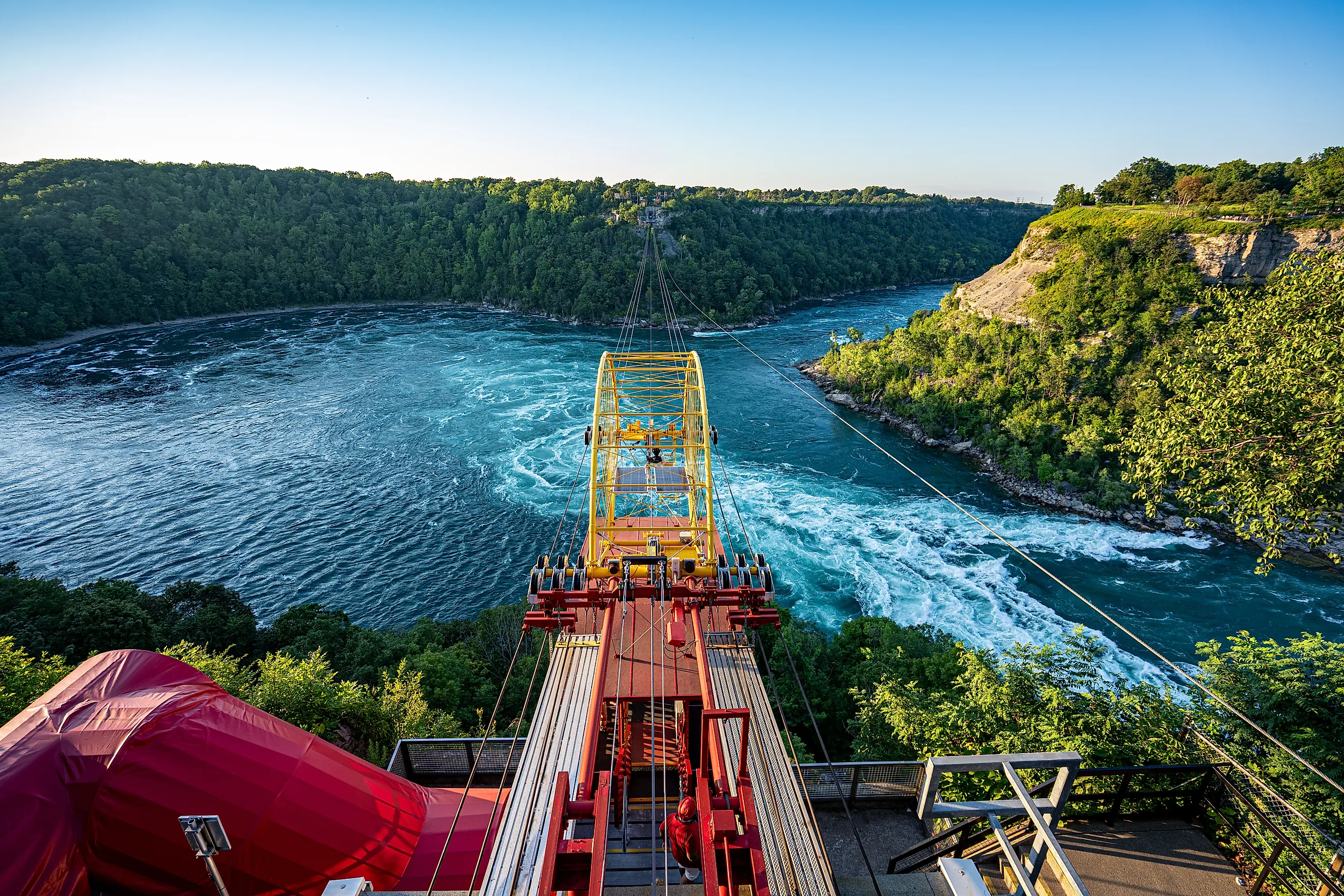
The Niagara Whirlpool sits in the Niagara Gorge, a couple of miles downstream from the Falls, right on the border between New York and Ontario. It forms where the river, racing out of a narrow stretch of gorge, hits an almost 90-degree bend and swirls into a basin roughly 1,700 feet long and up to 125 feet deep. It came into being about 4,200 years ago, when the slowly retreating Falls carved back far enough to intersect an ancient, buried riverbed that cut across the Niagara's path. The river tore out the old channel's soft fill, and that sharp, sudden turn in the water created the whirlpool we still see today.
A Whirlpool That Spins Both Ways

What makes this whirlpool genuinely extraordinary is its party trick. Most of the time, at full river flow, it rotates counterclockwise, churning its way around the basin before the water finally finds its way out. But at regular intervals it stops, reorganizes itself, and begins spinning clockwise instead. It is often described as the only natural whirlpool on Earth that routinely reverses its own direction of rotation, and the switch is dramatic enough to be clearly visible from the overlooks high above.
The Hydroelectric Secret

The reason for the reversal is not some deep natural mystery; it is people. Upstream of the Falls, enormous volumes of the Niagara River are diverted into hydroelectric power plants, and the amount taken changes with demand. At night, roughly from 10 p.m. to 8 a.m., and throughout the slower off-season, far more water is pulled away for power, cutting the flow over the Falls by as much as half. When that happens, the water level at the whirlpool can drop around 10 feet, and the weakened current is no longer strong enough to hold its usual pattern, so the entire whirlpool flips from counterclockwise to clockwise. Turn the power demand up or down, in effect, and you change which way the whirlpool spins.
How the Whirlpool Forms

The mechanics behind it are surprisingly delicate. Water comes blasting out of the narrow gorge upstream at speeds of up to 30 feet per second and jets into the wide basin, where it suddenly has to make that hard turn and find the outlet. At full flow, pressure builds as the incoming water tries to cut straight across the basin to reach the exit, and that pressure forces it to dive down and double back underneath the incoming stream, which is exactly what sets the whole mass spinning. Because the entire balance depends on precisely how much water is moving through, dialing the flow up or down is enough to tip the vortex into reverse.
Riding Above It

For all its danger, the whirlpool is a spectacular sight, and you can get remarkably close to it. The Whirlpool Aero Car, also known as the Spanish Aero Car, has been carrying passengers in an open cable car some 250 feet directly above the swirling water since 1916, well over a century now. There are also overlooks and trails leading down into the gorge on both the US and Canadian sides. What you are really watching, as the water turns, is a meeting of two rivers separated by thousands of years: the modern Niagara and the ghost of an ancient one buried beneath the rock, now spinning together in one of North America's most underrated natural marvels. So the next time you visit Niagara, look past the Falls to the quiet green basin downstream, and remember that its slow, hypnotic spin might just be running backward.