The Stadiums With Retractable Roofs In North America
Retractable roofs give stadiums the ability to shift between open-air and enclosed configurations, but the term covers several different designs. In this context, a stadium qualifies when a mechanically movable roof section can open over the playing or spectator area; fixed domes, permanent canopies, and retractable playing fields do not count. As of 2026, 15 stadiums meet that definition in the US and Canada. Mexico has no current stadium that meets that definition.
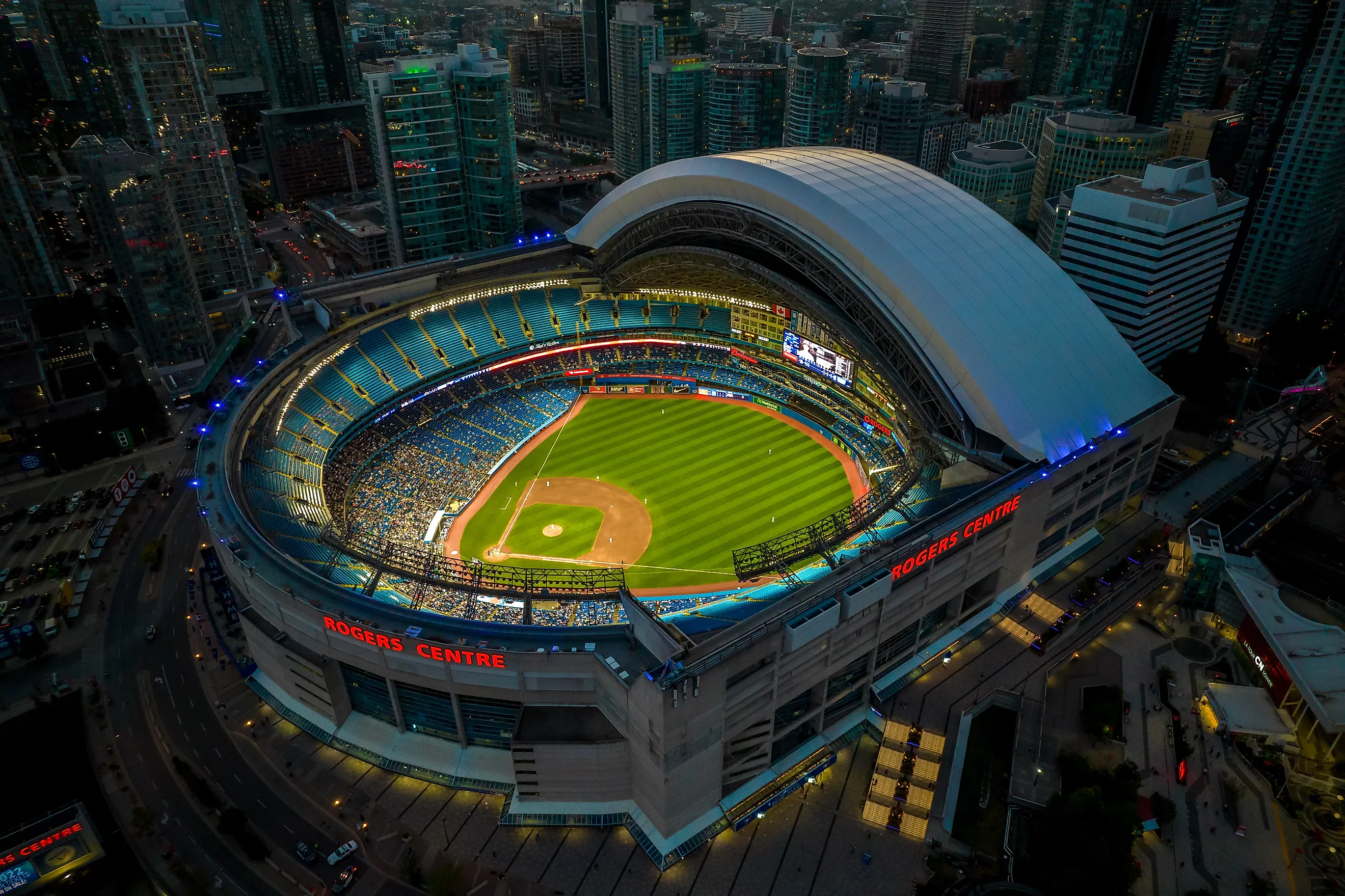
Rogers Centre, Toronto, Ontario, Canada

Rogers Centre opened in Toronto, Ontario, in 1989 as the SkyDome with the first fully retractable motorized roof on a major stadium. Its four-panel system includes one stationary section and three moving sections that cover 339,343 square feet (31,526 m²). The roof can open or close in about 25 minutes, allowing the stadium to switch between an enclosed venue and an open-air ballpark. The Toronto Blue Jays continue to use the stadium, which also hosts concerts and other events. The building underwent a major renovation between 2022 and 2024 that added new seating and gathering areas while retaining the original roof system.
BC Place, Vancouver, British Columbia, Canada

BC Place opened in 1983 with an air-supported dome, but a major renovation replaced it with a cable-supported retractable roof in 2011. The stadium in Vancouver, British Columbia, has a movable center section measuring about 328 by 279 feet (100 by 85 meters) and exposing more than 89,729 square feet (7,500 m²) of sky. The fixed outer roof keeps the seating covered even when the center opens. The stadium's current roof also provides natural ventilation when open while protecting from Vancouver's frequent rain when closed. BC Place is home to the BC Lions and Vancouver Whitecaps FC and also hosts concerts and major sporting events.
Arthur Ashe Stadium, Queens, New York, US

Arthur Ashe Stadium is located in Queens, New York. The stadium opened in 1997, but its retractable roof was not installed until 2016, during a major renovation of the US Open grounds. The roof sits on an independent structure rather than directly on the original stadium and uses two movable panels over an opening that spans 63,500 square feet (5,899 m²). The system helps matches continue during rain while also offering shade and climate control when necessary. The stadium remains the US Open's main court and hosts the tournament's biggest matches. With a capacity of over 23,000 spectators, it is the largest tennis stadium in the world by seating capacity.
Louis Armstrong Stadium, Queens, New York, US

The new Louis Armstrong Stadium opened in 2018, replacing a stadium that dated back to the 1964 World's Fair. Its retractable roof gave the US Open a second roofed stadium alongside Arthur Ashe, with both located in Queens, New York. The 14,000-seat venue combines the movable roof with natural ventilation, so the stadium retains an outdoor character when conditions permit. The roof covers the court and seating bowl so tournament matches can continue when weather interrupts. The sides of the stadium concourse stay open to the surrounding tennis center. It is part of the USTA Billie Jean King National Tennis Center.
American Family Field, Milwaukee, Wisconsin, US

American Family Field is in Milwaukee, Wisconsin. It opened in 2001 as Miller Park, but was renamed in 2020. It features a fan-shaped convertible roof, a design the Milwaukee Brewers identify as unique in North America. Fivef movable roof panels can open or close in less than 10 minutes, with the panels moving along rails above the stadium. Large glass sections help natural light reach the grass, supplemented by mobile heat lamps during the offseason. The design means the Brewers can play in an open-air setting during favorable weather while protecting the field and spectators when rain or cold conditions make that impractical.
T-Mobile Park, Seattle, Washington, US

T-Mobile Park opened in 1999 as Safeco Field and was renamed after the 2018 season. It has a retractable roof designed as an umbrella rather than a full enclosure. Because of its location in Seattle, Washington, the option to cover the field is crucial due to the lengthy rainy season. Three movable panels cover nearly nine acres and can open or close in roughly 10 to 20 minutes. The roof does not fully enclose the building, so fresh air and the sounds of the surrounding city remain part of the ballpark experience. The roof can even remain partially open, giving the stadium flexibility as weather conditions change during a game. The Seattle Mariners call T-Mobile Park home, and the venue also hosts concerts, college baseball, and other events throughout the year.
Lucas Oil Stadium, Indianapolis, Indiana, US

Lucas Oil Stadium is in Indianapolis, Indiana. It opened in 2008 as the new home of the Indianapolis Colts, who used to play at the RCA Dome. Its retractable roof consists of two large panels that slide toward the north and south ends of the building, so the stadium can easily shift between indoor and outdoor configurations. The roof takes about 11 minutes to open or close. Large retractable glass windows on the north end can also open toward downtown Indianapolis, giving the stadium another way to connect the interior with its surroundings. The roof is designed to let natural light into the building when open, while the enclosed configuration provides climate control for the Colts' football games, along with concerts, college football, and other events.
Chase Field, Phoenix, Arizona, US

Chase Field opened in 1998 as the first retractable-roof stadium in the US. Located in Phoenix, Arizona, it gave the Arizona Diamondbacks a way to play through the city's intense summer heat. Its two roof halves use drawbridge-style mechanics and can move independently so the stadium can remain open when weather permits or close for a controlled environment. The stadium also contains a swimming pool beyond the outfield wall, one of its most distinctive features. A retractable roof was particularly important for baseball in Phoenix because the building's enclosed configuration can keep temperatures manageable during the Diamondbacks' afternoon and evening games.
State Farm Stadium, Glendale, Arizona, US

In nearby Glendale, Arizona, State Farm Stadium opened in 2006. It has a retractable roof and a separately retractable natural-grass field, allowing the playing surface to be moved outside the stadium when necessary. Because the grass field sits on a movable tray, it can be rolled outside to receive natural sunlight and ventilation. The stadium's two roof panels move along steel rails, using a 480-horsepower system, meaning the roof can open in about 12 minutes. The roof's translucent material lets natural light into the building while the enclosed configuration gives protection from Arizona's heat. The Cardinals use the building for football, and the stadium hosts major concerts and sporting events, including the Fiesta Bowl.
Daikin Park, Houston

Daikin Park opened in 2000 as Enron Field and introduced retractable-roof baseball to Houston, Texas. The roof, which is 242 feet (73.76 m) high, can slide open in about 14 to 20 minutes, giving the Astros the choice between open-air conditions and climate-controlled baseball. Unlike a fully enclosed dome, the stadium can expose the playing field and seating bowl to the outdoors when weather permits. The park also features a natural grass field and the Crawford Boxes in left field, a section of up-close seating that became one of the ballpark's recognizable features. The Houston Astros still use this downtown stadium, which also hosts concerts and events.
Reliant Stadium, Houston

Reliant Stadium has gone through several name changes since it opened in 2002 as the home of the expansion Houston Texans. It was renamed NRG Stadium in 2014 and just went back to its Reliant roots in 2026. The stadium's retractable roof consists of two large panels that can move apart to expose the field or close to create an enclosed environment. The design means the stadium can accommodate football, concerts, and other large events while giving organizers some control over weather conditions. Reliant Stadium is also the main venue for the Houston Livestock Show and Rodeo, one of its largest annual events. The stadium's location in Reliant Park with other venues, including the Astrodome, makes it a major player in the city's entertainment district.
Globe Life Field, Arlington

Globe Life Field opened in 2020 with a 5.5-acre retractable roof designed partly to manage the heat in Arlington, Texas. The Rangers moved here after playing at nearby Globe Life Park, which was retrofitted for soccer and football games. The roof uses a single operable panel and weighs 24 million pounds, making it the largest single-panel operable roof in the world, according to the Texas Rangers. Clear ethylene tetrafluoroethylene (ETFE) panels bring daylight inside when the roof closes, helping the ballpark maintain a more open appearance even when enclosed. The roof can open or close in roughly 12 minutes, so the Rangers have control over playing conditions during games.
AT&T Stadium, Arlington

AT&T Stadium opened in Arlington, Texas, in 2009 as the new home of the Dallas Cowboys. Two monumental arches support its expansive retractable roof, while massive glass doors at each end can also open to the exterior. The roof-supporting arches span 1,290 feet (393 m), making them among the most prominent structural features of the building. When the roof and end-zone doors are open, the stadium can create an open-air environment despite its enclosed construction. The venue also contains one of the world's largest high-definition video boards suspended above the field. AT&T Stadium can accommodate roughly 80,000 people for Cowboys games, and even more for other events with different configurations.
Mercedes-Benz Stadium, Atlanta

Mercedes-Benz Stadium is the home of the Falcons and United in Atlanta, Georgia. Built in 2017, its retractable roof uses eight moving petals that slide along straight rails, creating a camera-aperture effect when they open. The petals form a watertight seal when closed and are covered with translucent ETFE pillows that let daylight into the building. The roof design was intended to provide the visual effect of an open-air stadium, though the building can also operate as an enclosed venue. The stadium also uses a large circular video board around the roof opening, giving the interior a distinctive appearance. It remains a major venue for professional sports, concerts, and other events.
IoanDepot park/LoanDepot Park, Miami

The Miami Marlins play in loanDepot park, which opened in 2012. It has a three-panel retractable roof spanning about 560 feet (171 m) from track to track. The panels can move together or independently so the stadium can provide partial shade as conditions change. Opening or closing the roof takes roughly 13 to 15 minutes, giving the venue a way to control rain, heat, and humidity during baseball games. The roof also allows the park to maintain an outdoor atmosphere when weather conditions are favorable. The stadium's location in Little Havana places it within one of the best-known neighborhoods in Miami, Florida.
How Retractable Roofs Benefit Venues
These stadiums use retractable roofs for various practical reasons. Venues in Arizona, Texas, and Florida use them to manage heat and humidity, while Seattle's system emphasizes rain protection without enclosing the seating bowl. Other venues use the technology to create controlled environments for games and large events.
The engineering varies considerably, with sliding panels, folding sections, and petal-shaped segments producing different visual effects when the roofs open. Each design reflects the stadium's climate, sport, and architectural requirements. Together, these designs show how the same basic mechanism has produced very different stadiums across North America.