The Largest Planetariums In The United States
While there's a definite winner to the title of America's largest planetarium, the competition's certainly tough. The Jennifer Chalsty Planetarium in Jersey City, New Jersey, takes the top spot by projecting the night sky onto an 89-foot screen, but the runners-up offer no less an awesome experience. The largest here means the diameter of the projection dome, the figure the planetarium industry itself ranks by, using facts and figures taken from each operator's published specifications and verified in September 2026. Seating and building size, while noted, don't affect the order. Here's what indoor stargazers need to know.
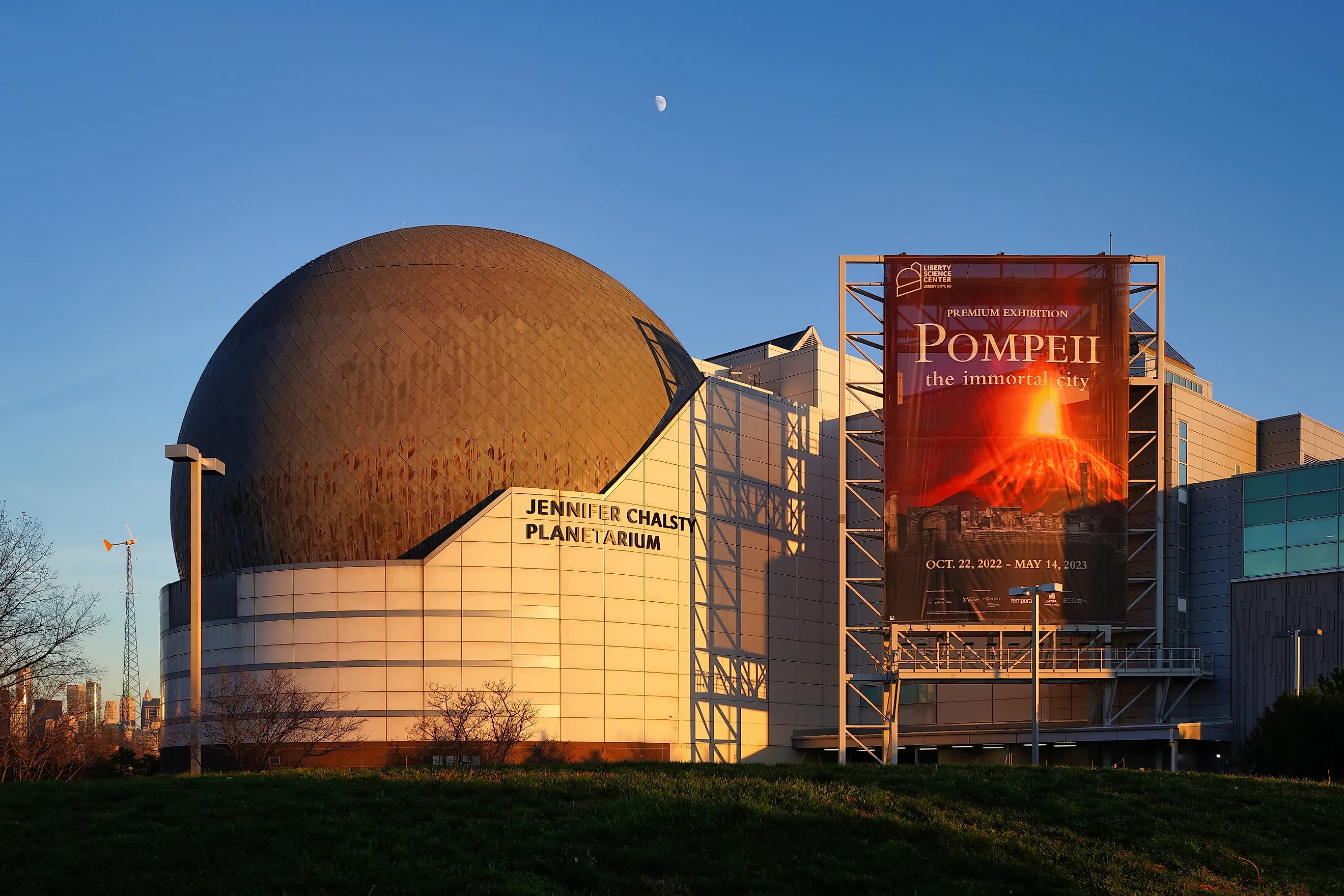
1. Jennifer Chalsty Planetarium, Liberty Science Center, Jersey City, New Jersey
Dome Diameter: 89 feet

Liberty Science Center opened in 1993 in Liberty State Park in Jersey City, just across the Hudson River from Lower Manhattan. Its giant-screen IMAX Dome Theater was the original tenant of the space that was converted into the Jennifer Chalsty Planetarium in 2017. Described as the biggest planetarium in America, in addition to its 89-foot full-dome screen, the facility comes with some serious tech specs, including a resolution of 88 million pixels, a lighting system capable of 281 trillion colors, and 30,000 watts of digital sound.
Add 10 Christie Boxer projectors running Digistar software in 8K and a seamless NanoSeam surface, and planetarium experiences simply don't get any more state-of-the-art. Upgraded in 2026 with new laser-powered projectors, it now features a rich program of shows including Black Holes and the Dark Cosmos, the live Tonight's Sky presentation, and Space Talk evenings with guest astronomers.
2. James S. McDonnell Planetarium, Saint Louis Science Center, St. Louis, Missouri
Dome Diameter: 80 feet

The James S. McDonnell Planetarium opened in April 1963 in the southeast corner of Forest Park, the St. Louis park that also contains the Saint Louis Zoo and the Saint Louis Art Museum. The building's hyperboloid concrete shell is unchanged, but the original 60-foot projection dome was replaced with an 80-foot dome during a renovation completed in 2001.
That new dome inside the Bill and Laura Orthwein StarBay Theater was the largest in North America until the Jennifer Chalsty Planetarium came along.
Fresh from a $2.5 million upgrade completed in July 2026, the planetarium now has a GOTO Chiron III hybrid star projector, the first in the United States, alongside a Cosm Digistar full-dome system. Lobby exhibits include two genuine 1960s spacecraft, Mercury 19 and Gemini 3A, both built across town by McDonnell Aircraft Corporation. Admission to the science center is free, and planetarium shows cost just $6 for non-members.
3. (Tied) Samuel Oschin Planetarium, Griffith Observatory, Los Angeles, California
Dome Diameter: 75 feet

When the Griffith Observatory opened in 1935 on the south slope of Mount Hollywood in Los Angeles' Griffith Park, its planetarium was the third to be constructed in the United States and the first on the Pacific Rim, and its 75-foot plaster dome was among the largest in the world. Rebuilt as the Samuel Oschin Planetarium, the original plaster was replaced with a seamless perforated aluminum dome of the same diameter, and the 1964 Zeiss Mark IV projector was swapped out for a Zeiss Universarium Mark IX.
This 290-seat theater is unusual among large planetariums as it presents its shows with a live storyteller rather than a recording. The current programs are Centered in the Universe, Signs of Life, and Water Is Life, and tickets are sold only in person on the day of the visit. Admission to the observatory building itself is free.
3. (Tied) Morrison Planetarium, California Academy of Sciences, San Francisco, California
Dome Diameter: 75 feet

The Morrison Planetarium occupies a 75-foot dome inside the California Academy of Sciences in Golden Gate Park, a natural history museum that also contains the Steinhart Aquarium and a four-story rainforest under a separate 90-foot glass dome. The current planetarium opened in 2008, replacing the original Morrison Planetarium, which had operated since the 1950s.
Made entirely of recycled steel, its frame is tilted to match the tilt of the Earth, and it supports a NanoSeam projection screen that appears to vanish once the lights go down. Every star, planet, and galaxy shown is drawn from real observational data rather than artwork, and the academy's shows have been seen by more than six million visitors since 2008. A planetarium pass is included with general admission.
5. (Tied) Grainger Sky Theater, Adler Planetarium, Chicago, Illinois
Dome Diameter: 70 feet

The Adler Planetarium opened in 1930 on Chicago's lakefront Museum Campus as the first planetarium in the Western Hemisphere. Its historic Sky Theater closed in 2010 and reopened in July 2011 as the Grainger Sky Theater, featuring a 70-foot dome that's unusual as it extends 190 degrees, 10 degrees past a full hemisphere and down to floor level. Entering through the dome surface rather than beneath it is all part of the audience experience.
Tech specs include six Sony projectors running Digistar for an 8K-by-8K image. A 15.2-channel sound system and live presentations by Adler staff round out programs like The Universe Explained and Skywatch Live. The building also contains the 55-foot Space Theater, the Samuel C. Johnson Family Star Theater, and the Doane Observatory.
5. (Tied) Jim Cherry Memorial Planetarium, Fernbank Science Center, Atlanta, Georgia
Dome Diameter: 70 feet

The Fernbank Science Center was completed in December 1967 by the DeKalb County School District, which uses it for student instruction as well as public programs. Its Jim Cherry Memorial Planetarium projects onto a 70-foot dome that still uses its original Zeiss Mark V optical star projector. It's now paired with a Spitz SciDome 4K laser fulldome system that adds digital imagery across the whole dome.
Shows on the current schedule include CAPCOM Go! The Apollo Story, Firefall, and the seasonal Star of Bethlehem program each December. An interesting side attraction is the Apollo 6 command module in the exhibit hall, flown without a crew on a Saturn V test flight in 1968. The adjoining Ralph L. Buice Jr. Observatory has a 36-inch Cassegrain reflector, the largest telescope in the southeastern United States.
5. (Tied) Chabot Space and Science Center Planetarium, Oakland, California
Dome Diameter: 70 feet

Chabot Space and Science Center traces its history back to the Oakland Observatory, founded in 1883, and moved to its current 86,000-square-foot building in the Oakland hills in 2000. The site covers 13 acres inside Redwood Regional Park, and its 241-seat theater is one of only four in the United States with a Zeiss Universarium fiber-optic star projector. This top-tier instrument shows 9,000 stars and celestial objects alongside a digital fulldome system used for recorded shows and live sky tours by staff astronomers.
The dome has also started hosting Sci-Fi Nights, after-hours screenings of science fiction films that sold out their first three dates. The center is home to the NASA Ames Visitor Center, which tells the story of research at NASA's Ames Research Center in nearby Mountain View. Three of its telescopes are open to the public free of charge on Friday and Saturday evenings.
5. (Tied) Northrop Grumman Planetarium, National Air and Space Museum, Washington, D.C.
Dome Diameter: 70 feet

The planetarium at the Smithsonian National Air and Space Museum on the National Mall opened in 1976 as the Albert Einstein Spacearium, timed to coincide with the United States Bicentennial, with a Zeiss Model VI projector given by the government of West Germany. It went digital in 2002, received a Definiti 8K fulldome system in 2014, and reopened in 2022 as part of the museum's building renovation, backed by a $285 million fundraising campaign and completed in 2026.
In June 2025, the Smithsonian renamed it the Northrop Grumman Planetarium in recognition of a $10 million gift from the Northrop Grumman Foundation, the charitable arm of the aerospace company that built the Apollo lunar module. Entry to the museum is free with a timed pass, and planetarium tickets are sold only at the box office on the day. Ticketed films include Birth of Planet Earth and Edge of Darkness, while free live sky tours run twice a month.
Close Contenders And Dual-Use Domes
Morehead Planetarium in Chapel Hill, North Carolina, opened in 1949 as the first planetarium on a university campus and trained 62 astronauts in celestial navigation, including 11 of the 12 men who walked on the Moon. Its 68-foot dome is among the largest fulldome theaters in the southeastern United States. New York's Hayden Planetarium is often described by the 87-foot diameter of the Hayden Sphere that encloses it, but the Space Theater screen inside the sphere's upper half measures 67 feet. The Frost Planetarium in Miami also measures 67 feet, and the Fiske Planetarium in Boulder, Colorado, at 65 feet, is the largest between Chicago and Los Angeles, according to the University of Colorado.
One larger dome is left out because astronomy is not its primary use. The 76-foot tilted dome at the Fleet Science Center in San Diego opened in 1973 as the world's first IMAX Dome theater and runs planetarium shows monthly. Below the 70-foot cut, the Dorrance DOME at the Arizona Science Center in Phoenix reopened in October 2025 with a 60-foot dome made of 9,026 LED panels and 44 million LEDs in place of projectors. It's a sure sign of where the next generation of large planetariums may be heading.
Big, Bigger, Biggest
None of the domes on this list could really be labeled as "small," and each is well worth a visit. Griffith Observatory has had three Zeiss projectors since 1935, and the youngest and largest, the Jennifer Chalsty Planetarium, was refitted with state-of-the-art laser projectors. Dome diameter still decides which theater can claim the title as the country's largest, and operators in Jersey City and Oakland make use of their size in marketing materials. For a visitor, the practical difference is that a 70-foot-or-wider dome fills the entire field of view from every seat, which is why these are worth a detour.