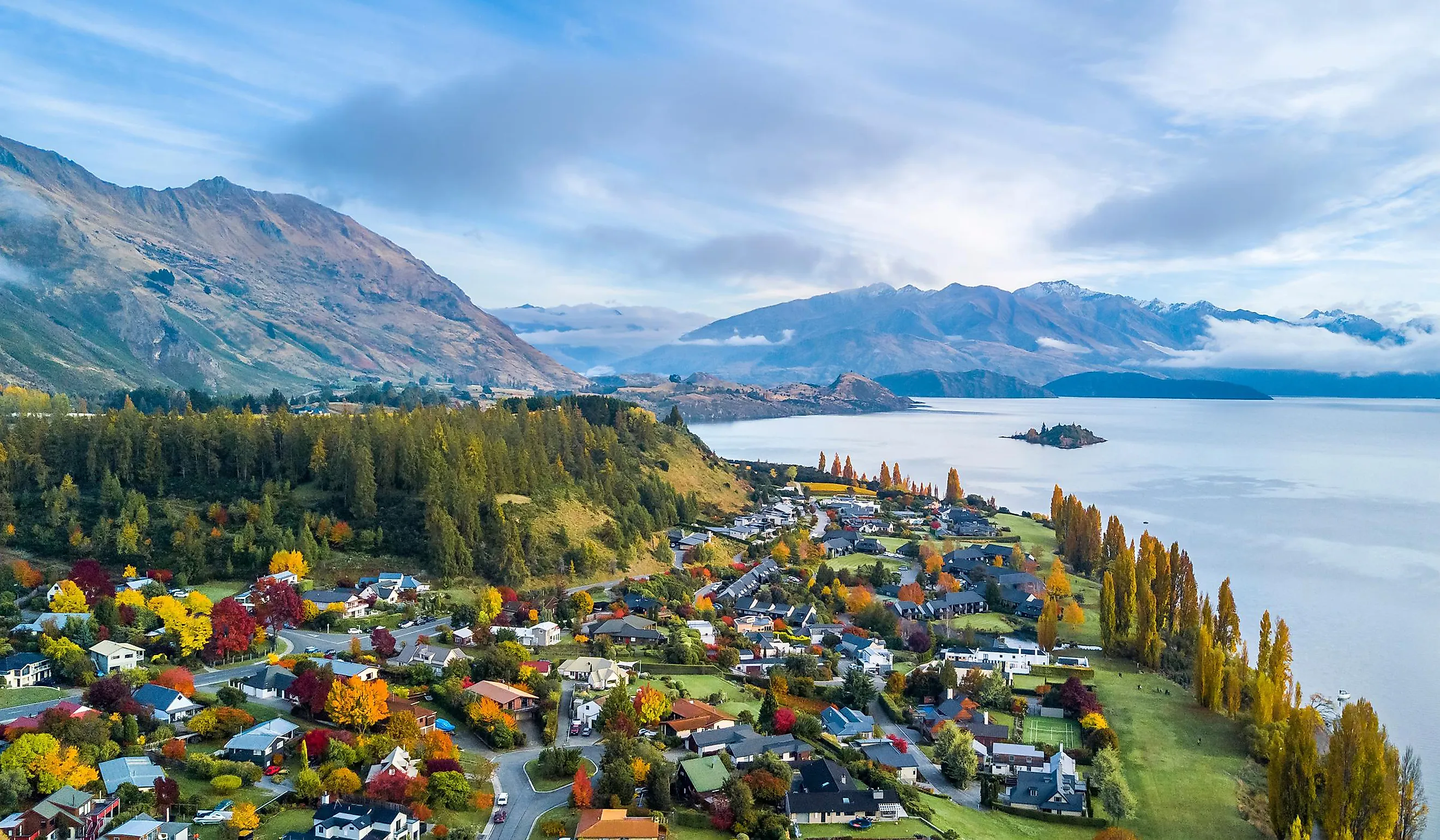
2026's 10 Most Scenic New Zealand Towns
New Zealand has about 5.3 million residents spread across two long islands, and many of its best views sit beside small settlements. Eight of these ten towns are on the South Island, where glacial lakes and steep mountain walls do most of the work. The two North Island picks, Raglan and Russell, offer black sand and a sheltered bay instead. Take the time to visit at your own pace to enjoy everything the most scenic New Zealand towns have to offer.
Te Anau

Te Anau sits on the shore of New Zealand's second-largest lake and acts as the main gateway to Fiordland National Park. Stats NZ estimated its population at about 2,920 in June 2025, which leaves the snow-dusted peaks across the water to dominate the view.
A short boat ride across the lake leads to the Te Anau Glowworm Caves, where a limestone path runs past an underground river and a small waterfall beneath ceilings dotted with glowworms. On the lakefront, the Te Anau Bird Sanctuary lies about 500 metres from the visitor centre and keeps takahē, a large flightless bird that was presumed extinct until it turned up in the late 1940s on the lake's western side. A self-guided walk through the sanctuary is free, although donations are welcome.
The Kepler Track is one of eleven official Great Walks. It loops about 60 kilometres through beech forest and along alpine ridges, yet it starts within a few kilometres of town. Drivers can instead take the Milford Sound Road, which begins in Te Anau and which NZ Pocket Guide ranks among the finest road trips in the country.
Queenstown

Queenstown is the biggest town on the list, with an estimated 29,000 residents when Lake Hayes Estate is counted, yet Lake Wakatipu and the Remarkables still frame most of what a visitor sees. The Skyline Gondola lifts passengers about 450 metres to Bob's Peak for a view across the water. From the top station, the Ben Lomond Track continues to a 1,748-metre summit, and riding the gondola saves roughly an hour of climbing.
On the lake, the TSS Earnslaw is a vintage steamship that still crosses Lake Wakatipu, and one package pairs the crossing with a tour of Walter Peak High Country Farm. Anyone after more speed can book a jet boat on the Shotover River, which PlanetWare also covers in its list of the town's top attractions.
Arrowtown

Arrowtown has about 2,860 residents and makes an easy day trip from Queenstown. Gold turned up in the Arrow River in 1862, and the heritage buildings along Buckingham Street still give the town its frontier look. The Lakes District Museum on the same street covers goldfields life and doubles as the local information centre.
A short walk from Buckingham Street, the Arrowtown Chinese Settlement preserves restored huts from the 1880s. Around 60 Chinese men came to work the goldfields at the invitation of the Otago Provincial Government but were pushed to the edge of town, and Ah Lum's Store later became the focal point of the settlement. The huts are free to visit.
Autumn turns the surrounding hills red and gold, and the town marks the season with its Autumn Festival every April. The local promotion association says Arrowtown has twice won New Zealand's Most Beautiful Small Town. A track beside the settlement connects with a wider network of hiking and cycling routes, so the colour can be seen on foot or by bike.
Wānaka

Wānaka had an estimated 13,200 residents in June 2025, which makes it the second-largest town here. Its emblem is a lone willow growing out of the lake shallows, one of the most photographed trees in the country. Photographers tend to aim for sunrise or sunset to catch the reflections against the mountains.
Roys Peak is the big climb. A steady zigzag through farmland and tussock leads to a viewpoint over Lake Wānaka and Mount Aspiring, and the hike takes five to six hours return. The track closes every year from 1 October to 10 November for lambing, so spring visitors need another plan. The half-day Rob Roy Glacier Track in the same region is one option. Puzzling World, on the edge of town, built its reputation on a giant outdoor maze and a set of illusion rooms.
Hokitika

Hokitika has about 3,420 residents and sits between the Tasman Sea and the Southern Alps. The Hokitika Gorge is the main draw, a short walk through native bush to a suspension bridge above turquoise water.
Hokitika is the only West Coast town centre right on the beach, and the sand is heaped with driftwood. Each January the Driftwood and Sand Festival turns that material into sculpture, a tradition that began in 2002 when local artist Donald Buglass saw the creative potential. On clear days, the view also takes in Aoraki Mount Cook, and the driftwood sign is a popular sunset stop.
Galleries and studios around town sell locally carved pounamu, and the town is known as the greenstone capital of the country. After dark, the free Glow Worm Dell is a short walk from the centre, and Tourism New Zealand lists it among the town's best evening stops.
Lake Tekapo

Lake Tekapo has a population of about 500 and sits in the Mackenzie Basin, roughly three hours by road southwest of Christchurch. The lake gets its milky turquoise colour from fine rock flour ground by glaciers and suspended in the water.
The Church of the Good Shepherd was built in 1935 for the pioneer families of the district and is still used for worship, and its altar window frames the Southern Alps. From mid-November to early January, lupins cover the shoreline around it in vivid colour.
Above town, the Mount John Walkway is an 8.9-kilometre loop that takes about three hours and ends at a viewing platform with a 360-degree panorama. The summit stands at 1,031 metres and holds an observatory. At night, the area is part of the Aoraki Mackenzie International Dark Sky Reserve, the country's largest, and the Dark Sky Project runs tours that include a professional research observatory. Tourism New Zealand says April to September is the best window for clear nights.
Akaroa

Akaroa is too small to appear in Stats NZ's list of urban areas above 2,500 residents. It sits on a harbour on Banks Peninsula, formed after two volcanoes erupted. French heritage defines the town. In 1838, French whaling captain Jean François Langlois negotiated a disputed purchase of Banks Peninsula. This set plans for a French settlement in motion before British officials asserted sovereignty in 1840. A group of French settlers arrived anyway, and street names such as Rue Lavaud remain.
The harbour cruise is the best-known activity because Hector's dolphins live in these waters. Tourism New Zealand notes that they are found only in New Zealand, and the same cruises turn up fur seals and penguins. On shore, the Akaroa Museum includes the Langlois-Eteveneaux House, and the colourful Giants House mosaic and sculpture garden rewards a detour.
Kaikōura

Kaikōura's small urban area held about 2,330 people at the 2023 estimate. The Kaikōura Peninsula Walkway crosses the clifftop with views of the Seaward Kaikōura Range and the coastline, and a loop leads from West End in the town centre out to the Point Kean car park.
Seals are likely to be around that car park, and the Department of Conservation recommends staying 20 metres away. Further along, a panel describes Bird City, the largest red-billed gull colony in the South Island, and a Hutton's shearwater colony behind a predator-proof fence.
Offshore, the draw is whales. Kaikōura is known for its sperm whale population, and some of those animals are resident while humpbacks and blue whales pass through. Visitors can watch from boats or on scenic flights.
Raglan

Raglan had an estimated 3,910 residents in June 2025. Its coast has black sand, and Manu Bay produces what many people believe is the longest, most consistent left-hand break in the world. The bay appeared in the 1966 surf film Endless Summer.
Beginners head to Ngarunui Beach, where surf schools run lessons. Back on land, Bridal Veil Falls (Wairēinga) drops 55 metres, and a 10-minute walk reaches the top of the falls. Mount Karioi is an ancient volcano that rises from the sea at the entrance to Raglan Harbour. A climb to the summit on a fine day opens a view all the way to Taranaki Maunga.
Russell

Russell, also called Kororāreka, sits in the Bay of Islands and is usually reached by ferry from Paihia. Like Akaroa, it falls below Stats NZ's 2,500-resident cutoff for the main urban-area table.
Christ Church was built in 1836 and is described as New Zealand's oldest surviving church. Nearby, Pompallier House dates to 1842 and served as the base of the French Catholic mission. Its printing press printed texts in te reo Māori and produced about 40,000 books.
Flagstaff Hill offers 360-degree views of the bay, and it is also where Hōne Heke and his warriors cut down the flagpole before the Battle of Kororāreka. The Russell Museum then traces the story from the first Polynesian arrivals through the fishing village and whaling port to the present-day town.
The ten towns share a scale more than a setting. Each is small enough to cover on foot or by ferry, and in every one the main sights sit close to the edge of town. Lakes and mountains carry the southern entries, while the northern pair rely on surf breaks and a historic bay.
Arrowtown's autumn colour peaks around April, while Tekapo's lupins bloom from mid-November to early January. Roys Peak closes for lambing from 1 October to 10 November, and Tekapo's dark skies are best between April and September. A traveller who picks the season first will usually find that one of these ten towns fits it.