10 Main Streets Where Italy Comes Alive
Italy's smaller towns, scattered along the Apennines and the coasts of the Ligurian and Tyrrhenian Seas, often save their defining features for a single main street. In Chiavari, medieval arcades shade the old commercial heart of town. Sulmona's Corso Ovidio opens onto a 13th-century aqueduct and a broad piazza in a town where sugared-almond confetti are still a local trade. Pietrasanta carries its centuries-old connection to Tuscan marble into public art, while Scicli's honey-colored limestone palazzi give its central street a distinctly Sicilian character. These 10 main streets show the authentic, everyday side of Italy that lives beyond its best-known cities.
What To Know Before Exploring Italy's Main Streets

Piazza is the Italian word for a town square, and every town here has several, most of them on or just off the main street. Italian towns are administered as comuni (singular comune), which are grouped into provinces, and the provinces in turn belong to Italy's 20 regions, such as Liguria or Sicily. The ordinary word for a street is via, but a town's principal street is often called the corso, a word meaning "course," and the two terms are sometimes used interchangeably in a street's name. Many main streets also carry the name of Vittorio Emanuele II, who became the first king of a unified Italy in 1861, the year of Italian unification. His name is among the most common street names in the country, in the same way that Washington Street honors the first US president in towns across America.
Chiavari

Chiavari sits on the Gulf of Tigullio in Liguria, about 32 km (20 miles) southeast of Genoa. Its main commercial street is Via Martiri della Liberazione, which locals call the Caruggio Dritto (the straight alley), with shops and cafés set beneath long medieval arcades (portici) on both sides. Piazza Mazzini, midway along the street, holds a produce market every morning, and on the second weekend of each month more than 150 antiques dealers set up in and around the Caruggio Dritto.
The town's woodworking tradition survives in the Chiavari chair, or chiavarina, a light wooden chair designed by local craftsman Giuseppe Gaetano Descalzi in 1807 and still made by workshops in town. Most of the historic center dates to the 19th century, with painted facades above the arcades, but the Torre Fara on the seafront belongs to a different era. The modernist tower was built in 1935 as the Colonia Fara, a children's summer camp, and reopened as a hotel in 2022. A block off the arcades on Via Bighetti, Antica Osteria Luchin has baked farinata, the thin Ligurian chickpea flatbread, in its wood-fired oven since 1907.
Sulmona

Sulmona, in the Peligna Valley of Abruzzo, has built its reputation on confetti. In Italian, the word means sugar-coated almonds rather than scraps of paper. Revelers once threw the sweets during Carnival, and the paper version is usually credited to Milanese businessman Enrico Mangili, who began selling it in 1875. Several confectioners still sell almond confetti along Corso Ovidio, the main street, which is named for the Roman poet Ovid, born in Sulmona in 43 BCE.
Corso Ovidio opens onto Piazza Garibaldi, one of the largest squares in central and southern Italy. The pointed arches of the medieval aqueduct, built in 1256 under King Manfred of Sicily, line its western edge. On market days, stalls in the square sell pecorino cheese and braids of Aglio Rosso di Sulmona, the town's red garlic. The Pelino family has made confetti since Bernardino Pelino founded the business in 1783, and its factory, about 1 km beyond Porta Napoli at the southern end of Corso Ovidio, houses a museum of confectionery art and technology. The Majella massif rises just east of town, and Rome lies roughly 120 km (74 miles) to the west.
Pietrasanta

Pietrasanta, in the Versilia district at the foot of the Apuan Alps, has worked marble for centuries, and its studios and foundries still attract sculptors from abroad. Locals call it La Piccola Atene (Little Athens). The town's link to Michelangelo dates to 1518, when Pope Leo X, a Medici, sent him to open quarries on Monte Altissimo, in territory Florence had taken over from Lucca in 1513. Carrara marble had to be bought, while stone from Florentine land cost the pope nothing. Michelangelo spent about two years cutting a road down the mountain for a marble facade on Florence's Basilica of San Lorenzo, a Renaissance project that was cancelled in 1520 and never built. Today, large works by contemporary sculptors stand in squares and streets across town.
Via Giuseppe Mazzini, the main street, is a promenade of galleries and shops that ends at Piazza del Duomo. The Duomo di San Martino has a white marble facade, and the brick bell tower beside it hides a spiral staircase inside. The piazza doubles as an open-air gallery for rotating exhibitions of contemporary sculpture. Beyond the square, the main street continues as Via Giuseppe Garibaldi.
Nizza Monferrato

Nizza Monferrato grew up in 1225 around the Abbey of San Giovanni in Lanero, near the Belbo River in the province of Asti. The town gives its name to Nizza DOCG, a red wine made entirely from Barbera grapes grown in 18 municipalities in the surrounding hills. DOCG (Denominazione di Origine Controllata e Garantita) is the highest tier of Italy's wine classification, one step above DOC. Nizza earned DOCG status in 2014, and on June 22, 2026, Italy's agriculture ministry formally recognized a consortium for the appellation, headquartered in Nizza Monferrato, with 97 member wineries. Sales reached around 1 million bottles in 2025, spread across more than 180 labels.
The main street, Via Carlo Alberto, is still known as the Via Maestra. It is a pedestrian street of low arcades and shops that connects Piazza Garibaldi with Piazza XX Settembre, the old vegetable-market square, where a monument honors Francesco Cirio, the Nizza-born pioneer of Italian canned food. Off the Via Maestra, Piazza Martiri di Alessandria faces the town hall and its tower, known locally as el Campanon. The Enoteca Regionale in nearby Palazzo Crova offers tastings of local wines, and Scarpa, one of the town's historic wineries, still makes Barbera in Nizza. The vineyards around town form part of the Vineyard Landscape of Piedmont: Langhe-Roero and Monferrato, a UNESCO World Heritage Site since 2014.
Scicli

Scicli rebuilt itself in golden limestone after the 1693 earthquake that leveled much of southeastern Sicily, and it is one of the eight Late Baroque Towns of the Val di Noto on the UNESCO World Heritage list. Its main street, Via Francesco Mormino Penna, was once called Corso San Michele and is now a pedestrian promenade of baroque churches and noble palazzi. Palazzo Spadaro stands out for its eight wrought-iron balconies. The same street holds Palazzo Bonelli-Patanè and a small Museo del Costume devoted to the traditional dress of the Iblean region.
Where the street widens in front of Palazzo Municipio, the town hall completed in 1906, fans of Inspector Montalbano will recognize the fictional Vigàta police station. The building's interior served as the set for the station, and the mayor's office stood in for the police chief's. In Piazza Italia, the Chiesa Madre di Sant'Ignazio holds the Madonna delle Milizie, a rare painted statue of the Virgin as a warrior on a white horse. It recalls a legendary battle against Muslim invaders and is carried through town each year in late May.
Martina Franca

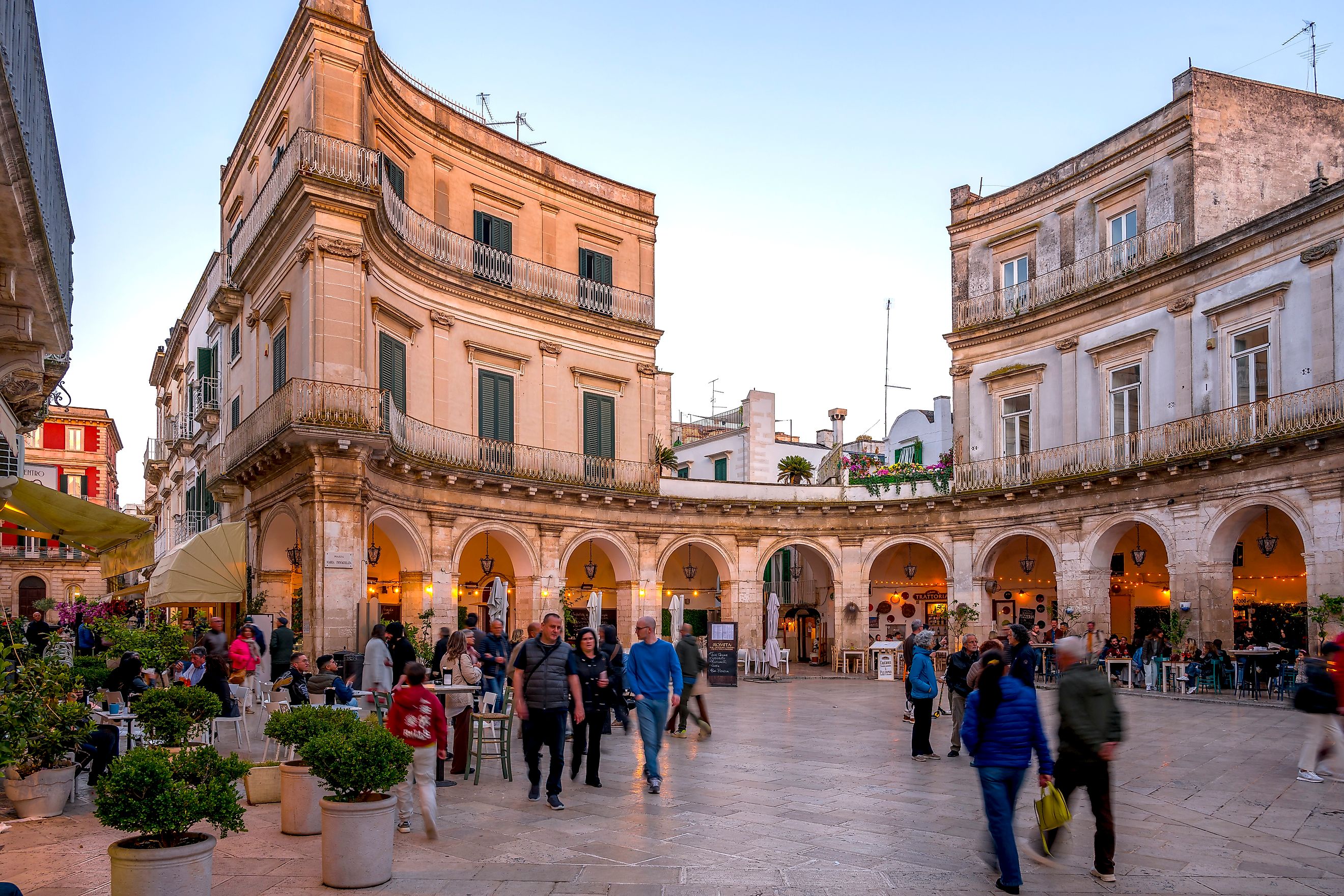
Martina Franca overlooks the Itria Valley from the southern edge of the Murgia plateau in Apulia. Much of its old town was rebuilt in the 18th century in a white-stone style of baroque and rococo known as barocco martinese, with carved window frames and wrought-iron balconies. Local tradition holds that the bulging petto d'oca (goose-breast) balconies were shaped to make room for the wide hooped skirts of the period. The main street is Corso Vittorio Emanuele, known locally as il Ringo, the route of the town's evening stroll.
Just outside the Porta di Sant'Antonio, the gateway to the old town, the late-17th-century Palazzo Ducale hosts the Festival della Valle d'Itria in its courtyard each summer. Founded in 1975, the opera festival specializes in rarely performed works and original versions of better-known ones. Farther along the Ringo, the Basilica di San Martino, built between 1747 and 1775, has a rococo facade crowned by a sculpted scene of Saint Martin and the beggar. Beside it, the curved neoclassical portico of Piazza Maria Immacolata once sheltered the town's market stalls. The town's signature food is capocollo, a cured pork cut marinated in cooked wine and smoked over oak bark.
Orvieto

Orvieto stands on a volcanic tufa butte whose sheer sides made it a natural fortress. The plateau was home to an Etruscan city, with traces of settlement reaching back to around the 9th century BCE, and the town's name comes from the later Latin Urbs Vetus, meaning "old city." Its white wine, Orvieto DOC, and its ceramics workshops remain part of everyday trade.
Corso Cavour, the main street, crosses the old town on an east-west line. At its midpoint stands the Torre del Moro, a 47 m (154 ft) medieval tower with a lift for the first stretch and more than 200 steps to the top. The tower marks the junction where Orvieto's four historic quarters meet. Via del Duomo branches off the corso to the cathedral, where the Chapel of San Brizio holds frescoes of the Last Judgment and the end of the world, begun by Fra Angelico in 1447 and completed by Luca Signorelli by 1504. Signorelli's figures are often cited as an influence on Michelangelo's Last Judgment in the Sistine Chapel. Back on Corso Cavour, the Montanucci family has operated its café for more than a century, and it is known for house-made chocolates.
Bosa

Bosa lies on the Temo River near the west coast of Sardinia, Italy's second-largest island. Coral fishing and lacemaking shaped its early economy, but tanning made it prosperous in the 19th century, and the old tannery buildings, known as Sas Conzas, still stand on the opposite bank of the river. The hills around town produce Malvasia di Bosa DOC, a white wine made in both dry and sweet styles, and a Malvasia wine route links the local cellars.
Corso Vittorio Emanuele II, the main street, parallels the river a block inland. Along it, the Museo Casa Deriu displays local embroidery and art. The corso widens into Piazza Costituzione and its old fountain, while the medieval Sa Costa quarter climbs the hill behind. At the top stands the Castello di Serravalle, built by the Malaspina family and traditionally dated to 1112, which is open to visitors.
Bassano del Grappa

Bassano del Grappa sits where the Brenta River emerges from the Alpine foothills, about 60 km (37 miles) northwest of Venice. The town was called Bassano Veneto until 1928, when it took the name of nearby Monte Grappa to honor the Italian soldiers who fought there in World War I. Its landmark is the Ponte Vecchio, also called the Ponte degli Alpini, a covered wooden bridge designed by Andrea Palladio in 1569 and rebuilt several times since. At the foot of the bridge, the Nardini grapperia, founded in 1779, claims to be Italy's oldest distillery and still serves grappa, a brandy distilled from grape pomace. Printing and ceramics built the town's reputation, along with the white asparagus grown on the surrounding plain.
The main shopping route strings together Via Roma and the cobbled Via Gamba around the town's two connected central squares, Piazza Libertà and Piazza Garibaldi. Palazzo Sturm houses a ceramics museum and a collection of prints from the Remondini firm, which operated in Bassano from the 17th century until 1861 and grew into one of the largest print publishers in 18th-century Europe.
Tropea

Tropea sits atop a cliff roughly 60 m (200 ft) above the Tyrrhenian Sea, on the stretch of Calabrian shore known as the Costa degli Dei (Coast of the Gods). Local legend credits Hercules with founding the town. Its clifftop position made it a stronghold against Saracen and later Ottoman raids, and the old town still ends abruptly at the cliff edge, where lookout balconies face the water.
Corso Vittorio Emanuele leads through the old town toward the sea. It and the lanes around it are dotted with the carved stone portals of noble palazzi, a feature Tropea is known for. The corso opens onto Piazza Ercole, named for the town's legendary founder and home to the Sedile dei Nobili, where the local nobility once met. Below the cliffs, public beaches such as Spiaggia della Rotonda face clear turquoise water.
The Everyday Heart Of Small-Town Italy
Italy's small towns, strung along the Apennines and out to the islands, still do much of their living on a single main street. At the foot of Orvieto's Torre del Moro, Corso Cavour marks the meeting point of the city's four historic quarters. Bassano del Grappa's streets lead to a wooden bridge Palladio designed in 1569, and Tropea's corso ends at a cliff edge high above the Tyrrhenian Sea. Each of these streets shows how local trades and histories still shape the everyday center of Italy's smaller towns.