The Deep-Sea Creatures We Only Discovered Recently
A ghost-white octopus known simply as "Casper," discovered near Hawaii, still has no scientific name a decade after scientists first saw it. Another newly recognized animal, pulled from almost five miles down in the Atacama Trench, turned out to be an active predator. The deep sea is still producing animals that science has never documented before, including creatures first encountered or formally described within roughly the past decade. Every creature here lives thousands of feet beneath the surface, well beyond the familiar coastal ocean.
The "Mystery Mollusc"

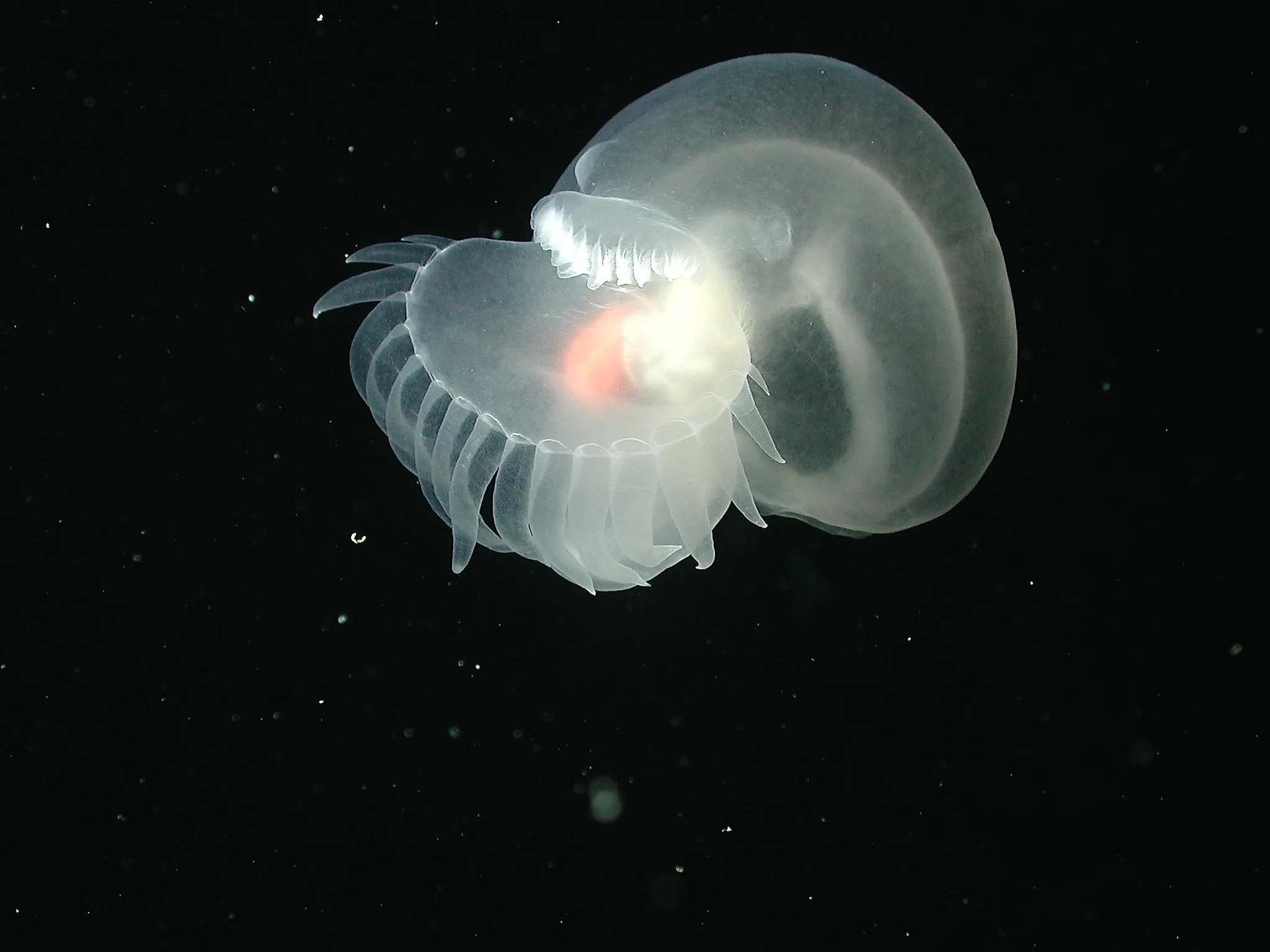
For more than two decades, researchers off California knew they were looking at something strange. They just did not know exactly what it was. MBARI scientists first encountered the translucent animal off Monterey Bay in 2000 at a depth of 2,614 meters, or 8,576 feet. It had a huge hood at one end, a paddle-like tail at the other, and a snail-like foot. Researchers nicknamed it the "mystery mollusc." After more than 150 observations and extensive anatomical and genetic work, scientists formally described Bathydevius caudactylus in 2024.
It proved stranger than expected. Bathydevius is a nudibranch, or sea slug, but it is the first known nudibranch adapted to living in the deep open-water column rather than on or near the seafloor. It inhabits the midnight zone roughly 1,000 to 4,000 meters down and has been observed between Oregon and Southern California. Its cavernous hood traps crustaceans, while its body can produce bioluminescence. On one occasion, researchers watched one detach a glowing projection from its tail, apparently leaving the bright object behind as a distraction.
Duobrachium sparksae

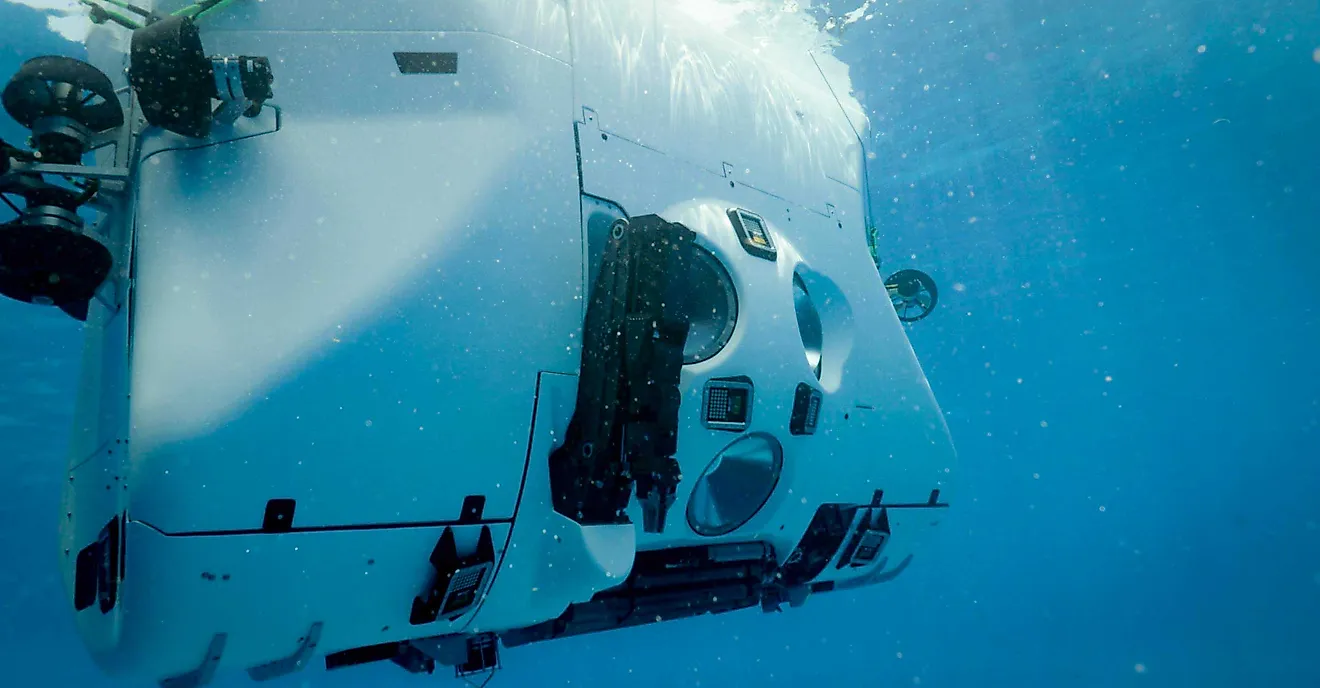
A NOAA expedition near Puerto Rico found an animal in 2015 that looked like a transparent balloon trailing two long arms through the darkness. It was a comb jelly, but not one scientists recognized. The three animals were observed about 3,900 meters, or 12,795 feet, below the Atlantic surface. They were so delicate that researchers did not collect a physical specimen. Instead, scientists used detailed high-definition footage recorded by the remotely operated vehicle Deep Discoverer to study the animals. In 2020, they named the new genus and species Duobrachium sparksae.
For NOAA, it was an unusual milestone. The agency had never before used video alone to formally establish both a new genus and species. That approach would be difficult with many animals, but gelatinous creatures can be especially challenging to collect without damaging them. The discovery happened in deep waters off Puerto Rico, putting one of the strangest recent additions to the marine catalog in the US Caribbean.
The "Casper" Octopus

One of NOAA's most famous deep-sea encounters remains scientifically unresolved. In February 2016, Deep Discoverer was exploring near the Hawaiian Archipelago when its cameras found a tiny, nearly colorless octopus sitting on the seafloor 4,290 meters, or about 14,000 feet, down. Its pale body inspired the nickname "Casper." The animal was an incirrate octopus, the group containing many of the more familiar finless octopuses, but none had previously been documented at such an extreme depth.
A decade later, NOAA reported in February 2026 that Casper still had not received a scientific name. Scientists have seen similar animals since the original encounter and have even gathered clues about their reproduction, including observations of Casper-like octopuses brooding eggs on dead sponge stalks. But researchers still lack what they need for a formal description. The animal is considered almost certainly an undescribed species and could even represent an undescribed genus.
The E.T. Sponge

NOAA explorers began encountering an unusual glass sponge in the central Pacific in 2015. A specimen was collected the following year, and researchers later found more around Johnston Atoll and the seamounts north of Hawaii. Its long stalk and body with two large openings gave it an uncanny resemblance to an alien head, earning it the nickname "E.T. sponge."
Detailed examination showed that it was not merely a new species. Scientists had to create an entirely new genus for it. In 2020, the sponge received the name Advhena magnifica, which roughly reflects its "magnificent alien" appearance. One specimen was collected at approximately 2,000 meters, or 6,560 feet. NOAA subsequently encountered the species again during Pacific exploration in 2025.
Dulcibella camanchaca

One of the more intimidating recent discoveries came from considerably deeper water. During a 2023 expedition to the Atacama Trench off South America, researchers collected four unfamiliar crustaceans at 7,902 meters, or nearly 26,000 feet. Genetic and anatomical analysis showed that the animal represented both a new species and a new genus. Scientists described it in 2024 as Dulcibella camanchaca.
The animal is only about four centimeters long, but its behavior is notable. Researchers described it as the first large, active predatory amphipod identified at these extreme Atacama Trench depths. It swims through the hadal darkness and uses specialized appendages to seize smaller amphipods.
A New Ghost Shark

Scientists announced Harriotta avia, the Australasian narrow-nosed spookfish, in 2024 after determining that specimens from the waters around Australia and New Zealand did not belong to the species with which they had previously been grouped. Spookfishes are chimaeras, relatives of sharks and rays that have inhabited Earth's oceans for hundreds of millions of years.
Harriotta avia has an elongated snout, large eyes, a slender body, and unusually broad pectoral fins. It inhabits deep water reaching about 2,600 meters, or 8,500 feet. Because animals living at those depths are difficult to observe repeatedly, researchers still know relatively little about its biology and conservation status.
The Deep Ocean Is Still Producing Surprises
The striking part of these discoveries is not simply that scientists are finding tiny obscure organisms. Within the past decade, researchers have encountered or formally described a ghostlike octopus near Hawaii, an entirely new kind of deep-water sea slug off California, a previously unknown comb jelly near Puerto Rico, and even a new deep-sea relative of sharks.
Better cameras, genetic analysis, and submersibles are making parts of the ocean accessible that were once nearly impossible to study. Yet the Casper octopus shows how incomplete that access remains. Scientists have known it exists since 2016, have seen similar animals since, and still cannot formally say exactly what it is. Ten years after humans first pointed a camera at it, one of the deep Pacific's most recognizable animals remains scientifically unnamed.