How Lake Titicaca Compares To The Great Lakes
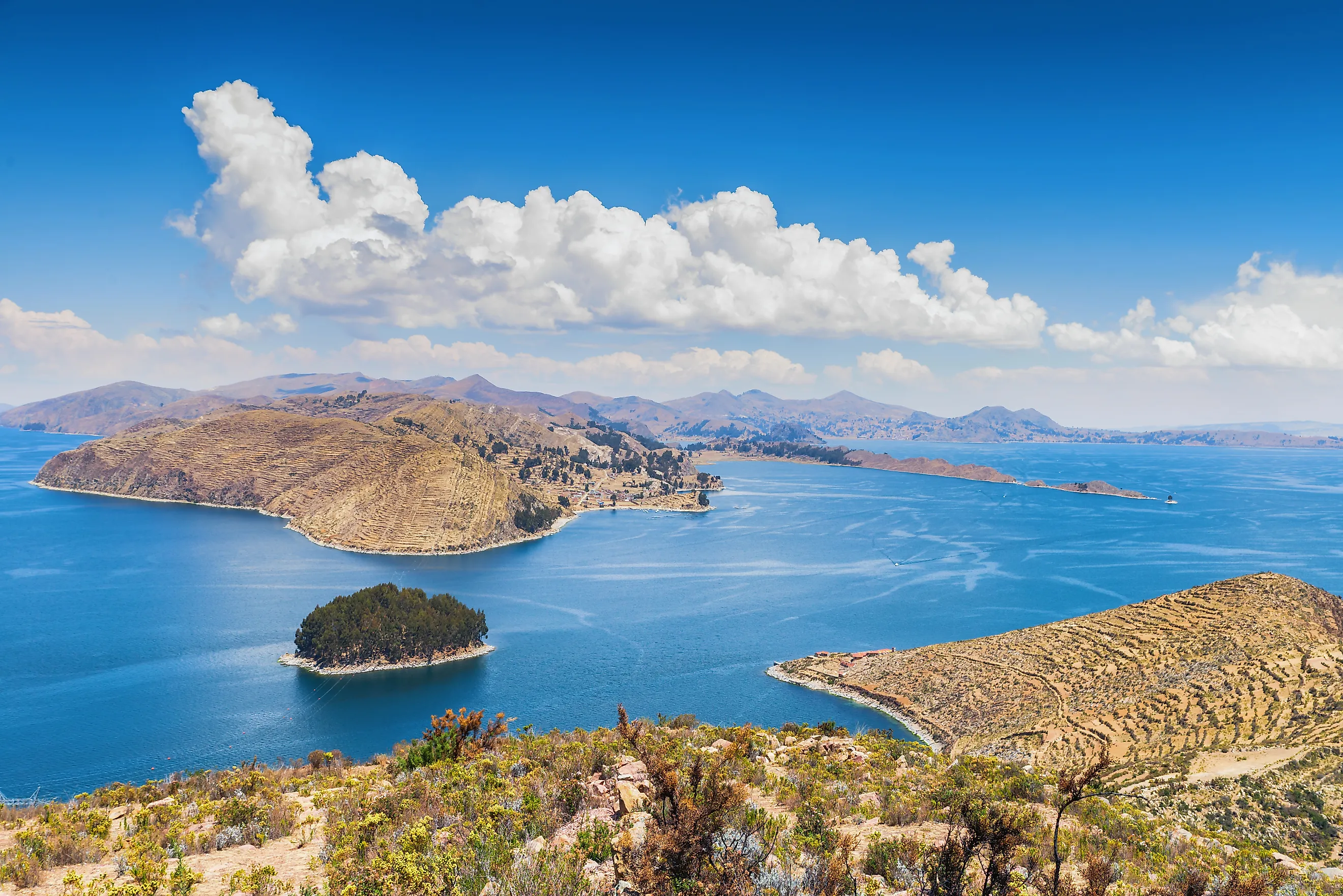
High in the mountains of Peru and Bolivia there is a vast lake that can rival the Great Lakes: Lake Titicaca.
Lake Titicaca is comparable in volume to the smaller Great Lakes, but is much smaller in surface area than all of them. What sets this lake apart is its geological history, as it dates back millions of years before the Great Lakes formed.
This ancient lake was of deep importance to the people who lived here, with one legend stating that this body of water was the birthplace of the Incan Empire itself, a civilization that came to its end when it met the Spanish conquistadors in the 16th century.
Lake Titicaca's dimensions

Lake Titicaca is the largest freshwater lake in South America by surface area at 3,200 square miles. It is 120 miles long from northwest to southeast, and is 50 miles wide at its widest point. This is less than half the size of the smallest Great Lake, Lake Ontario, at 7,340 square miles, and is a mere fraction of the size of the 31,700 square mile Lake Superior, the largest freshwater lake on Earth by surface area.
In reality, the lake is actually two bodies of water, separated by a strait called Tiquina. In Peru, the larger body of water is called Lago Grande, while the smaller is called Lago Pequeno, meaning "large lake" and "small lake" in Spanish.
Its overall water volume is 214.24 cubic miles, which is more than Lake Erie at 116 cubic miles. However, it isn't even a tenth of the water volume of Lake Superior, which consists of 2,900 cubic miles.

Where Lake Titicaca stands out is its depth. Its average depth of about 350 feet tops every Great Lake, except Superior. In terms of maximum depth, it beats out all of the Great Lakes save for Lake Michigan's 925-foot deepest point and Lake Superior with its 1,332-foot deepest point.
Lake Titicaca is fed by more than 25 rivers, of which the largest is the Ramis River. Although it is fed by many rivers, it only has one outlet: the Desaguadero River to its south. This river only takes away 5% of the lake's excess water, with the rest evaporated by the sun and winds from the High Plateau.
Geology

Lake Titicaca's origins date back millions of years ago with the development of the Tinajani Basin, which began to form at some point 27 to 20 million years ago as fault lines pulled apart in a strike-slip movement within the Andean Mountains. The basin itself has volcanic rocks from this time period and is much larger than the lake, covering 22,400 square miles of the High Plateau of the central Andes Mountains.
Several ancestral lakes filled the basin prior to Lake Titicaca itself, including Lake Mataro, Lake Cabana, Lake Ballivan, Lake Minchin, and Lake Tauca. As for Lake Titicaca itself, it began forming in the basin around 3 million years ago from a collection of precipitation and glacial melt. It is one of only a handful of ancient lakes left in the world, including Lake Baikal, a 25-million-year-old lake in Siberia.

Lake Titicaca is the highest navigable lake on Earth, sitting at 12,500 feet above sea level. For comparison, this is only 1,940 feet shorter than the highest peak in the Rocky Mountains: the 14,440-foot-tall Mount Elbert in Colorado.
By comparison, the Great Lakes sit at a much lower level, with even its highest point, Lake Superior, being only 600 feet above sea level at its furthest point. In addition, the Great Lakes are younger, first originating 20,000 years ago as the Laurentide ice sheet began to melt. There were several periods of glacial advancing and retreating during this time period, and the Great Lakes did not reach their current shape until 3,000 years ago.
Humans by Lake Titicaca

There is evidence of people living within the Titicaca area as early as 8,000 BCE, but the first permanent settlement didn't emerge until around 2,000 BC, with the discovery of pottery on the southern end of the lake.
Humans relied on this lake for fish and reeds to make boats and mats, along with growing potatoes, quinoa, and oca, and mining for precious metals in the surrounding mountains. Human development tended to focus more on the southern end of the lake due to warmer temperatures and better soil.
Prior to the Incas, the Tiwanaku culture rose to prominence on the southern end of the lake from 200 BC to 1,100 CE, alongside the Pucara culture to the north. The Tiwanaku left behind several structures of note, such as pyramids and the Gateway of the Sun. It was centered around the city of Tiwanaku itself, which was large enough to support up to 70,000 people. Historians believe that a drought in the 11th century could have been the main culprit for why this civilization disappeared.

In the 15th century, the Incas came to control Lake Titicaca, defeating several leaders near the Desaguadero River under the command of Pachacuti Inca Yupanqui. The tribes were resettled throughout the burgeoning Incan Empire, which at its height stretched from Ecuador all the way to Chile.
The lake was also considered a holy site for the Incas, as they believed that their founder Manco Capac and wife Mama Ocllo were born out of a rock. They would construct several religious sites around the lake, including a Palace of the Virgins of the Sun on the Island of the Moon.
When the Spanish conquistadors arrived in 1532, they heard stories of treasure that had been left behind in the lake as offerings. In fact, 10 men drowned in 1541 while diving through the depths looking for the treasure. The Spanish settlers conquered the Incan capital of Cuzco in 1533, although they would fight against Incan groups until 1572.
Lake Titicaca today

Lake Titicaca today provides water for agriculture, industrial, and drinking use for people in Bolivia and Peru, as well as serving as a tourist destination for those visiting South America. They are also a rich source for archaeological discovery. In 2000, archeologists discovered a sunken city near the town of Copacabana, Bolivia. This city included a road, agricultural terraces, and even a stone wall. This city is believed to have been built by the Tiwanaku people and dates back to 500 to 1,000 AD.
On the islands of Lake Titicaca themselves is home to the Uros people, who still build floating islands out of reeds and who still speak the Aymara language today. While Lake Titicaca isn't nearly as big as the Great Lakes, its heritage goes back much farther, encompassing tectonic activity, sacred temples, and hidden treasures under the surface.