How Long Would It Take To Sink To The Ocean Floor?
Mathematically speaking, it would take just about 2.5 hours to reach the deepest part of the ocean, assuming we are traveling at a constant speed from the surface to the deepest point of the ocean. With that said, the real answer to the question varies, particularly as we add additional factors into the equation. The deepest part of the ocean is 35,876 feet (10,935 meters), and while it takes deep-sea equipment over two hours to get to the bottom of the Challenger Deep, a human is different.
The shape and size of something determine how it sinks and how fast. The truth is, as you sink, many things, like your clothing, how big or small you are, or even whether you're holding your breath, affect how fast you sink.
How Deep Is the Ocean?

The average depth of the ocean is about 12,080 feet (3,682 meters). This calculation was based on satellite measurements from 2010. There are five zones when considering ocean depth. The sunlight zone is the one we know best, as 90% of all marine life lives there. It is anywhere from 0 to 656 feet (0 to 200 meters). After that comes the twilight zone, the midnight zone, the abyssal zone, and the hadal zone.
Most of the ocean hasn't been explored yet. As of April 2026, only 28.7 percent of the global seafloor has been mapped with high-resolution technology. Around the United States, about 56 percent has been mapped, but there is still plenty to explore.
More than 90 percent of the ocean is deep ocean, making the majority of it harder to explore. The deepest point is the Challenger Deep, at roughly 35,876 feet (10,935 meters).
What Determines How Fast Something Sinks

The shape, size, and density of an object all determine how fast it sinks. Say you take a pebble and drop it into the deepest part of the ocean; it would take anywhere between 1 and 6 hours to reach the bottom because the water pushes back against it.
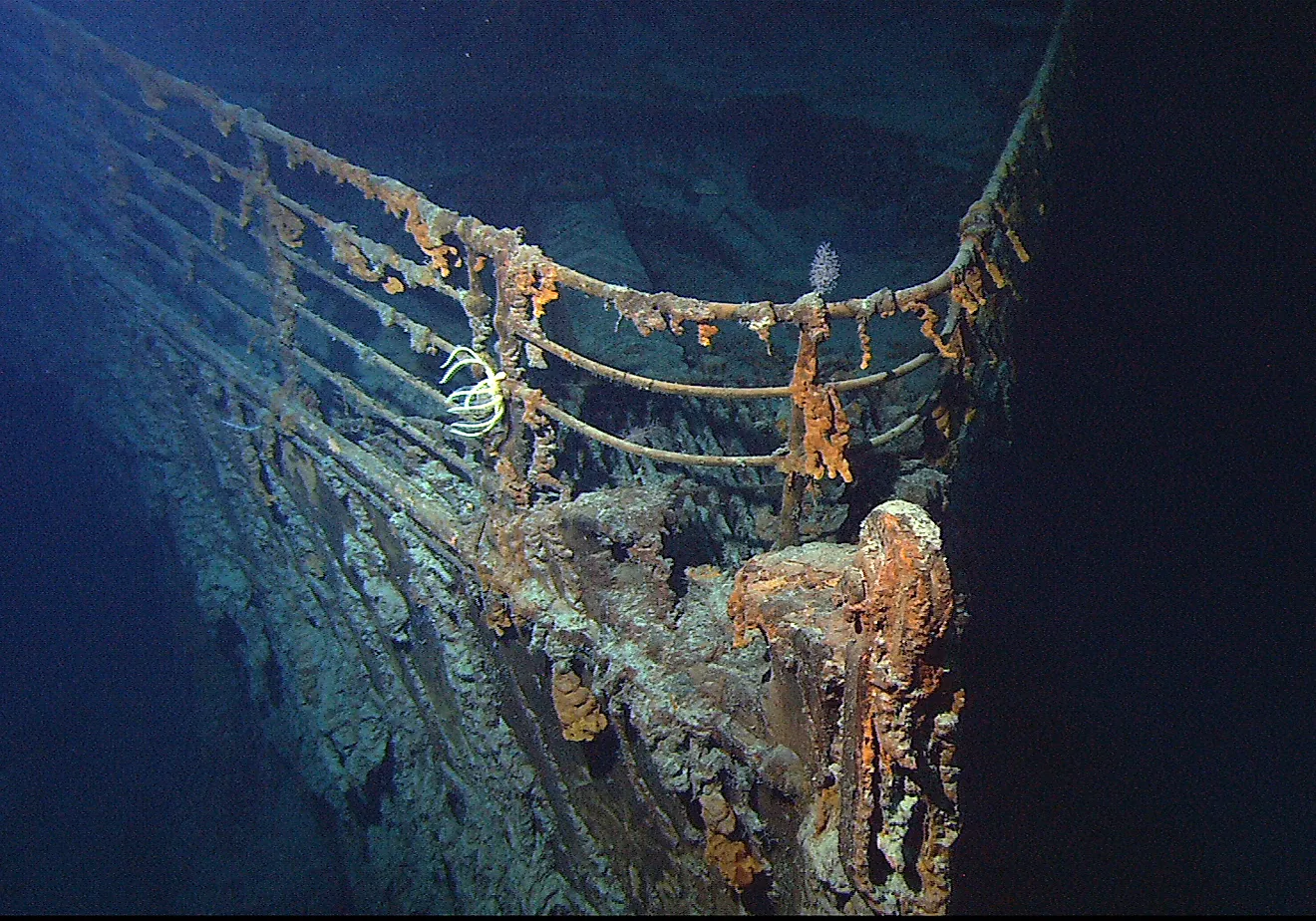
Dense or streamlined objects cut through the water much faster and can reach the bottom in minutes. Whereas structures take far more time. One of the most famous is the Titanic, whose bow section took 5 to 6 minutes to sink 12,451 feet, although the total ship took around two hours and 40 minutes to sink.
Mathematically, it would take a human 2.5 hours to reach the deepest part of the ocean by sinking, if we assume the human is falling constantly at the terminal velocity speed. However, there are plenty of factors that could affect this number. Clothing, how much air is in the lungs, decomposition, and scavengers make that number just a theory.
How Fast Would a Person Sink?

The truth is, it depends.
All the math says it would take 2.5 hours to reach the deepest part of the ocean. The terminal velocity, the fastest something can go, would be roughly 0.5 to 1 mph. That isn't super fast, and that is assuming they have fully exhaled. What makes that hard to determine in real-world conditions is how much someone weighs, what they are wearing, and the marine life present.
We know this because of whales. Whales have taught us that after gases finally escape from decomposition, it takes about 1 to 4 hours to reach the average ocean floor depth of 12,080 feet. If we ignore currents, scavengers, and everything else that affects how fast something sinks, it would sink quickly. The heavy muscle and bone are what sink to the bottom.
What Happens As You Sink Deeper?

Once a human sinks deep enough into the ocean, any part of the body that still has air will collapse. Unlike the common myth, once a human reaches the bottom, the body doesn't flatten. Internal organs do deform under the thousands of pounds of pressure, but not to the point of being unrecognizable.
The bottom of the ocean ranges anywhere from 34°F to 39°F (0°C to 3°C). The water pressure prevents the body from freezing solid, but the extreme cold slows normal bacterial putrefaction.
The deepest anyone has gone in a no-limit free dive is 831 feet (253.2 m). This did not go without complications, as the diver experienced decompression sickness during the dive. Decompression sickness is caused by dissolved gases forming bubbles inside the body tissues during decompression. If not treated properly, it can easily be fatal.
There Is No Single Answer

The deeper the ocean gets, the less useful a simple stopwatch becomes. A mathematical estimate can suggest how long a descent might take under fixed conditions, but real bodies and real oceans do not behave so neatly. Things like buoyancy, lung volume, clothing, and drag can all change how quickly a person sinks. At extreme depths, crushing pressure and near-freezing temperatures add even more complexity. That uncertainty is part of what makes the deep ocean so difficult to study. Even with modern mapping and submersibles, much of the seafloor remains poorly understood, leaving plenty of questions about what exists beneath the surface.