The Creatures Waiting At The Bottom Of The Deep Sea
At the bottom of the deep sea, it seems the creatures get stranger the farther down they live. The Mariana Trench is about as deep as the ocean gets, bottoming out at Challenger Deep some 10,935 m (35,876 ft) below the surface, and its inhabitants are every bit as strange as that suggests. Fish with enormous teeth and glowing lures share that water with animals that resemble imaginary sea monsters more than living creatures, making the deepest parts of the ocean home to some of Earth's most unusual inhabitants. Below are eight of the weirdest species that actually live at the bottom, or very near it, in the deep sea.
Tripod fish (Bathypterois grallator)

The Tripod fish is an elongated, deep-sea fish that appears to stand upright on the deep-ocean floor at depths between 900 and 4,700 m (2,950 to 15,400 ft). The fish lives in total darkness, which renders its tiny eyes virtually useless. Instead, to survive, it faces the current and uses its pectoral fins to detect passing prey, then directs the food towards its mouth. Its body is only about 30 cm (12 in) long, but its fins can be almost 1 m (3.3 ft) long, approximately three times its body length. Tripod fish are hermaphrodites, meaning they have both male and female reproductive organs. If a fish can't find a mate in the sparsely populated deep sea, it can fertilize its own eggs, ensuring the survival of the species.
Goblin shark (Mitsukurina owstoni)

With a reputation as the "ugliest shark on the planet," Goblin sharks are a rare species of deep-sea shark, known to dive to depths between 244 and 914 m (800 and 3,000 ft). Thanks to their protruding jaws, pointy snouts, and rows of sharp teeth, goblin sharks have taken on a mythological quality because they are seldom seen alive, only accidentally hooked on a fishing line. Recorded lengths range between 2.7 and 6.1 m (9 and 20 ft), with semi-translucent skin that appears pink. Scientists believe the sharks can live up to 60 years, but goblin sharks are an ancient species that have inhabited the oceans for about 125 million years.
Living goblin sharks were filmed in their own habitat for the first time only recently, in two separate encounters. A camera aboard the remotely operated vehicle Hercules recorded one in 2019 at a depth of 1,237 m (4,058 ft) near a seamount northwest of Jarvis Island, a US territory in the central Pacific, though the animal went unidentified until researchers reviewed the archived footage years later. A baited seafloor camera caught a second individual in 2024 during an expedition to the Tonga Trench, at 1,997 m (6,552 ft). That is roughly 700 m (2,300 ft) deeper than the species had ever been recorded, and the deepest confirmed sighting of any mackerel shark, the order that also contains the great white.
Black Seadevil (Melanocetus johnsonii)

The Black Seadevil is one of the strangest deep-sea anglerfish, using a glowing lure powered by bioluminescent bacteria to attract prey in the darkness. Its scientific name, "Melanocetus," comes from Greek words meaning "black sea monster," the perfect name for a fish that looks like something out of a nightmare. Fortunately, the female black seadevil grows to only 15 cm (6 in) long, while the male, whose only job is to reproduce, remains under 3 cm (1 in) long. Like many creatures waiting at the bottom of the deep sea, it lives in near-total darkness between 200 and 2,000 m (660 to 6,560 ft) below the ocean surface.
Another fish with a reputation for being rarely seen in the wild, a team of researchers in the Canary Islands caught a single black seadevil anglerfish swimming uncharacteristically near the ocean's surface in January 2025. Previously, the sea creature was captured on video only once, in 2014, in Monterey Bay by the remotely operated vehicle Doc Ricketts at a depth of 580 m (1,900 ft).
Stoplight Loosejaw (Malacosteus niger)

The Stoplight Loosejaw is an unattractive member of the dragonfish family, with a highly hinged lower jaw that allows it to open its mouth wide enough to ambush prey in a sudden, gaping strike. Like the Black Seadevil, the Stoplight Loosejaw uses bioluminescence to hunt in the darkness, but its approach is very different. Instead of dangling a glowing lure in front of its mouth, it has bioluminescent organs beneath its eyes that produce red light, allowing it to illuminate potential prey. It is a relatively small fish, growing no longer than 25 cm (9.8 in). Sightings of the stoplight loosejaw in the wild are extremely rare, as the fish lives at depths of 500 m (1,640 ft) to nearly 3,900 m (12,800 ft) below the surface, in the perpetual darkness of the deep sea.
Dumbo Octopus (Grimpoteuthis spp.)

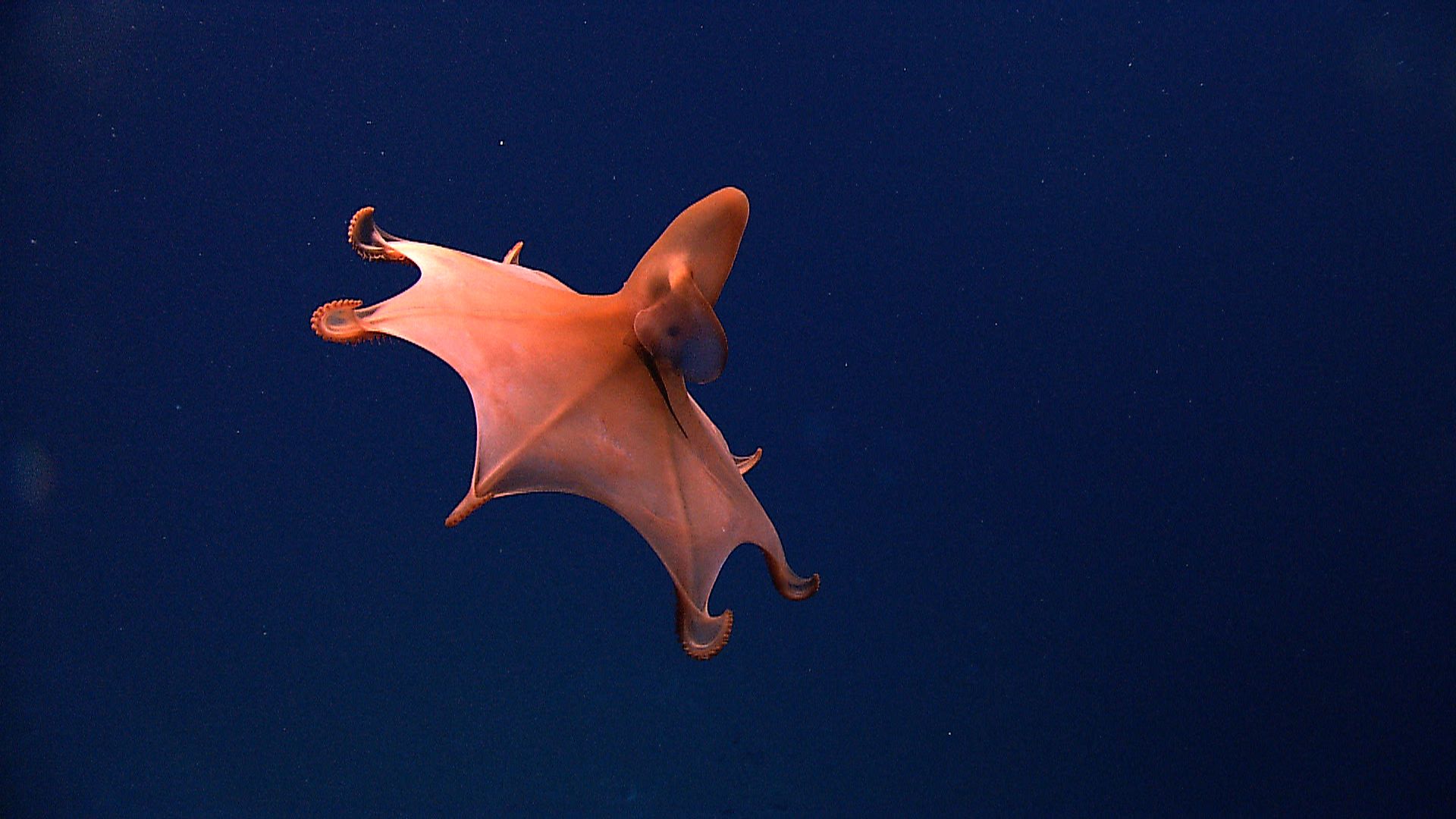
Dumbo octopuses are among the deepest-living of all octopus species, named for the ear-like fins on their heads that resemble Disney's famous flying elephant, Dumbo. These unusual creatures live on the deep-ocean floor at depths of 3,000 to 4,000 m (9,800 to 13,000 ft) in oceans worldwide. Dumbo octopuses have webbed skin between their arms, giving them an umbrella-like appearance, and average between 20 and 30 cm (7.9 to 12 in) in length. The largest Dumbo octopus ever recorded was 1.8 m (5 ft 11 in) long and weighed 5.9 kg (13 lb). They have been found in New Zealand, Australia, Monterey Bay, Oregon, the Philippines, and Papua New Guinea.
Giant Isopods (Bathynomus giganteus)

Giant isopods look like pill bugs blown up to gigantic proportions, thought to be the result of adapting to living under the extreme pressure of the deep sea. Found on the ocean floor, giant isopods are the largest known isopods, a group of crustaceans closely related to shrimp and crabs. They scavenge for food on the seafloor at depths of 170 to 2,140 m (550 to 7,020 ft), waiting for dead fish, crabs, squid, sponges, and even whale carcasses to sink from above. These scavengers can grow to around 19-36 cm (7.5-14.2 in) in length.
Known for surviving up to 4 years without food when kept in a protected environment, they will gorge themselves when finally given food until they can barely move. Researchers examining the stomach contents of three giant isopods collected near the Yucatan Peninsula in the southern Gulf of Mexico found large quantities of plastic.
Vampire Squid (Vampyroteuthis infernalis)

With a scientific name meaning "vampire squid from hell," the Vampire Squid was first described in 1903 and initially mistaken for an octopus. Scientists later discovered that it was neither a squid nor an octopus, but a unique deep-sea creature that belongs to its own order, Vampyromorphida, and family, Vampyroteuthidae. Today, it is the only living species in that order.
One of the most striking characteristics of the vampire squid is its enormous eyes, which are among the largest compared to the body size of any animal. Its eyes can grow to about 2.5 cm (1 in) in diameter, while its body reaches only about 30 cm (1 foot) in length. Adding to its otherworldly appearance, light-producing organs on the tips of its arms produce a bright blue bioluminescent glow. The sea creature lurks at depths of 600 to 3,300 m (1,970 to 10,830 ft), where it is a "detritivore," meaning it feeds strictly on dead matter called "marine snow," such as dead animals, rotting materials, snot, and poop.
Sea Pig (Scotoplanes globosa)

The Sea Pig is another detritivore commonly found on the muddy seafloors of the Atlantic, Pacific, Indian, and Southern Oceans, usually in the company of young crabs who use the pigs for protection from predators. Scotoplanes globosa has been studied extensively by the Monterey Bay Aquarium Research Institute (MBARI) in the Monterey Bay area. Its name comes from its pink-colored, translucent body, but despite being pig-like in its slow-moving habit of snuffling through the detritus on the seafloor, it is a type of sea cucumber. Most sea pigs are between 4 and 15 cm (1.5 to 6 in) long and are found all over the world at depths of 550 to 6,700 m (1,800 to 22,000 ft). Resembling a tiny alien, the sea pig has tube feet on its back and underside, as well as around its mouth.
The Weirdest Creatures of the Deep Sea
Glow-in-the-dark anglerfish, sharks with flexible jaws, walking fish, giant isopods, and sea pigs all share the same address. The deep ocean is filled with creatures that seem almost too strange to be real. These eight unusual animals have adapted to life in one of Earth's most extreme environments, where encountering one in the wild is about as unlikely as it gets. Still, reading about these otherworldly creatures is the next best thing to seeing them firsthand.