Why Lake Tahoe Never Freezes
Lake Tahoe sits at 6,225 feet in one of the snowiest mountain ranges in the country, surrounded by ski resorts that measure their winters in feet rather than inches. It has never frozen over in recorded history, and it is not going to.
The reason is not that the water is warm. It is that fresh water does something counterintuitive at 39 degrees Fahrenheit, and Lake Tahoe is far too big to let it happen.
Water Is Heaviest At 39 Degrees, Not 32

Nearly every substance gets denser as it cools, right down to the point where it solidifies. Fresh water quits early. It reaches maximum density at about 39.2 degrees Fahrenheit, a full seven degrees above freezing, and then starts getting lighter again.
That quirk is why ice floats, and it is why lakes freeze from the top rather than the bottom. It also sets a condition that has to be met before any lake can ice over.
Surface water cools, becomes denser, and sinks. Warmer water rises to replace it, cools, and sinks in turn. That cycle keeps running until the entire water column has reached 39.2 degrees. Only then can the surface layer cool past that point, become buoyant, and start forming ice.
Tahoe Cannot Finish The Job Before Spring

Tahoe is 1,645 feet deep at its maximum and averages around 1,000 feet, which makes it the second-deepest lake in the United States behind Crater Lake and the sixth-deepest in the world by average depth. It holds roughly 39 trillion gallons.
Chilling all of that to 39.2 degrees would take a cold season far longer and far harsher than the Sierra provides. Every winter the lake starts the process, mixing deeper and deeper as surface water sinks, and every spring the sun turns up before the job is finished.
The temperature record shows exactly where it stalls. The lake is coldest in late March, at around 41 degrees at the surface, easing to 39 degrees only at 500 or 600 feet down. The top layer never gets cold enough to sink past that depth, so the deep water never cools and the surface never freezes.
Shape Matters As Much As Size

A lake loses heat through its surface, and Tahoe has remarkably little surface for the volume behind it. Twenty-two miles long and twelve wide, with a mile-deep bathtub underneath, it has one of the lowest surface-area-to-volume ratios of any lake in North America.
Compare that with a reservoir ten feet deep. Same square mileage of surface losing heat, a tiny fraction of the water behind it, and the whole thing hits 39 degrees in a week and freezes in the next one.
Tahoe's famous clarity works against freezing too. Water this clear lets sunlight reach far deeper than it would in a murky lake, so solar energy is absorbed through hundreds of feet of water rather than just the top few.
Emerald Bay Is The Exception That Proves It

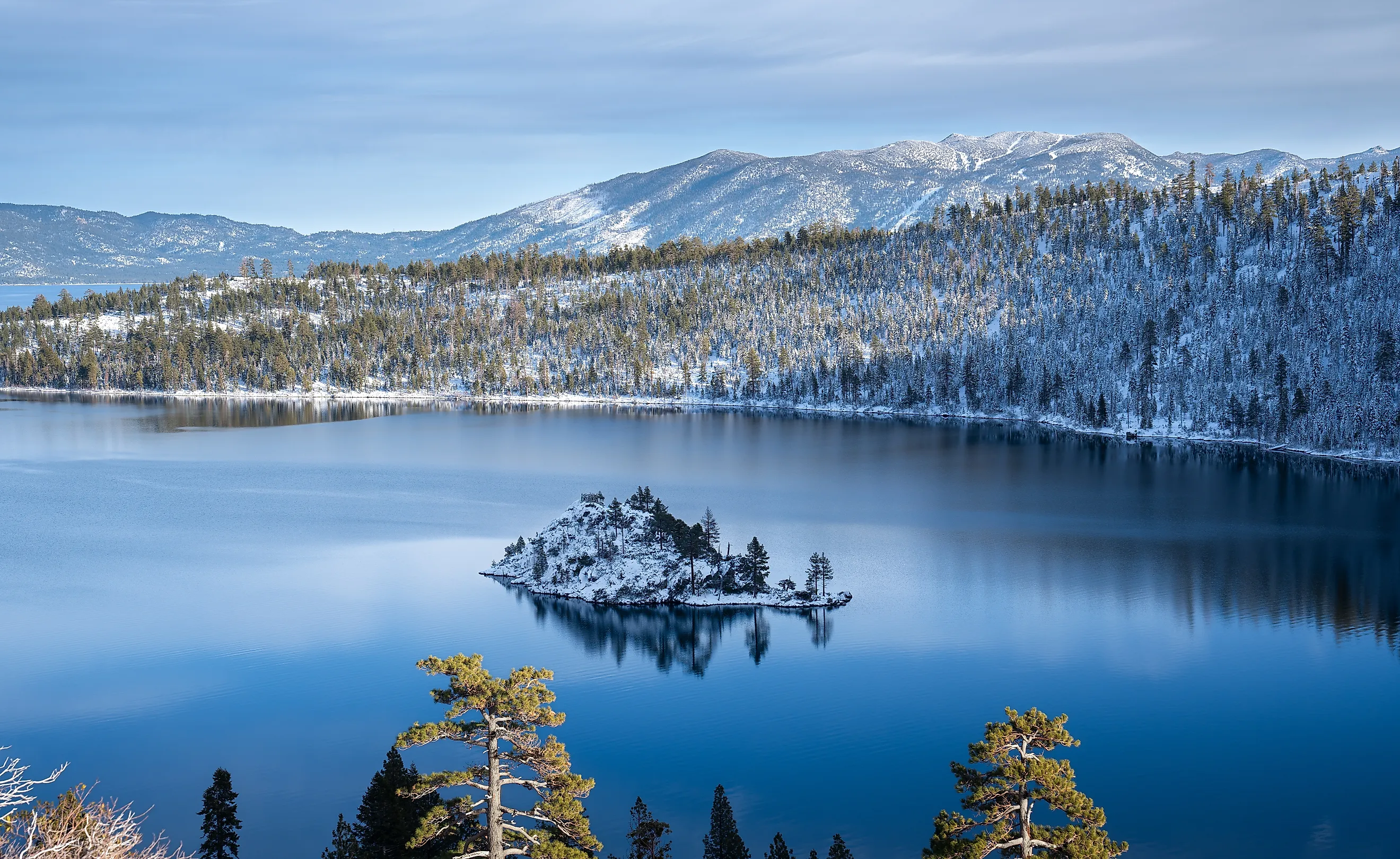
One corner of Tahoe does freeze, occasionally. Emerald Bay reaches about 230 feet deep and connects to the main lake through a channel only six to eight feet deep, which effectively makes it a separate body of water with its own thermal budget.
Shallower, sheltered, and with a much higher surface-area-to-volume ratio, the bay can reach 39 degrees top to bottom in a severe winter and skin over. It did so in 1952, again in the 1990s, and once more in the early 2020s, which gives you a sense of the frequency.
Every one of those events is the same physics working on a smaller volume, which is the clearest possible demonstration of why the main lake stays open.
The Mixing Does Another Job Entirely

That failed annual attempt at freezing is doing something vital. The sinking surface water carries dissolved oxygen into the depths, and it is essentially the only mechanism that gets oxygen down there. Tahoe's water has a residence time of around 650 years, with only about 0.1 percent replaced annually, so nothing else is going to do it.
In cold winters the lake mixes all the way to the bottom. In mild ones it only mixes partway, and researchers at UC Davis have warned that if full-depth mixing stops for twenty or thirty years, nutrients locked in the sediment could be released into the water column.
That would threaten the clarity the lake is known for. So the irony sits neatly: the process that stops Tahoe freezing is the same process keeping it blue, and warming winters put both at risk.
What Would Actually Have To Change

Two things could put ice on Lake Tahoe, and neither is happening. The climate would have to turn substantially colder for long enough each winter to chill 39 trillion gallons to 39.2 degrees. Or the basin would have to fill with sediment until it was shallow enough to give up its heat in a season.
The second is technically underway, since every one of the 63 tributaries carries sediment in, but the timescale runs to hundreds of thousands of years. The first is moving in the opposite direction.
So the surface temperature holds between about 40 degrees in late winter and the high 60s in August, snow piles up on the shoreline in California and Nevada, and the water sits there refusing to cooperate. Bring a wetsuit rather than skates.