How Low The Mississippi Has To Drop Before Barges Stop
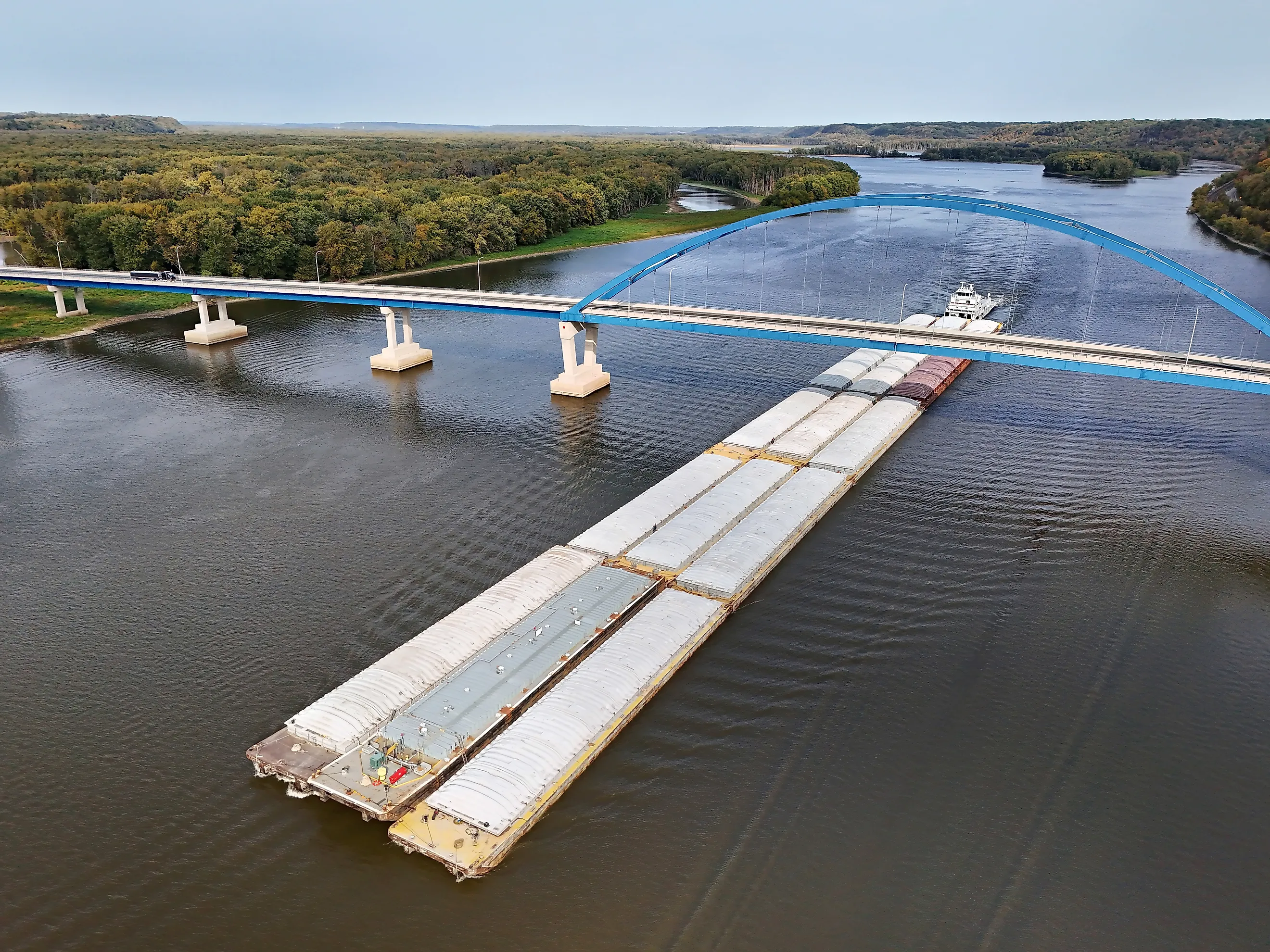
Barges do not stop. That is the first thing to understand about low water on the Mississippi, and it is why the question has a more interesting answer than a single number. What happens instead is a cascade of restrictions that begins when the Memphis gauge hits minus five feet. Each foot below that costs about 200 tons of cargo per barge, and the channel narrows until tows are cut from forty barges to twenty-five, then fifteen, then five across. By the time the river reaches its record low, the system is still running and carrying a fraction of what it should.
Minus Five Feet Is The Trigger

The number everything turns on is a gauge reading at one city.
The low water threshold at Memphis is minus five feet. When the gauge drops below it, the Coast Guard has in recent years imposed a nine-foot maximum draft on barges operating on the lower river.
Negative readings sound alarming and are not what they appear. A gauge reading zero or below does not mean the river has gone dry, only that it has fallen below an arbitrary reference point set long ago.
Each Foot Costs 200 Tons

This is the piece of arithmetic that governs the whole industry response.
A barge in good conditions loads to about 12 feet of draft and carries roughly 1,500 tons. At a nine-foot draft it carries about 900. Every foot of reduced draft removes around 200 tons of cargo.
Put in the terms a grain shipper uses, dropping from 12 feet to 9 means each barge hauls 20,000 fewer bushels of soybeans.
Then The Channel Narrows

Draft is only half of it, and the second restriction compounds the first.
Low water narrows the navigable channel, which limits how many barges can be lashed together into one tow. In 2022 the Coast Guard capped tows at five barges wide on the southern Mississippi.
A tow that normally runs 30 to 40 barges was cut to 25. Fewer barges, each carrying less.
The Cuts Vary By River Section

Restrictions are imposed stretch by stretch rather than across the whole river.
USDA figures from one low-water fall list tow sizes down 14 to 46 percent from Cairo to Hickman, 14 to 34 percent from Hickman to Greenville, and 9 to 17 percent from Greenville to the Gulf.
The worst of it sits in the upper part of the lower river, between the Ohio confluence and Memphis, which is also the stretch where groundings have closed the river outright.
The Record Is Minus 11.91 Feet

Two consecutive years broke a record that had stood since the 1980s.
In October 2022 the Memphis gauge fell to around minus 10.8 feet, below the previous record of minus 10.70 set in July 1988. In October 2023 it went further, reaching minus 11.91 feet, the lowest since records began.
Low water then returned in 2024 for a third consecutive year, which industry figures described at the time as drastic and extreme conditions repeating.
It Happens Every Three Years Or So

The headline records obscure how routine the underlying problem is.
The Mississippi at Memphis has fallen to minus five feet or below in 23 individual years since 1954, which works out at roughly once every three years.
So the threshold that triggers draft restrictions is not an extraordinary event. What was extraordinary about 2022 and 2023 was how far past it the river went.
Two Thousand Barges Got Stuck

The closest the river came to actually stopping was in the fall of 2022.
Groundings and the need for emergency dredging closed sections of the river and halted barge movements for intermittent periods, producing a backup of more than 2,000 barges on the lower Mississippi in early October.
That is the real answer to when barges stop. Not a gauge reading, but a grounding that blocks the channel until a dredge clears it.
Rates Hit An All-Time High

The price signal shows the squeeze better than the tonnage figures do.
During the week of 11 October 2022, barge spot freight rates reached an all-time high of 105.85 dollars per ton at St Louis. The following year, Cairo to Memphis rates went from 14.33 dollars per ton in August to 26.66 in September.
Less capacity chasing the same harvest produces exactly that. The restriction does not stop the grain moving, it makes it expensive.
The Timing Is The Cruellest Part

Low water arrives when the river is needed most, which is not a coincidence.
Levels typically fall furthest in late summer and fall, after a dry season has drained the basin. That coincides exactly with the US grain harvest and the peak southbound shipping season.
Upbound traffic suffers too. Fertilizer and cement moving north for spring planting get delayed, which cuts the supply of empty barges available for the next load going south.
Delays Of A Day Or Two Are Standard

Even without a closure, moving through restricted water takes longer.
One major operator warned of transit delays of 24 to 48 hours due to reduced navigable space, with loading drafts and tow sizes lower than normal producing delays of two to three days.
Two days on a journey of a week is a substantial penalty, and it applies to every tow on the river rather than just the unlucky ones.
The Short Answer

Barges do not stop at a particular river level. Restrictions begin when the Memphis gauge falls below minus five feet, which happens about once every three years, and tighten from there: a nine-foot draft limit costing 200 tons per barge per foot, tow widths cut to five barges, and section-by-section reductions of up to 46 percent.
Traffic halts only when a grounding closes the channel, as it did repeatedly in October 2022 with 2,000 barges backed up behind it. The record low of minus 11.91 feet in 2023 did not stop the river working. It just made every ton on it cost far more to move.