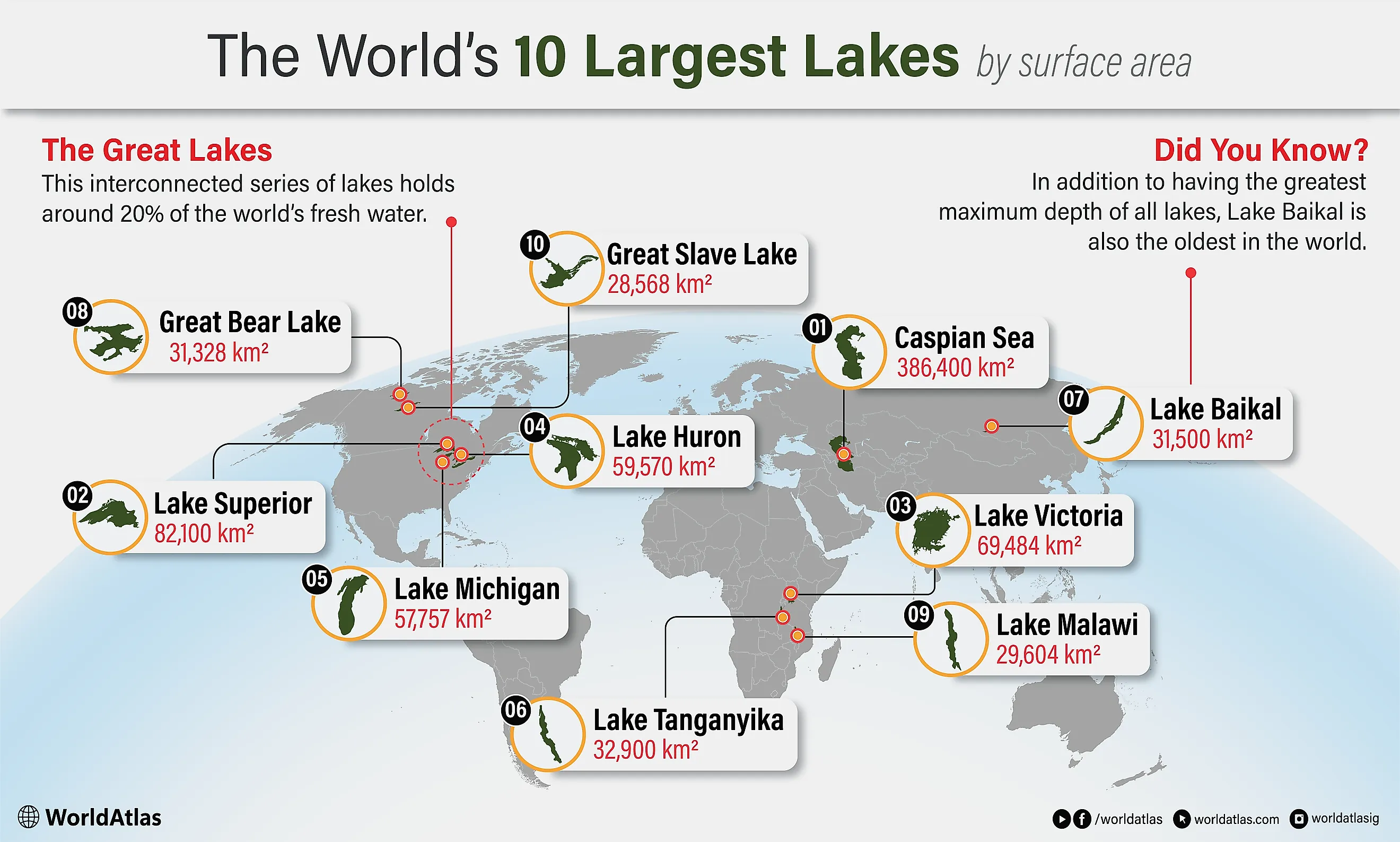
The Largest Lakes in the World by Surface Area
When calculating the size of a lake, we measure the surface area, which refers to the visible expanse of water that horizontally meets the atmosphere. It can be described as the lake’s footprint on the Earth’s surface.
The lakes listed below are the ten largest inland bodies of water in the world. They span multiple continents and climate zones, from Africa to the Canadian Arctic. Many are so large that they function almost like inland seas, helping regulate weather patterns and support fragile ecosystems. They also provide drinking water, food, transportation routes, and economic support for millions of people. The lakes below are ranked by surface area, starting with the massive Caspian Sea.
The Largest Lakes in the World by Surface Area
| Rank | Lake | Surface Area (sq km) |
|---|---|---|
| 1 | Caspian Sea | 386,400 |
| 2 | Lake Superior | 82,100 |
| 3 | Lake Victoria | 69,484 |
| 4 | Lake Huron | 59,570 |
| 5 | Lake Michigan | 57,757 |
| 6 | Lake Tanganyika | 32,900 |
| 7 | Lake Baikal | 31,500 |
| 8 | Great Bear Lake | 31,328 |
| 9 | Lake Malawi | 29,604 |
| 10 | Great Slave Lake | 28,568 |
Note: This list follows the common convention of ranking Lake Michigan and Lake Huron separately, although the two are hydrologically connected and are sometimes treated as one lake system.
1. The Caspian Sea

The Caspian Sea is so big that it contains more than one-third of Earth’s inland surface water. It is located to the east of the Caucasus Mountains and to the west of the steppe of Central Asia, and its name comes from the ancient Kaspi people. Its name is a bit of a conundrum, since it is called a sea because of its size and saltwater, but technically, it is a landlocked lake. It has no natural outlet to any of the world’s oceans. As for its sheer size, if the lake were placed over the United States, it would cover the entire state of Montana. Its surface area alone is an incredible 386,400 square kilometers, and its drainage basin covers around 3,625,000 square kilometers.

The Caspian Sea is a remnant of the ancient Paratethys Sea, which was connected to the broader Tethys Ocean system millions of years ago. It contains brackish water, which is about a third as salty as ocean water, and the water only leaves the endorheic basin through evaporation. This process leaves minerals behind, so the lake cannot be considered a freshwater lake. The Caspian is divided into northern, middle, and southern basins. The northern basin is very shallow and often freezes in winter, while the southern basin reaches depths of about 1,025 meters.
2. Lake Superior

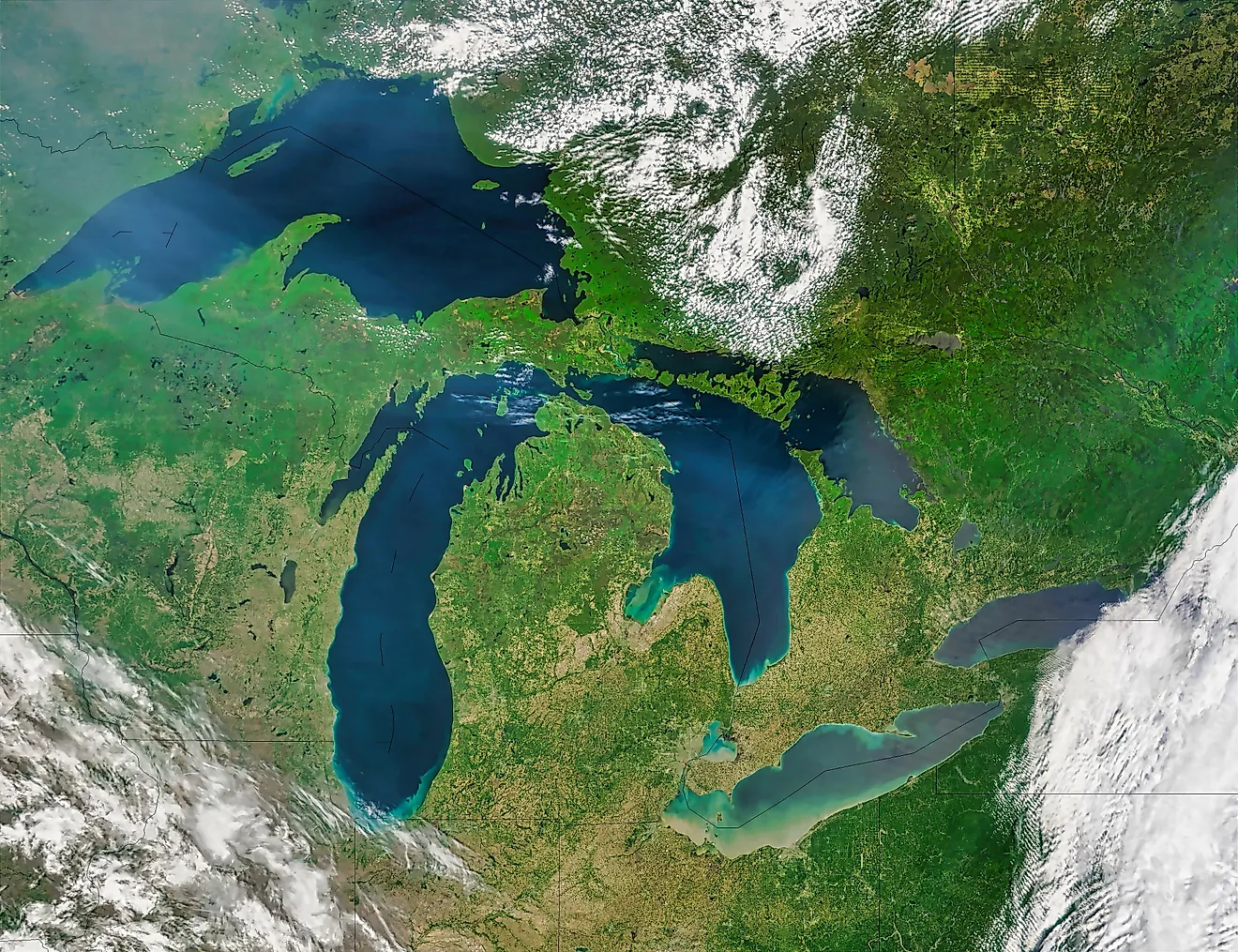
Lake Superior, spanning the border between the US and Canada, shares its shoreline with the states of Michigan, Wisconsin, and Minnesota, as well as the province of Ontario. It is usually listed as the largest freshwater lake in the world by surface area, covering approximately 82,100 square kilometers. It is so enormous that, if you spread all of its water out evenly, it could cover the combined land area of North and South America in nearly a foot of water.

The modern lake took shape around 10,000 years ago as massive glaciers retreated at the end of the last Ice Age, though its basin also reflects much older geologic structures associated with the Midcontinent Rift. The Lake Superior region includes extensive volcanic rock as well as sandstone formations. Because the lake is cold, deep, and relatively low in nutrients, its water is often exceptionally clear, though clarity varies by location and conditions. In some areas, the clear water helps make underwater rock formations and shipwrecks unusually visible. The water is also dangerous, with an average temperature of only about 4°C (39°F), which means that long or unexpected exposure to the water in Lake Superior could quickly lead to hypothermia. It is also subject to high winds and storms, which create challenges when it comes to boating.
3. Lake Victoria

Lake Victoria is the primary reservoir for the White Nile. The White Nile joins the Blue Nile to form the Nile, often regarded as the world’s longest river. The lake is also the largest tropical lake in the world, with a surface area of 69,484 square kilometers, and it borders Tanzania, Uganda, and Kenya. Victoria is relatively shallow, with its maximum depth only reaching around 81 meters. The lake’s northern shore sits on the equator, so the water is always warm and never freezes.

Lake Victoria is famous for its extraordinary cichlid diversity, historically including hundreds of endemic species. In the 1950s and early 1960s, Nile perch were introduced to the lake to support fisheries. Their spread, together with eutrophication and other human pressures, caused a major collapse in many endemic cichlid populations and permanently altered the lake’s ecosystem. More recently, water hyacinth has remained a recurring problem in parts of Lake Victoria, where dense mats can obstruct boats and contribute to low-oxygen conditions.
4. Lake Huron

With a surface area of 59,570 square kilometers, Lake Huron is one of the largest of the Great Lakes. It features massive bays, including Saginaw Bay in Michigan and Georgian Bay in Ontario, and is also home to 30,000 islands. When including the coastlines of these islands, Huron boasts the longest shoreline of any of the Great Lakes, stretching over 6,100 kilometers. The most famous feature of the lake is Manitoulin Island, which is also the largest freshwater island in the world. Manitoulin Island is big enough to contain 100 lakes of its own, such as Lake Manitou, which is home to its own series of small islands.

Lake Huron’s geography is strongly shaped by the Bruce Peninsula, which separates Georgian Bay from the lake’s main basin. Georgian Bay, to the east, is often nicknamed the “Sixth Great Lake.” Parts of its coast are known for clear water and for the white quartzite ridges of the La Cloche Mountains. On the Michigan side, Lake Huron curves inward to form Saginaw Bay.
5. Lake Michigan

Lake Michigan is considered the geological twin of Lake Huron and is the only one of the Great Lakes that sits entirely within the United States. Because water flows freely between Lake Michigan and Lake Huron, the two are sometimes treated as a single hydrologic lake system known as Michigan-Huron. On its own, Lake Michigan covers about 57,757 square kilometers and borders Indiana, Illinois, Wisconsin, and Michigan.

Lake Michigan is often called the Third Coast of America. Its eastern shoreline, which sits in Michigan, features the largest system of freshwater sand dunes in the world. The dunes were formed by glacial sands, and they can reach heights of 137 meters. The lake is an integral part of the local economy, providing drinking water to millions of people.
6. Lake Tanganyika

Lake Tanganyika has broken several records, including being the longest freshwater lake in the world and the second-deepest lake on Earth. It stretches 660 kilometers from north to south, reaches 1,436 meters at its deepest point, and has a surface area of 32,900 square kilometers. The lake sits in Africa’s Albertine Rift, with a large share of the water located in Tanzania. In the rift, the Earth’s tectonic plates are slowly pulling apart, a process that has shaped the lake into a narrow trench with steep underwater walls.
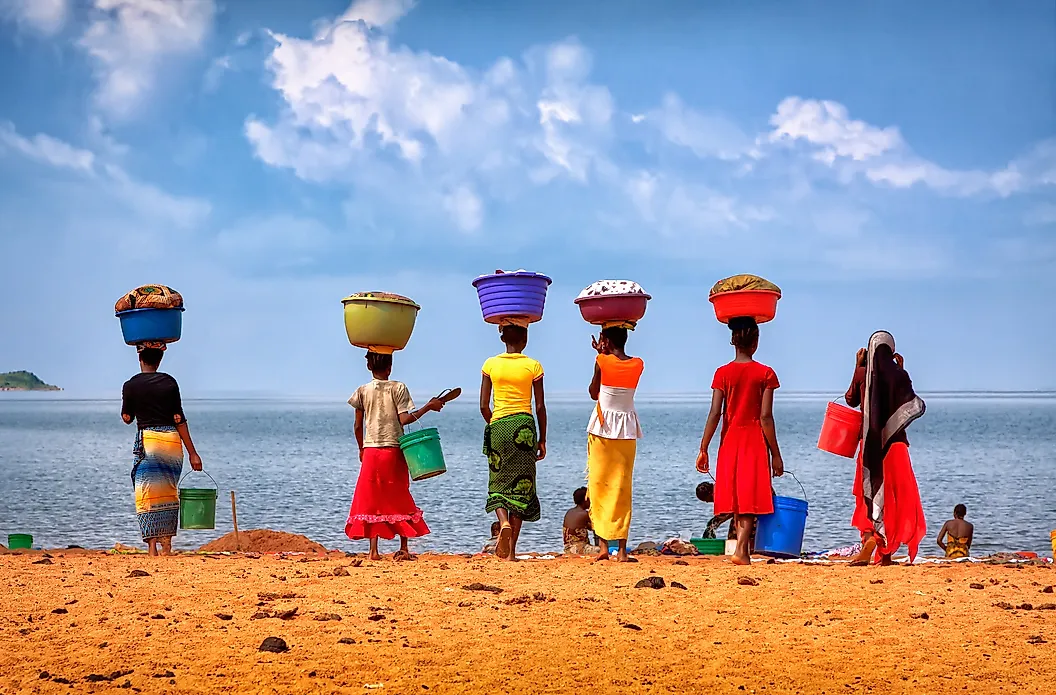
The deep waters of the lake are largely oxygen-poor or anoxic because the water column is strongly stratified and mixes only weakly. Below roughly 100 to 200 meters in much of the lake—deeper in some basins than others—the water becomes oxygen-deficient, and most fish are confined to the upper layers. Despite this, Lake Tanganyika is famous for its extraordinary biodiversity, including about 250 species of cichlid fish. Its long isolation has made it one of the world’s best examples of cichlid adaptive radiation, with species evolving strikingly different forms, colors, and lifestyles.
7. Lake Baikal

Even though Lake Baikal in Siberia ranks seventh in surface area at 31,500 square kilometers, it holds a massive 20% of the world’s unfrozen surface freshwater. The volume is more than all five of the Great Lakes combined, and this feat is possible because Baikal is the deepest lake in the world, with a maximum depth of 1,642 meters. Baikal is also the world’s oldest lake, with experts estimating it to be around 25 million years old. While most lakes eventually fill with mud and sediment, transforming them into swamps, this has not happened to Baikal. The lake sits on a continental rift where the Earth’s crust is pulling apart, so the lake is getting wider every year by about 2 centimeters.

The lake is also old enough to have become a so-called Galapagos of Russia. This means that around 80% of the animals and plants that live in and around it are found nowhere else in the world. The lake is also home to the Nerpa, the only living seal species that inhabits freshwater environments exclusively. It is unclear how these seals got there, but scientists believe they have thrived in the lake for millions of years. During the harsh Siberian winter, the lake freezes, but the ice is so clear that fish and stones can be seen well below the surface. In some places, the ice can also become very thick, and in suitable conditions, officials open marked ice roads, including the seasonal crossing to Olkhon Island.
8. Great Bear Lake

Great Bear Lake is the largest lake that lies completely within Canada. It is situated directly on the Arctic Circle and is a true wilderness lake. At the same time, the lake, which has a surface area of 31,328 square kilometers, is oligotrophic. This means it is very low in nutrients, slowing down fish growth. For instance, lake trout might take around 15 years to mature and can live several decades longer. For around nine months of the year, the lake is covered with ice.

It is also one of the clearest lakes in Canada, with explorer John Franklin writing in 1828 that a white rag he had dropped in the water was visible until it reached a depth of “15 fathoms,” or roughly 27 meters. Great Bear Lake was also the site of the historic Port Radium mine, whose uranium contributed to the Manhattan Project during the Second World War. The mine is now closed. Today, Great Bear Lake remains central to the culture and stewardship of the Délı̨nę Got’ı̨nę and the broader Sahtú region, where the water and surrounding lands hold deep cultural and spiritual significance.
9. Lake Malawi (Lake Nyasa)

Like Lake Tanganyika, Lake Malawi is part of the East African Rift System. This lake is famous for its clear waters and gorgeous beaches, which draw tourists from all over the world. Lake Malawi, also known as Lake Nyasa, borders Malawi, Mozambique, and Tanzania, and has a surface area of 29,604 square kilometers. The lake is also well known for its biodiversity, as it contains more species of fish than any other lake. Scientists believe the waters are home to hundreds of cichlid species, with some estimates approaching 1,000.

The lake is also meromictic, which means its deep and surface waters do not fully mix. The top layer is warm and full of life, while the deepest layers are oxygen-depleted or anoxic. This feature makes the lake very sensitive to climate change. If the surface water gets too warm, a sort of “lid” is created that can limit the movement of nutrients from deeper water into the upper layers where much of the lake’s life is concentrated. Since lakeshore communities depend heavily on fish as a source of protein, protecting Lake Malawi’s water quality is critical for food security and livelihoods for millions of people.
10. Great Slave Lake

Canada’s Great Slave Lake rounds out the top ten list of the largest lakes in the world. Its surface area is 28,568 square kilometers, and its maximum depth is 614 meters, making it the deepest lake in North America. Like Great Bear Lake, it was carved by the retreat of ice sheets during the last Ice Age. In winter, frozen sections of the lake and connected winter-road routes become important transportation corridors, supporting travel to nearby communities and freight movement in the North. The lake is also a well-known place to watch the northern lights, where dark skies, clear winter air, and broad frozen surfaces can create spectacular reflections.
Protecting the World’s Largest Lakes
The world’s largest lakes include ancient rift lakes packed with unique fish, immense northern waters locked in ice for much of the year, inland seas with no outlet to the ocean, and Great Lakes that support millions of people with drinking water, food, transport, and tourism. Yet these extraordinary ecosystems are under pressure from invasive species, pollution, mining legacies, and climate-driven warming. Protecting them means protecting biodiversity, livelihoods, and irreplaceable natural history.