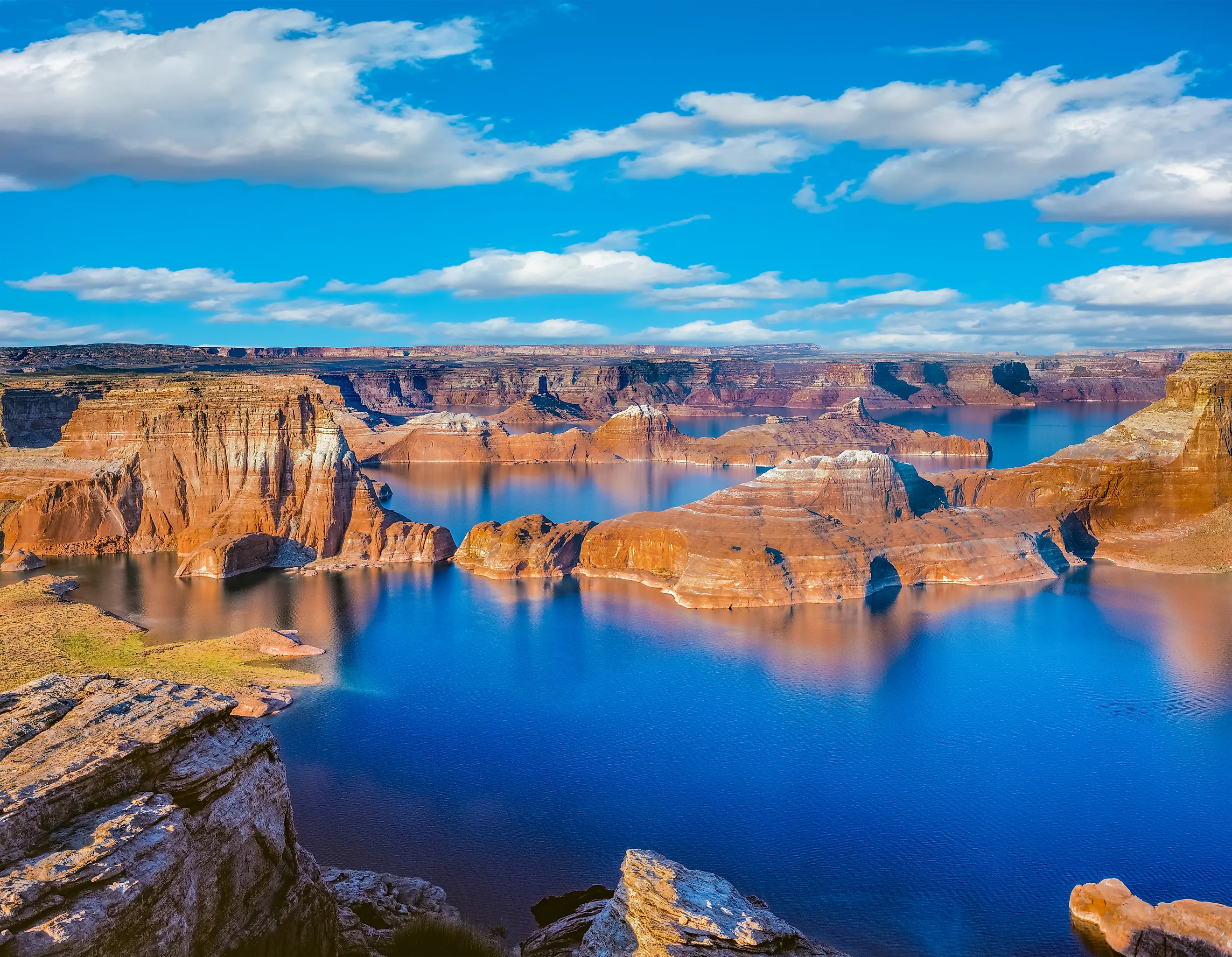
What Happens If Lake Powell Runs Dry
Roughly 40 million people draw water from the Colorado River, which Lake Powell helps regulate. Glen Canyon Dam would stop generating electricity for seven western states. Millions of acres of Southwestern farmland could lose the irrigation timing they depend on. Native fish in the Grand Canyon would face warmer water and hungrier predators.
These are not certain doomsday outcomes. They describe what would follow if Lake Powell ran dry. The failure would not arrive in a single moment. Water managers track two elevations. Minimum power pool is where hydropower stops. Dead pool is where stored water can no longer pass through the dam. The reservoir sat about 34 feet above minimum power pool in July 2026. Federal forecasters have warned it could cross that line within the year.
The Thresholds That Define Failure

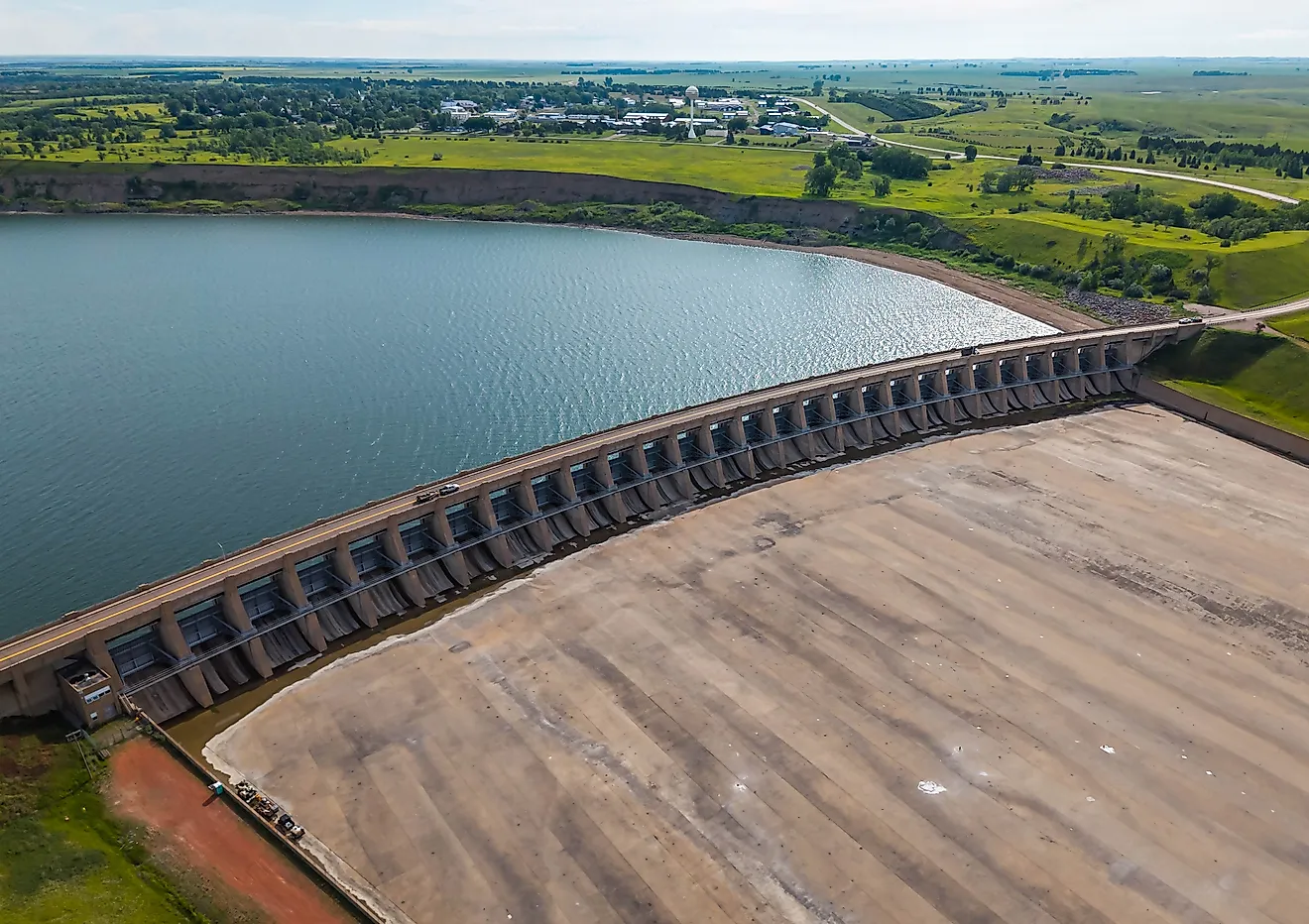
Lake Powell's normal operating level is about 3,700 feet above sea level, according to the U.S. Bureau of Reclamation. A U.S. Geological Survey survey calculated its 2018 full-pool capacity at 25.16 million acre-feet. That was 1.833 million acre-feet, or 6.79%, below its estimated 1963 capacity because sediment had accumulated on the bottom. The first critical threshold is 3,490 feet, which Reclamation calls minimum power pool. Below it, water cannot drive the turbines. Dead pool occurs near 3,370 feet, according to Reclamation. At that elevation, remaining water lies below the normal release outlets. The reservoir could therefore still contain water while losing its main operational functions.
Hydroelectric Generation Would Stop

The first major failure would be the loss of hydropower at 3,490 feet. The Bureau of Reclamation states that Glen Canyon Dam's powerplant has eight generators with a combined capacity of 1,320 megawatts and produces around five billion kilowatt-hours in a typical year. The Western Area Power Administration distributes this electricity across seven western states. Other generators could replace the output, so the regional grid would not immediately collapse. Replacement power could nevertheless cost more and might require additional fossil-fuel generation when wind and solar supplies were low. Hydropower revenue also finances dam operations and environmental programs in Glen and Grand canyons.
Water Releases Would Become Less Reliable

Below minimum power pool, releases would have to pass through four lower river outlet pipes instead of the turbines. Reclamation's 2026 technical assessment describes these pipes as 96 inches in diameter and gives them a combined capacity of 15,000 cubic feet per second at a reservoir elevation of 3,500 feet. Their capacity declines as the lake falls because lower water pressure pushes less water through the dam. Long-term reliance on the outlets would create engineering uncertainty because they were not designed to serve indefinitely as the only release route. At dead pool, gravity-fed releases would effectively end unless new pumps, siphons, or tunnels were built.
Shortages Would Spread Across the Basin

Dead pool would not stop every Lower Basin delivery immediately because Lake Mead and downstream tributaries would provide temporary storage and inflow. The larger problem would be the loss of Powell's ability to regulate when water moves downstream. The U.S. Department of the Interior reports that the Colorado River system supports about 40 million people, 30 Tribal Nations, and 5.5 million acres of farmland. If Powell could no longer provide controlled releases, Lake Mead would decline faster unless total consumption fell. Lower-priority users would probably face the earliest reductions, while disputes over interstate compact obligations, Tribal rights, and treaty deliveries to Mexico would intensify.
Grand Canyon Ecology Would Shift

Lake Powell changes the temperature and biological content of water entering the Grand Canyon. As the reservoir falls, its warmer upper layer moves closer to Glen Canyon Dam's intakes. The U.S. Geological Survey reported that low levels in 2022 allowed warm water and non-native smallmouth bass to pass through the dam, leading to the first recorded smallmouth bass reproduction below it. Smallmouth bass prey on native fish, including the federally protected humpback chub. A 2025 USGS study found that maintaining Lake Powell near or above about 3,590 feet would substantially reduce conditions supporting downstream bass establishment. Lower levels would also restrict high-flow releases used to rebuild sandbars and maintain habitat.
Sediment and Contaminants Would Be Remobilized

Glen Canyon Dam traps sediment that once moved through the Grand Canyon. As the reservoir retreats, the Colorado and San Juan rivers would cut channels through exposed mud, sand, and organic material. The USGS found that sedimentation had removed 1.833 million acre-feet of storage capacity by 2018. USGS coring has also measured deposits more than 30 meters thick in some locations. Erosion could increase turbidity, release nutrients, and destabilize new shorelines. USGS research has detected potentially harmful elements in Lake Powell sediment, including arsenic, cadmium, lead, mercury, selenium, and uranium. Their ecological effect would depend on their concentrations, chemical forms, and rate of release.
The Canyon Would Reappear in an Altered Form

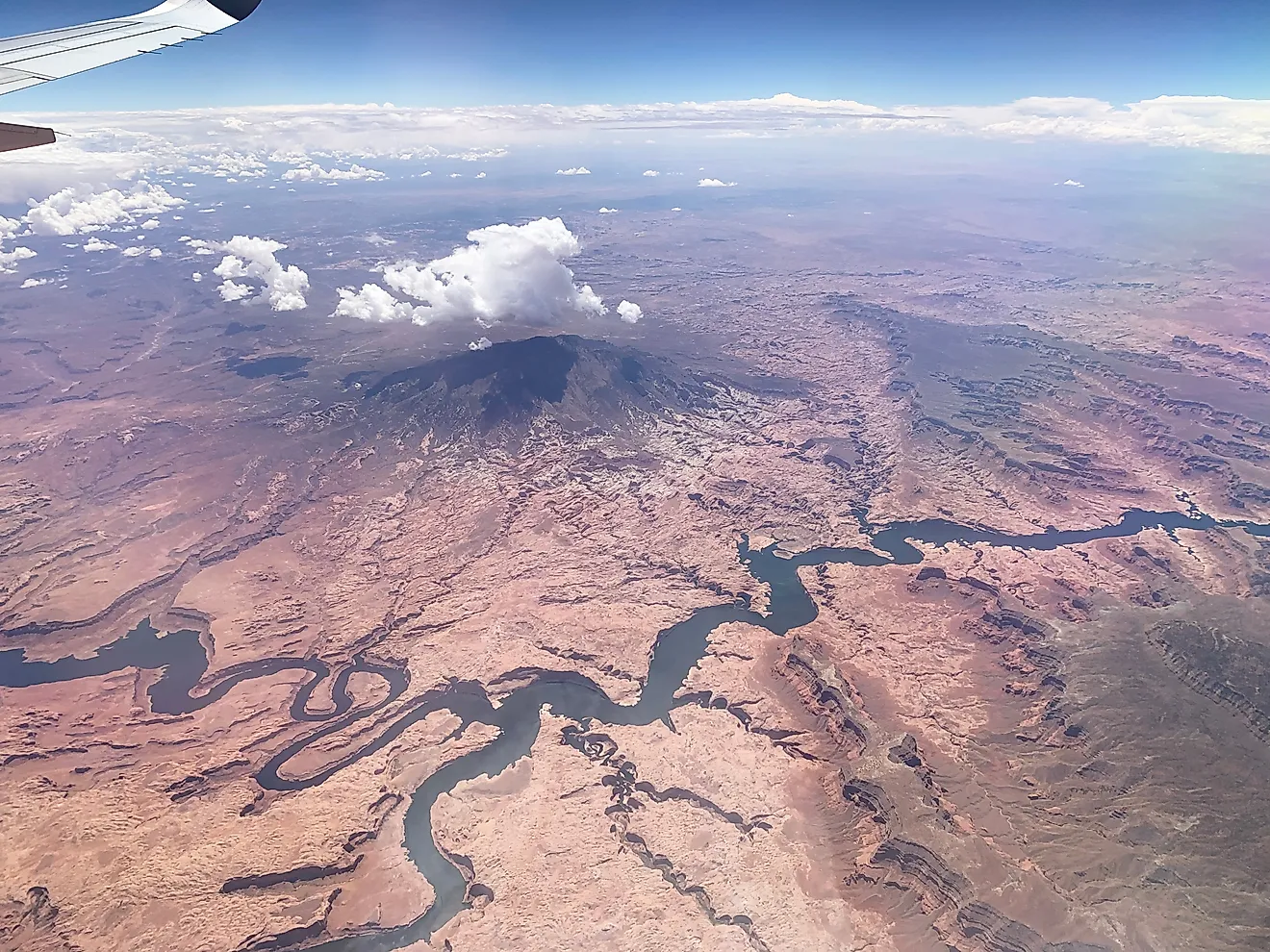
Falling water would expose side canyons, springs, river terraces, rock formations, and archaeological sites submerged for decades. Vegetation would colonize some areas, while rivers would establish new channels. This would not immediately restore the pre-dam ecosystem. Thick reservoir mud, invasive plants, unstable deltas, altered groundwater, and abandoned infrastructure would shape the landscape. Cultural sites could become more accessible to researchers and Tribal communities, but exposure would also increase erosion, weathering, unauthorized artifact collection, and vandalism. The National Park Service reports that approximately 2,500 cultural sites have been documented within Glen Canyon National Recreation Area. Recovery would vary by location, with broad sediment-filled reaches likely remaining unstable longer than narrow bedrock canyons.
Recreation and Local Economies Would Contract

A nearly empty reservoir would strand launch ramps and marina facilities above steep or sediment-covered terrain, reducing boating, houseboat rentals, and lake fishing. The National Park Service recorded 4,725,610 visits to Glen Canyon National Recreation Area in 2024. Its visitor-spending analysis estimated that visitors to Glen Canyon and Rainbow Bridge spent $518.2 million in nearby communities that year, creating a total local economic benefit of $635.4 million. These amounts would not disappear completely because visitors also come for hiking, scenery, and cultural sites. Businesses dependent on marina access, boat rentals, and waterfront accommodation would nevertheless face major losses. New land-based tourism would require roads, trails, and safety infrastructure.
Reduced Evaporation Would Not Offset Lost Storage

A smaller Lake Powell would expose less surface water to the dry desert atmosphere, reducing evaporation. However, lower evaporation would not compensate for the loss of more than 20 million acre-feet of usable reservoir capacity. Lake Powell's primary function is not to create water but to move it through time. It captures runoff during wetter periods and releases that water during later droughts. Near dead pool, inflowing water would move downstream with much less opportunity for long-term storage. The system might lose less water from its surface, but it would also lose its ability to preserve large wet-year inflows for future shortages.
Climate Warming Makes Recovery Harder

Lake Powell's decline reflects both high water use and a warmer climate. In a 2020 Science study, P.C.D. Milly and K.A. Dunne estimated that the Colorado River's annual mean flow decreases by about 9.3% for every 1°C of warming because snow loss and greater evapotranspiration return more water to the atmosphere. A 2022 Nature Climate Change study led by A.P. Williams found that 2000-2021 was the driest 22-year period in southwestern North America since at least the year 800. The researchers attributed about 19% of the drought's 2021 severity to human-caused climate trends. Even near-average snowfall can therefore produce less runoff than it did under cooler conditions.
The Main Loss Would Be Control Over Water
The most important consequence of a dry Lake Powell would be the loss of controlled storage, not the disappearance of its final pool. At 3,490 feet, hydropower would end. Farther down, release capacity would weaken, and near 3,370 feet the dam could no longer deliver stored water through its existing outlets. Lake Powell would function more like a river reach than a multiyear water bank. The effects would include more expensive electricity, faster decline at Lake Mead, deeper water cuts, invasive-fish risks, sediment erosion, and economic disruption. Emergency construction and upstream reservoir transfers could delay individual failures, but they would not create water. Long-term stability requires total withdrawals and system losses to remain within the Colorado River's reduced flow.