The Highest Navigable Lakes in the World
Satellite research has identified approximately 117 million lakes larger than 2,000 square meters across the world. Only a small share lie at extreme elevations and also support regular passenger, sightseeing, or recreational boat travel. Ranked by surface elevation, these eight lakes show how people travel across open water even in some of the world’s highest landscapes. Among them are some of the most famous lakes in the world, including Lake Atitlán, which Aldous Huxley famously compared with Italy’s Lake Como. Set out across the water as we explore some of the world’s highest navigable lakes.
Lake Junín, Peru

Lake Junín sits about 13,386 feet (4,080 meters) above sea level in the central Peruvian Andes, placing it higher than Lake Titicaca. Also known as Chinchaycocha, it covers roughly 205 square miles (530 square kilometers) and is the second-largest lake in Peru. Boat trips venture into its open waters, although navigation is more limited and focused on nature tourism than the passenger and commercial traffic found on Titicaca.
The lake lies within the Junín National Reserve and supports an exceptional variety of high-altitude wildlife. Birdwatchers venture onto the lake in search of the flightless Junín grebe, an endangered species found nowhere else in the world. Extensive reed beds, wetlands, and grasslands surround the water, making a boat trip as much a wildlife excursion as a journey across one of the world’s highest navigable lakes.
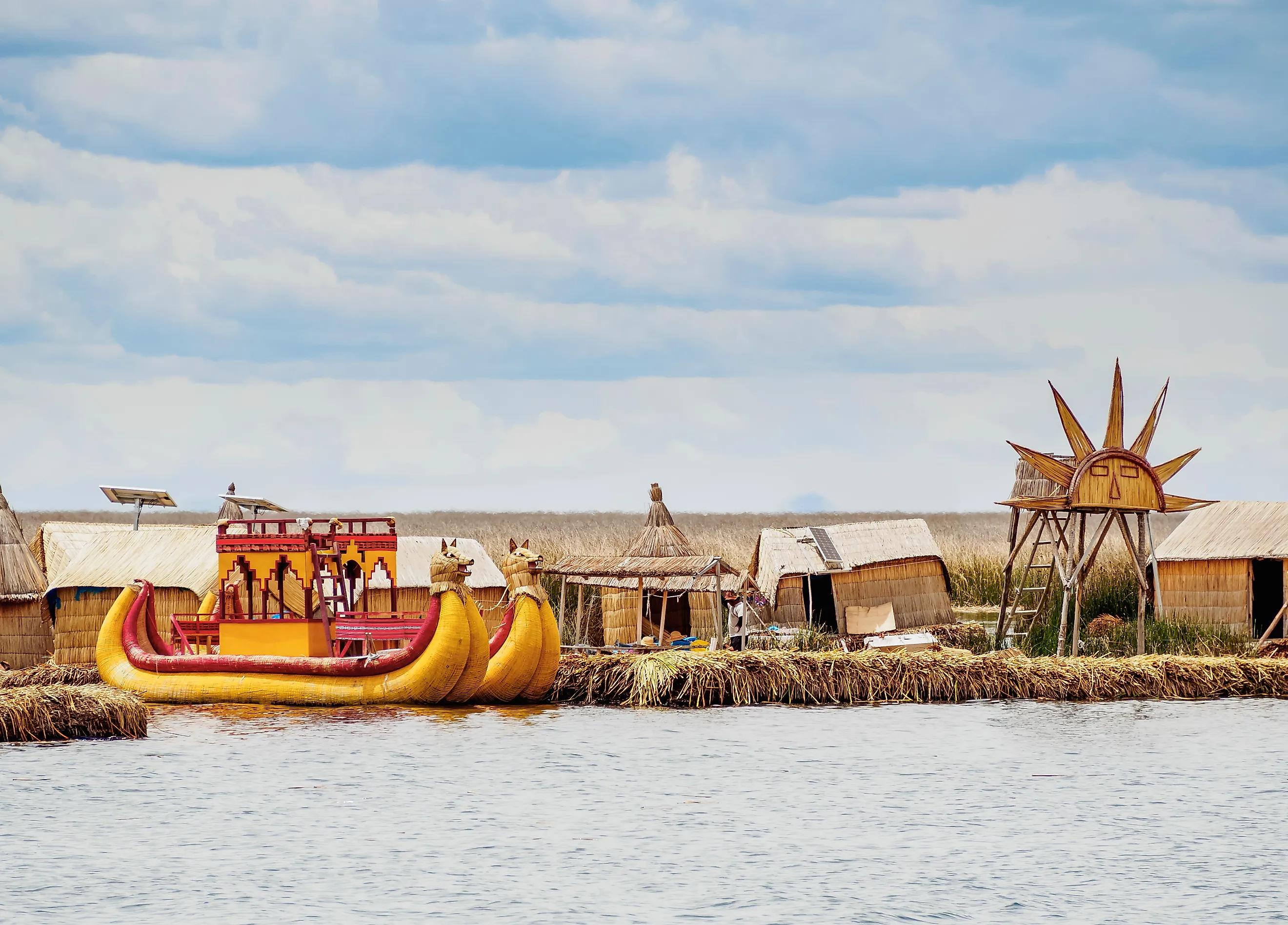
Lake Titicaca, Peru and Bolivia

Lake Titicaca is commonly described as the highest lake in the world navigable by large commercial vessels. Resting at about 12,500 feet (3,810 meters) above sea level in the Andes Mountains of South America, Titicaca is the continent’s largest freshwater lake by surface area. It covers approximately 3,200 square miles (8,300 square kilometers) and extends in a northwest-to-southeast direction for 120 miles (190 kilometers). Overall, there is plenty of space and depth for large passenger and cargo vessels to operate on the lake.
The meaning behind the lake’s name is uncertain, but it has been translated in various ways. Some have interpreted it to mean “Rock of the Puma,” while others have translated it as “Crag of Lead.” More than 25 rivers feed the lake.
Qinghai Lake, China

Qinghai Lake lies about 10,476 feet (3,193 meters) above sea level on the Tibetan Plateau. Sightseeing vessels operate from the Erlangjian Scenic Area, although services can be seasonal and more limited than those on Titicaca.
Qinghai Lake was added to China’s UNESCO World Heritage Tentative List because of its potential outstanding universal value and ecological importance. The lake and its surrounding watershed serve as a natural barrier to the expansion of the desert in western China, as well as a breeding ground for the endangered Przewalski’s gazelle. This rare species now survives only in the area surrounding Qinghai Lake.
Rara Lake, Nepal

Rara Lake lies at about 9,810 feet (2,990 meters) in the mountains of northwestern Nepal. Boating is available on its clear waters, although the remote location and protected surroundings mean that navigation is primarily recreational rather than commercial. At approximately 4.2 square miles (10.8 square kilometers), Rara is the largest lake in Nepal.
The lake is also Nepal’s deepest, reaching a maximum depth of about 548 feet (167 meters). It sits within Rara National Park, surrounded by forested hills covered with juniper and other alpine conifers. Travelers can explore the water by boat before hiking into the nearby hills for broader views of the lake and surrounding mountains.
Yellowstone Lake, United States

Yellowstone Lake sits at 7,733 feet (2,357 meters) and is North America’s largest high-elevation lake above 7,000 feet (2,134 meters). The National Park Service confirms that guided boat trips and rentals operate from Bridge Bay Marina, with canoeing, kayaking, fishing, and private motorboating also permitted. Its water remains dangerously cold, even in summer.
Yellowstone Lake generally freezes completely by late December or early January, with ice thickness varying from just a few inches to more than two feet. By late May or early June, the lake usually thaws. Considering how cold it is, swimming in this lake is not recommended. In fact, survival time in the water is estimated to be somewhere between 20 and 30 minutes at the lake’s average water temperature of 41°F (5°C).
Lake Sevan, Armenia

Armenia’s Lake Sevan lies at about 6,283 feet (1,915 meters) and supports speedboat rides, sightseeing excursions, kayaking, and other summer water sports. It is one of the largest high-altitude freshwater lakes in Eurasia.
Lake Sevan receives water from 28 rivers and streams. Only a relatively small portion of its water leaves through the Hrazdan River, its sole surface outlet, while most is lost through evaporation. Sevanavank monastery stands on what was once Sevan Island, which became a peninsula after the lake’s water level declined during the twentieth century.
Lake Tahoe, United States

Lake Tahoe sits at roughly 6,224 feet (1,897 meters) in the Sierra Nevada, straddling the California-Nevada border. It has extensive boating infrastructure, including large paddle-wheel sightseeing vessels, sailing cruises, private charters, marinas, and recreational rentals.
It is one of the area’s largest tourist attractions year-round, and it is easy to see why. The water is a clear blue, and green mountains surround much of the shoreline. Numerous launches and marinas also make Tahoe one of the easiest lakes on this list to explore independently, with options ranging from kayaks and sailboats to large sightseeing vessels.
Lake Atitlán, Guatemala

Lake Atitlán sits at 5,125 feet (1,562 meters) in Guatemala’s volcanic highlands. Small passenger launches are an essential form of transportation between towns such as Panajachel, San Pedro La Laguna, and Santiago Atitlán. Private sightseeing boats and kayaks are also widely available.
Lake Atitlán is generally regarded as the deepest lake in Central America, reaching an estimated maximum depth of 1,120 feet (340 meters). Its Nahuatl-derived name is often translated as “between the waters.” It is also considered one of the most beautiful lakes in the world because of its clear water and dramatic volcanic surroundings. In his 1934 travel book Beyond the Mexique Bay, Aldous Huxley compared its beauty with that of Italy’s Lake Como while suggesting that Atitlán’s towering volcanoes made its setting even more impressive.
Sailing at Altitude
For travelers, seeking out Lake Titicaca or Armenia’s Lake Sevan may feel like a challenge, but their relative remoteness adds to the adventure. Traveling to reach these lakes high above sea level will feel worthwhile once visitors set out across the water. Others, such as Lake Tahoe, are more accessible and remain famous summer getaways for those who love the outdoors. Lake Atitlán, surrounded by volcanoes, strikes a balance for North American travelers between accessibility and adventure. No matter which is chosen, these lakes offer the unusual experience of boating thousands of feet above sea level.