Why the Source of the Nile River Was a Mystery for Thousands of Years
For centuries, the quest to uncover the source of the Nile River has captivated explorers, rulers, and scholars alike. Much like the arduous task of untangling a tangled web of ropes, pinpointing the source of the Nile presented a complex and enigmatic puzzle to those who sought to uncover it. The river's vast expanse complicated matters further, as it was guarded by numerous territorial armies, making exploration dangerous and daunting.
Despite the early belief that there was only one source, geographers now understand that the Nile has multiple sources, which reveals the confusion that surrounded its discovery. From ancient rulers like the Roman Emperor Nero, who disguised an invasion as an expedition, to later explorers like John Hanning Speke, the search for the Nile's origin has been driven by determination, intrigue, and perseverance.
Geographical and Climatic Challenges

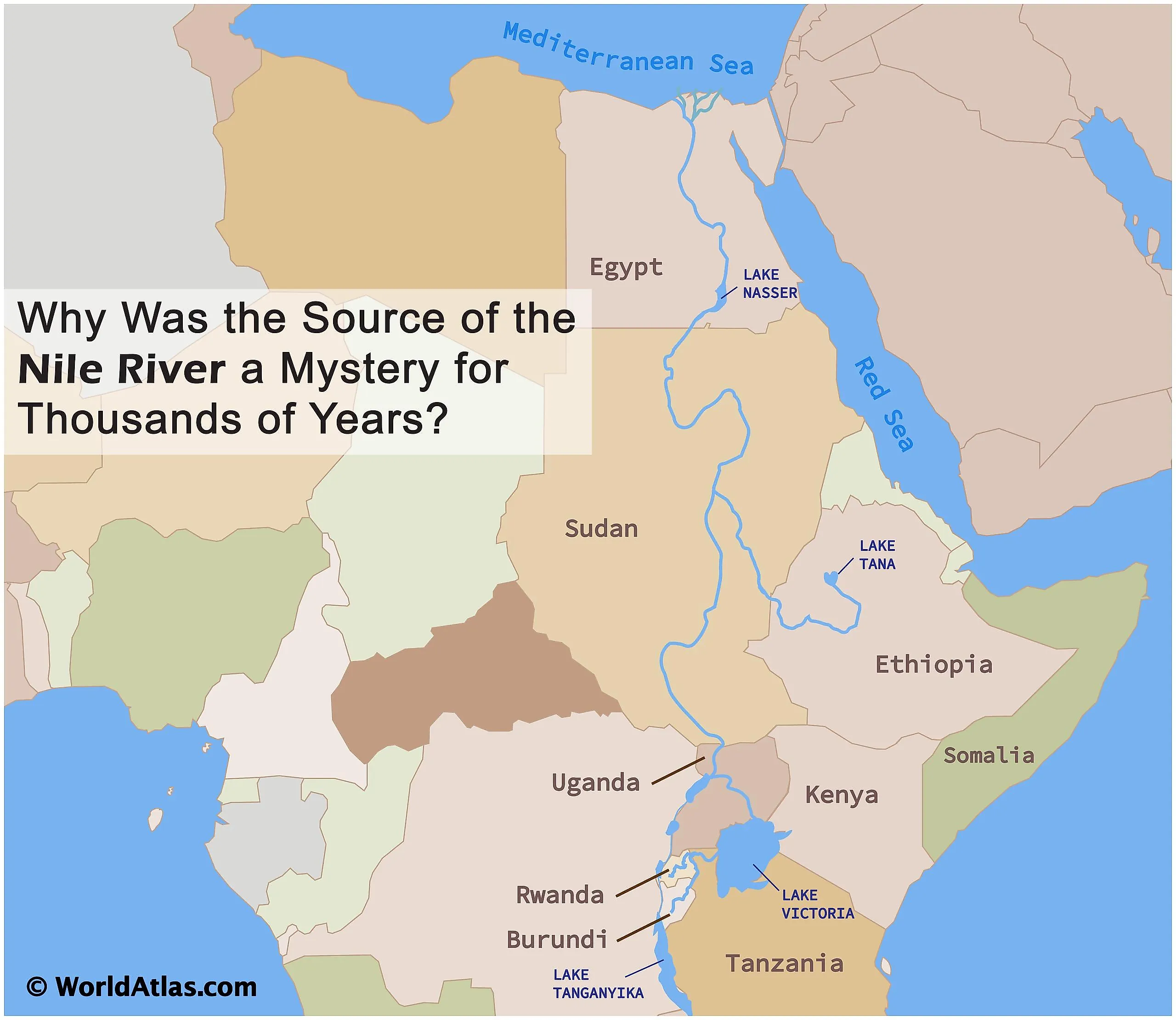
The Nile River, the longest in the world, stretches over 4,130 miles and flows through 11 countries, making its basin one of the largest and most complex globally. Its size and complexity made it challenging for early explorers to identify the true source of the river. The primary sources are the White Nile and the Blue Nile, which meet in Khartoum, Sudan, to form the main Nile River. This convergence caused confusion about which tributary was the main source of the Nile.
Moreover, the terrain and climate of the region added to the mystery. The Nile River flows through various environments, from swamps and savannahs to deserts and mountains. The area surrounding the source of the White Nile, the longest tributary, is characterized by dense equatorial rainforests, swamps, and a complex system of interconnected lakes, rivers, and streams. This challenging landscape made navigation difficult and hazardous for early explorers, who had to contend with extreme weather, diseases, and dangerous wildlife.
Limited Exploration Technologies

In ancient times, the lack of advanced exploration tools and technologies made discovering the Nile's source even more challenging. Navigational instruments like compasses, maps, and telescopes were either nonexistent or basic, which limited explorers' ability to chart their course and record their discoveries accurately. The absence of fast and reliable transportation methods, such as motorized boats and aircraft, further complicated the search. Early explorers relied on local knowledge, simple boats, and sheer determination to cross the Nile and explore its surrounding terrain.
This reliance on basic technologies and methods often resulted in incomplete or inaccurate documentation of the region. Without precise maps and navigation tools, explorers could not accurately determine their position or the river's course. As a result, their accounts frequently included inconsistencies and contradictions, adding to the confusion about the Nile's source. Moreover, early explorers lacked the scientific knowledge and equipment necessary to analyze the region's geological and hydrological features, making it difficult to understand the complex factors that influenced the river's course and its source.
Political and Cultural Factors

The mystery of the Nile River's source was further impeded by the political and cultural factors that restricted exploration and knowledge sharing. Ancient empires, such as Egypt, relied heavily on the Nile for agriculture, trade, and transportation, making it a vital resource that they closely guarded. Local militaries restricted access to the Nile, and the knowledge of its course and origins was a state secret, limiting the exchange of information among different civilizations.
Local cultures and beliefs also played a role in shaping the search for the Nile's source. The Nile River was deeply embedded in the religious and cultural practices of the societies it supported, often leading to myths and legends that complicated the search for its origins. For example, the ancient Egyptians believed the Nile's source was a divine underground cavern called the "Nile's Eye." As explorers sought the source of the Nile, they had to navigate a complex web of cultural beliefs and political realities, further obscuring the river's true origin.
The Role of European Explorers

The 19th century marked the beginning of a new era of exploration, as European adventurers ventured into the African continent in search of knowledge, resources, and prestige. The search for the source of the Nile River became a symbol of this broader quest for discovery, attracting numerous explorers who were determined to solve the ancient mystery. Among them were key figures such as Sir Richard Burton, John Hanning Speke, David Livingstone, and Henry Morton Stanley, each of whom embarked on ambitious expeditions to find the elusive source.
These European explorers faced numerous challenges, including hostile terrain, diseases, and resistance from local populations. Nevertheless, thanks to their advanced navigation tools, scientific expertise, and determination, they made significant progress in mapping the Nile River and its tributaries. As they ventured further into the African continent, they gathered valuable information about the region's geography, climate, and cultures, which would eventually contribute to unraveling the Nile's mystery.
The Discovery and Modern Understanding of the Source

The breakthrough in the search for the Nile's source came in 1858 when British explorer John Hanning Speke discovered Lake Victoria, the largest lake in Africa. While traveling with Sir Richard Burton, Speke reached the lake's northern shore and identified the outflowing river, the White Nile, as the primary source of the Nile River. Despite initial skepticism and controversy, subsequent explorations by Speke, James Augustus Grant, and Samuel White Baker confirmed the role of Lake Victoria as a primary source of the White Nile.
Recent research has improved the academic understanding of the Nile's source, exposing a complex network of rivers, lakes, and swamps that contribute to its flow. The origin of the Blue Nile, the other major tributary, was pinpointed in the Ethiopian Highlands, specifically at Lake Tana. The Blue Nile and White Nile meet in Khartoum, Sudan, to form the main Nile River, which then flows through Egypt and into the Mediterranean Sea.
Today, satellite imagery and advanced scientific tools enable geographers to precisely map and analyze the Nile River Basin, revealing the factors that influence its flow and formation. Researchers have identified several sources that feed into Lake Victoria, including the Kagera River, which is now regarded as the farthest source of the Nile.
Fictions such as Robinson Crusoe or Twenty Thousand Leagues Under the Seas ignite a desire in us to explore—whether it be lost treasures, uncharted wilderness, or unknown territories. This fundamental human trait has endured for millennia, as seen in ongoing efforts to explore the mysterious Nile. Yet, politics, geography, and the fierce landscapes of Africa have historically limited access to this knowledge. Consequently, one might wonder if humanity has uncovered all its secrets on Earth—perhaps only in the ocean depths or even deeper. And if that's the case, should we view this as a triumph worth celebrating or a loss to mourn?