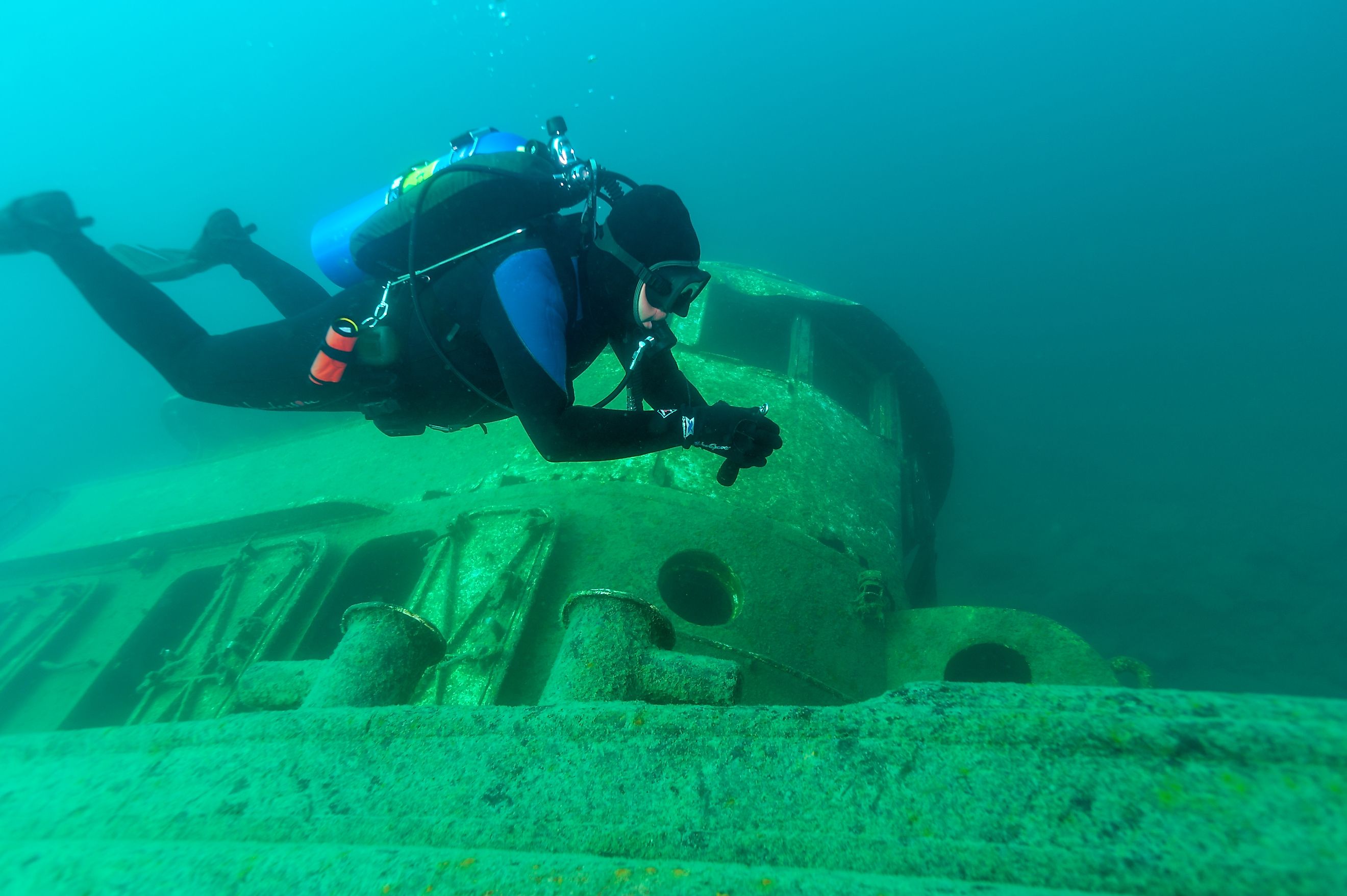
The Deepest Diving Sites In The Great Lakes
The very deepest diving sites in the Great Lakes are so deep that they are off limits to humans without submersible equipment. These include dives to the SS Scotiadoc at 850 feet (259 meters) in Lake Superior, and the SS Edmund Fitzgerald at a depth of 530 feet (162 meters), also in Lake Superior. In terms of active diving sites for expert technical divers, the deepest dives in the Great Lakes are to the Carl D. Bradley at a depth of 360 to 370 feet (110 to 112 meters) in Lake Michigan, and dives to the SS Superior City at a depth of 270 feet (82 meters) in Lake Superior. One of the most beautiful and perfectly preserved shipwrecks in the world, the luxury steam yacht called The Gunilda, is a dangerous dive to a depth of 270 feet (82 meters) in Lake Superior that attracts many advanced divers. Finally there are a few "advanced beginner" dives that make the list of deepest diving sites in the Great Lakes, and those are to The Gallinipper at a depth of 200 to 215 feet (61 to 66 meters) in Lake Michigan, and to the The Silver Lake at a depth of 190 to 200 feet (57 to 60 meters), also in Lake Michigan.
S.S. Carl D. Bradley (Lake Michigan)

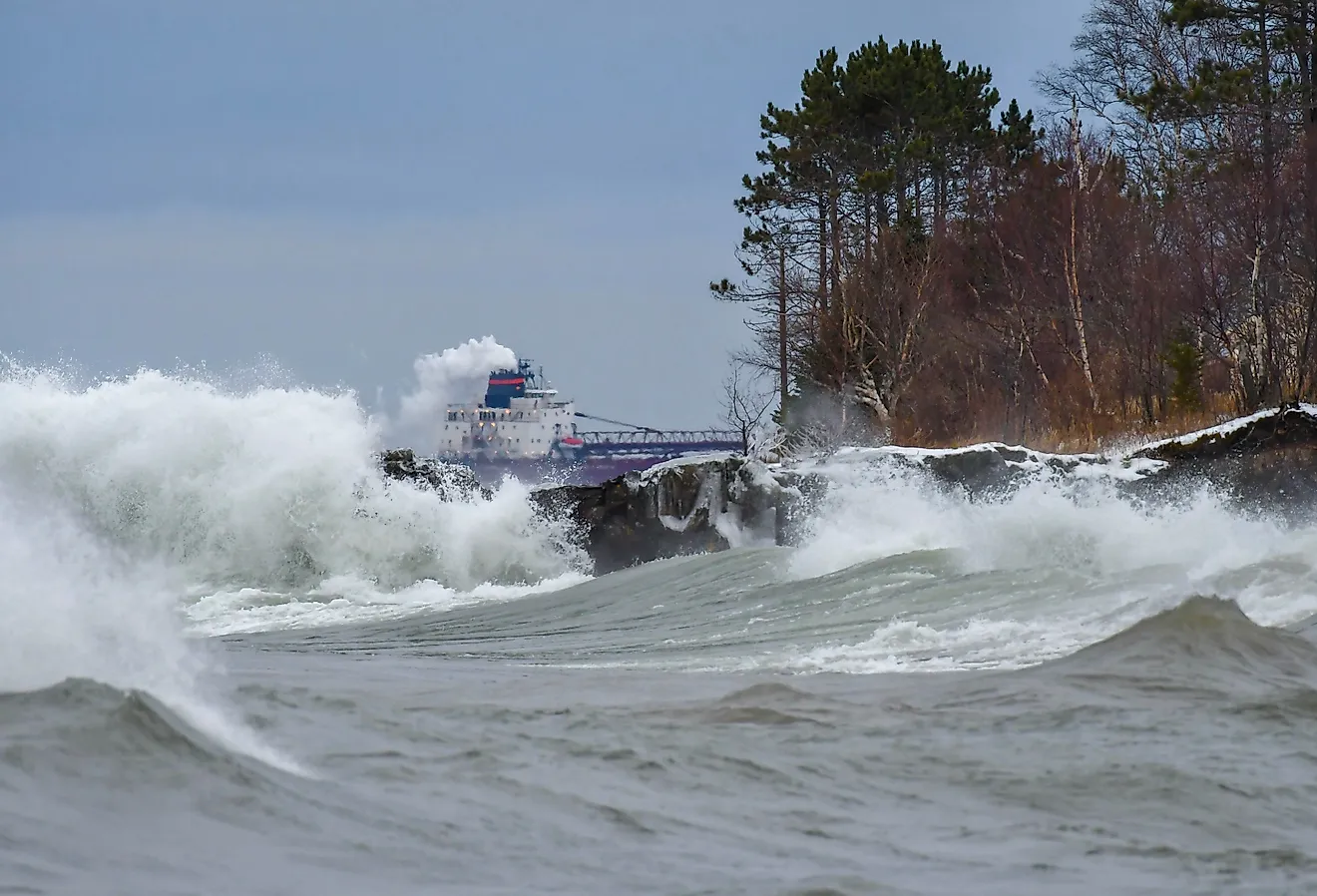
In Lake Michigan, at a depth of 360 to 370 feet (110 to 112 meters), lies the S.S. Carl D. Bradley, a massive steel freighter. She was an innovative ship of her time, a "self-unloading" ship designed and built to help fill an order for one million tons of limestone wanted in Buffington, Indiana. When she departed Buffington around 9:30 pm, Monday, November 17, 1958, she had just successfully delivered her last load for the year, and the ship was heading home. Bad weather came suddenly, and although the captain and crew were all expert, there was nothing they could do to save the massive ship as it broke apart in the 35 foot crashing waves and 60 mph wind of the storm. 33 souls were lost and are still mourned and memorialized today. 2 souls were mercifully saved. This diving site is extremely challenging, requires specialized equipment, and is not commonly attempted. Divers must charter a boat to reach the location, which is about 5 miles (8.0 km) northwest of Boulder Reef in Lake Michigan.
SS Superior City (Lake Superior, Whitefish Bay)

In Lake Superior, at a depth of 270 feet (82 meters) lies the S.S. Superior City. When she was first built in 1898, she was the largest freshwater vessel ever built, and she sailed successfully on the Great Lakes for 22 years. But in 1920, this enormous steamship sank following a collision with the Willis L. King, which struck the Superior City's port side. Cold water burst through to the boilers resulting in a huge explosion that killed 29 crew and left only four survivors. This is a challenging dive in Lake Superior's Whitefish Bay that requires advanced technical diving skills. Divers report that the site can be disorienting because the ship's explosion warped and scattered much of the ship and its equipment. That said, there are so many rooms, artifacts, and pieces of machinery to see at this wreck that divers can easily dedicate an entire trip to the Great Lakes exploring this one site.
The Gunilda (Lake Superior, Near Rossport, Ontario)

Gunilda sinking in Lake Superior 1911.
Remarkably, the Gunilda rests upright in 270 feet (82 meters) of cold, clear freshwater in Lake Superior near Rossport, Ontario, Canada. This wreck is regarded by technical divers as one the best preserved and most prestigious historic shipwrecks in the world. In fact, when Jacques Cousteau explored this site in 1980, he called it, "the most beautiful shipwreck in the world." From the golden bowsprit to the instruments in the binnacle to the grand piano and furniture in the salon to passenger's personal items, everything is perfectly intact. The Gunilda was, and is, private luxury yacht originally built in 1897 in Leith, Scotland for the American oil investor William L. Harkness. She only sank because of her rich owner's frugal nature. Refusing to pay $15 to hire a local guide to help navigate the ship through the shoals and islands on the way to Rossport, the ship ran aground. All the passengers were brought to shore safely, but the ship, again as the result of a frugal decision, was ordered to be tugged away by Harkness without first being inspected by a diver. He refused to believe the damage could be great enough to sink the ship. He believed the locals were trying to take advantage of him by recommending a diver should inspect the ship first. He was wrong. The Gunilda took on water and sunk to the bottom where she can still be found upright in all her splendor.
The Gallinipper (Lake Michigan)

At a depth of 200 to 215 feet (61 to 66 meters) in Lake Michigan, between the ports of Sheboygan and Manitowoc, lies a little wooden schooner called the Gallinipper. Built in 1833, the Gallinipper is the oldest shipwreck yet found in Wisconsin waters. She once transported goods and supplies from the east to the Wisconsin frontier and returned with loads of furs for the eastern markets. She capsized in a sudden storm on July 7th, 1851. All souls aboard were saved by a passing schooner called the Cleopatra. The Gallinipper did not sink right away, but all attempts to rescue her failed. She was written off as a loss (valued at $3,000 and insured for $2,000), and assumed to have sunk to the bottom. It wasn't until 1994 when a fisherman snagged its nets on the wreck that the ship was rediscovered. In 2009, the Wisconsin Historical Society conducted an archeological survey around the site and soon after, placed it on the National Register of Historic Places. Today, divers can find the Gallinipper more or less intact and sitting upright, listing somewhat starboard, with its masts still rising high above its deck. This is an accessible technical dive site managed by the Wisconsin Shipwreck Coast National Marine Sanctuary.
The Silver Lake (Lake Michigan)
The Silver Lake shipwreck is a popular deep dive because the ship is so remarkably well intact. She is a two masted scow-schooner built in 1889. In the year 1900 she was sailing in deep fog and rammed by a car ferry, the first steel car ferry on Lake Michigan, called the Pere Marquette. As far as it's known, this is the only example of a double centerboard scow-schooner in Wisconsin waters and possibly all of the Great Lakes. It cannot be said that she had a famous career, but she did serve an important purpose. Because of the ship's relatively small size, she could access smaller ports and include them in larger trade. Today, the ship is of great interest to historians because scow-schooners of this sort were never built to standard plans and had wide variation. Being able to investigate an actual ship like this is the only way to learn about its design and construction. The Silver Lake can be found in the waters off Port Washington and Sheboygan, both beach towns in Wisconsin, at an approximate depth of 190 to 200 feet (57 to 60 meters).
A Deep Dive Into The Great Lakes
Over the last few centuries, particularly in the 1800s and 1900s, thousands of ships used the Great Lakes like highway systems, and many (perhaps as many as 6,000 ships), as a result of heavy traffic or violent storms, have sunk to the bottom. Today, despite have been underwater for hundreds of years, many of those shipwrecks are still extremely well preserved hundreds of feet below the surface. In part this is because the water in the Great Lakes is fresh, and doesn't have a corrosive effect like saltwater does on ocean shipwrecks. In part, the wrecks are so well preserved because the water is freezing, too cold for shipworms to eat away at the older wooden vessels. In part, the shipwrecks are so well preserved because invasive species of mussels were introduced to the Great Lakes and they act as a filter, meaning what was once much darker and murkier water is much clearer today. Divers report being able to see some of the deeper shipwrecks from shallower water, perhaps from as high as 100 feet (30 meters) above them. But all divers should keep these shipwrecks as a reminder that the weather on the Great Lakes can be treacherous, and waters are freezing. Only certified technical divers should attempt any of these deep dives in the Great Lakes.