How Rough Lake Superior Has To Get Before Freighters Stay In Port
There is no wave height at which a thousand-footer is forbidden to sail. No regulator posts a number, no rule closes the lake, and the decision belongs entirely to the master. What exists instead is a forecast product and a judgment. A gale warning goes out when the National Weather Service expects sustained winds of 34 to 47 knots for three hours or longer, a storm warning covers 48 to 63, and what a captain does with that depends on the cargo, the route and how much the ship can take.
Two Warnings Set The Decision Point

The forecast categories are what captains actually watch, rather than a wave number.
A gale warning is issued for sustained winds or frequent gusts of 34 to 47 knots, roughly 39 to 54 miles per hour, lasting three hours or more. A storm warning covers 48 to 63 knots.
Those are the two levels a master weighs before leaving a dock. Neither of them prohibits sailing.
The Record Wave Is 28.8 Feet

Knowing what the lake is capable of puts the warnings in context.
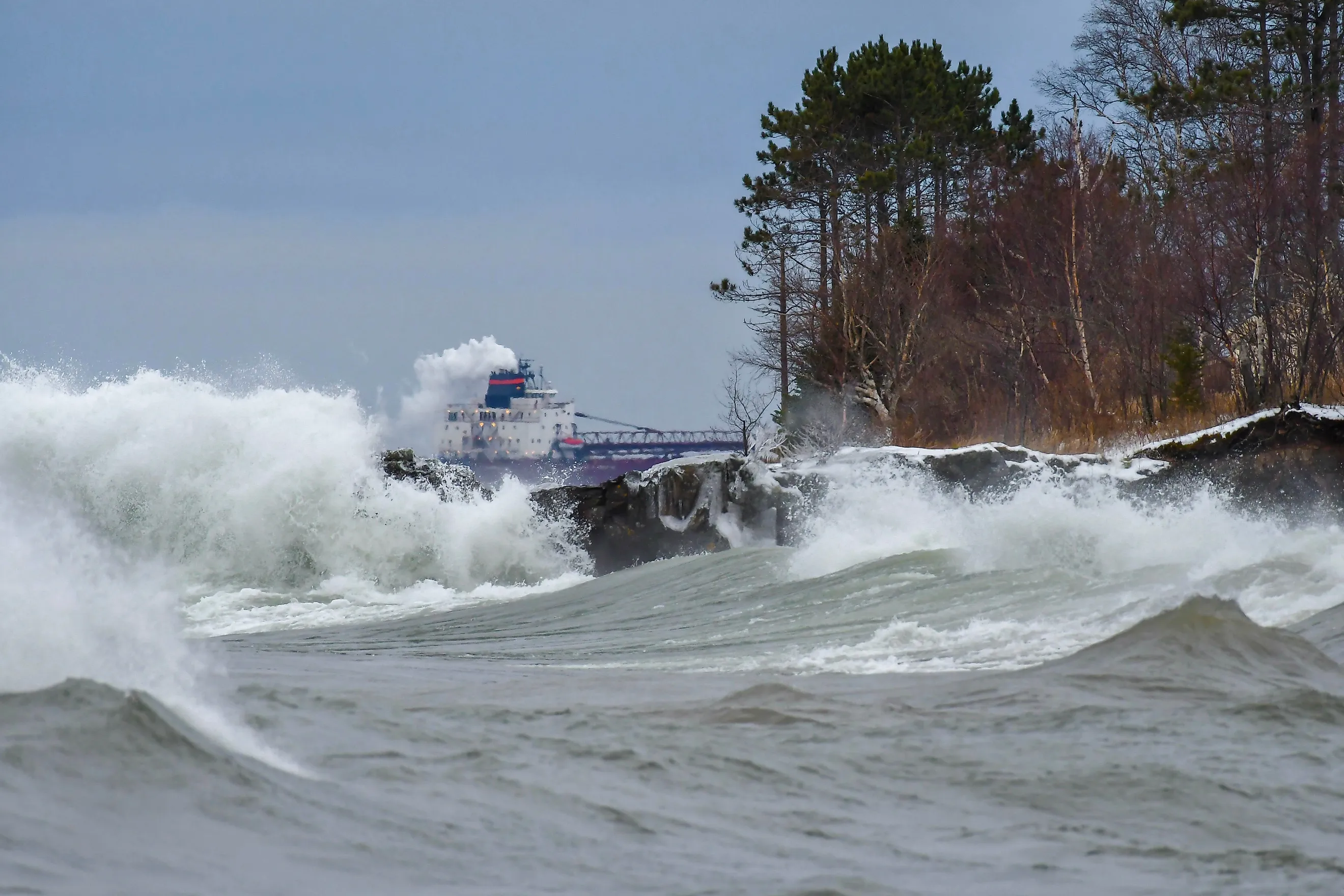
On 24 October 2017, buoys off Granite Island north of Marquette and off Munising recorded a significant wave height of 28.8 feet, the highest ever logged on Lake Superior.
Significant wave height is the average of the highest third of waves, which means individual waves that day ran considerably higher than 28.8 feet.
Superior Has The Most Room To Build

Fetch is the distance wind travels over open water, and this lake offers more of it than the other four.
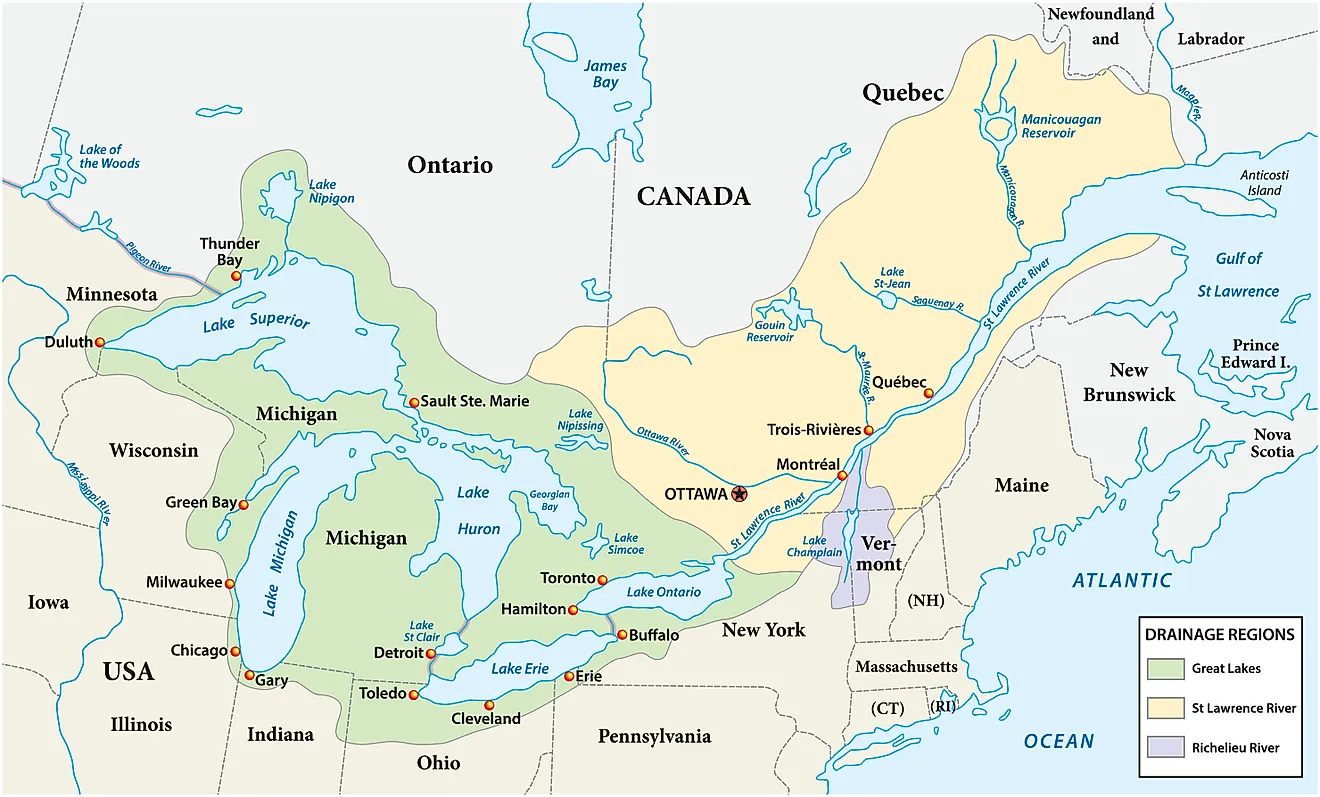
Superior runs about 350 miles long and 160 miles wide. A sustained northwesterly has the entire length of the lake to work with before the waves reach the Michigan shore.
That is still short by ocean standards, which is precisely the problem. The lake builds steep, closely spaced waves rather than long swells.
The Rhythm Hurts More Than The Height

A 20-foot wave on Superior is not equivalent to a 20-foot wave at sea.
Lake waves arrive every three to five seconds against ocean swells at ten to twelve. The bow buries, the next crest strikes before the ship has risen, and the pounding becomes a rhythm the hull cannot recover from between blows.
That relentless cadence is a key reason lake freighters have broken in half in storms their paperwork said they could survive.
Shelter Is The First Move

Staying in port is only one option, and often not the chosen one.
A captain with a gale forecast can delay departure, take a route along the Canadian north shore for the lee it offers, or anchor behind a point until conditions ease. Whitefish Bay is the classic refuge at the eastern end.
The Edmund Fitzgerald had both of a captain's main defenses on its final night, warnings posted hours ahead and a northern route, and still went down 17 miles short of Whitefish Bay.
Ballast Changes The Calculation

How a ship is loaded alters what weather it can accept.
A loaded hull sits deep with weight distributed along its length, roughly matching the buoyancy supporting it. An empty hull in ballast rides high and concentrates its weight in the machinery aft.
Both the Carl D. Bradley and the Daniel J. Morrell were running light when they broke in two. A master heading out in ballast is making a different decision from one leaving fully loaded.
November Is The Month That Matters

The worst weather arrives when the commercial pressure to sail is highest.
Fall gales form as cold air moves over water still holding summer heat, and the Soo Locks close on 15 January. Every cargo not delivered before then waits ten weeks.
That tension is the whole problem. The decision to stay in port costs money at exactly the point in the season when a lost trip is hardest to recover.
The Loads Are Lighter Late

One regulatory lever does tighten as the weather worsens, and it is not about sailing.
Winter freeboard applies from 1 November to 31 March, requiring more hull above the waterline than the midsummer rule and therefore a shallower load.
A ship sailing into November gales is carrying less cargo by law than the same ship in July. The regulation accepts that the weather is coming rather than trying to keep ships off the lake.
Forecasting Has Improved Enormously

The reason modern losses are rare has more to do with information than with hulls.
The Weather Service posted gale warnings for all of Lake Superior at 7pm on the evening before the Fitzgerald sank, and upgraded them. Modern captains get far more lead time, buoy data in real time and routing guidance.
The ships are not dramatically stronger than they were in 1975. The warning is.
The Master Still Decides

Everything above is input to a judgment rather than a rule that makes it.
No agency closes Lake Superior to commercial traffic in heavy weather. A master assesses the forecast, the vessel's condition, the loading and the available shelter, and decides.
Which is why two ships can make opposite choices on the same forecast, and both be defensible.
The Short Answer

There is no threshold. Gale warnings at 34 to 47 knots and storm warnings at 48 to 63 are the signals, and what a captain does with them depends on whether the ship is loaded or in ballast, whether a sheltered route exists, and how close the season is to closing.
Lake Superior has produced a 28.8-foot significant wave height, with waves arriving every three to five seconds rather than every ten. The height is not what breaks ships. The frequency is, and no warning system measures that.