The US Lakes Where Saltwater Fish Live Hundreds Of Miles Inland
Striped bass are an ocean fish. They spawn in coastal rivers, grow up in estuaries and spend their adult lives in the Atlantic. They are also swimming right now in reservoirs in Colorado, Arizona and Oklahoma, hundreds of miles from any sea, because somebody put them there. Introduced landlocked populations now exist in interior reservoirs across 24 states, and the first attempt was made in 1878.
The Fish That Does Not Need The Sea

The biology that makes this possible is the same thing that makes the species valuable to fisheries managers.
Striped bass are anadromous, meaning they move between salt and fresh water through their life cycle. That tolerance is what allows landlocked populations to be established by stocking rather than migration.
The earliest documented attempt to put them in interior water was a release of 140 fish into New York's Genesee River in 1878. The practice has since spread across two dozen states.
Most Of Them Cannot Breed There

The catch is that these populations are maintained rather than self-sustaining, and the reason is specific.
Striped bass require long stretches of free-flowing stream, generally 30 miles or more, for their eggs to stay suspended long enough to hatch. Most reservoirs do not offer that.
So state agencies restock. Indiana, Mississippi, Louisiana, Georgia and Colorado all run programs putting an ocean fish into lakes where it cannot reproduce.
Hybrids Fill The Gap

Where pure striped bass will not work, managers use a cross instead.
Hybrid striped bass, known to anglers as wipers, are a cross between freshwater white bass and saltwater striped bass. They are stocked to diversify fishing and to crop populations of gizzard shad.
Indiana stocks both in lakes and in the Ohio, Wabash, White and Tippecanoe rivers. Tailwater fisheries below dams are maintained by fish that escaped the reservoir through it.
The Salton Sea Had A Marine Fishery

The most extreme example sits in the California desert, roughly 60 miles from the Gulf of California and below sea level.
The Salton Sea is saline, and for decades it supported a fishery built on marine species deliberately introduced into it. It became one of the most productive fisheries in the state while sitting in one of the driest places in North America.
Rising salinity has since collapsed most of it. A lake that got saltier than the ocean stopped being able to hold ocean fish.
Bull Sharks Got There On Their Own

Everything above involved a stocking truck. One species made the journey unassisted.
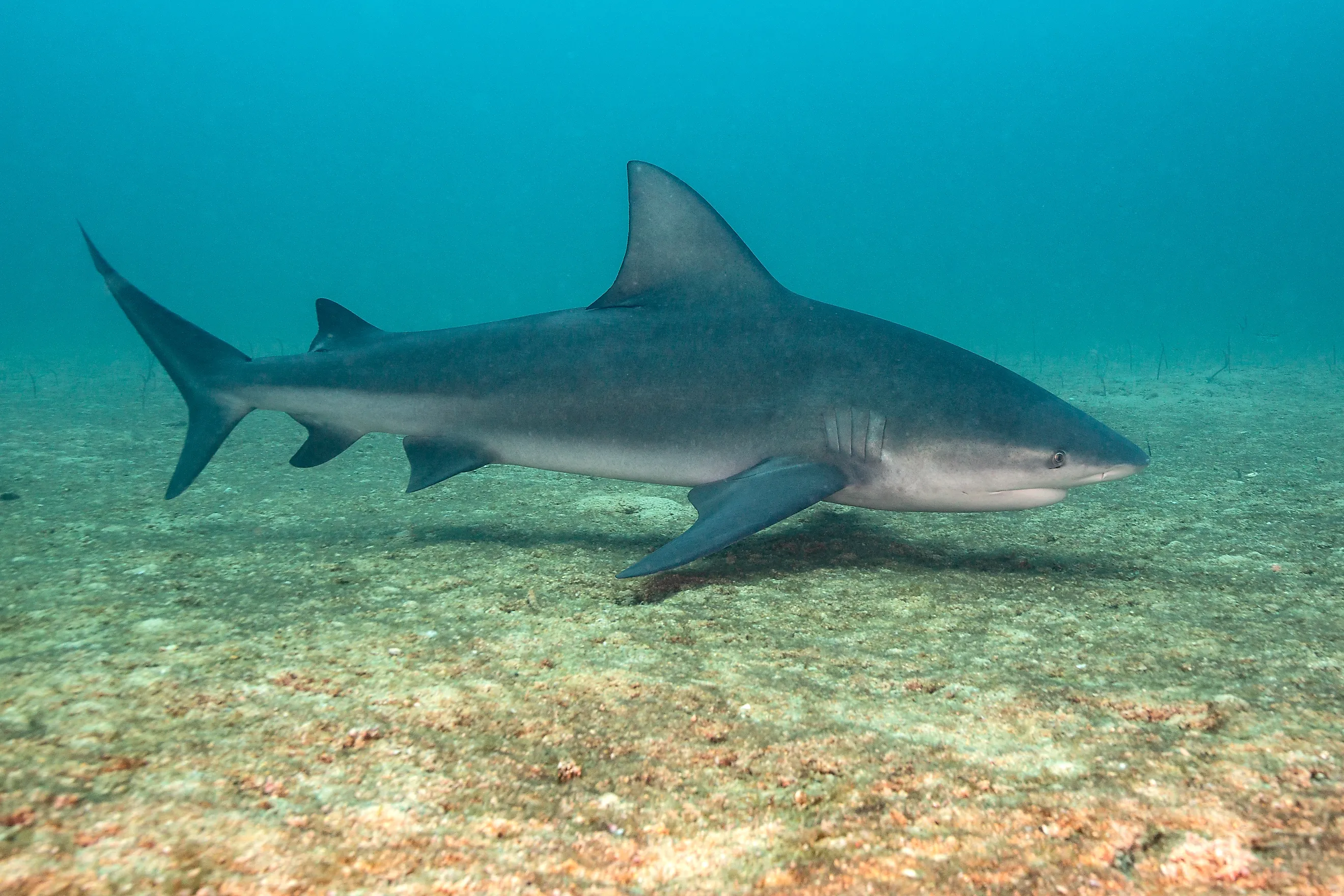
In September 1937, two commercial fishermen near Alton, Illinois found something destroying their bait traps. They reinforced the traps with wire and baited them, and the next morning found a dead bull shark, about five feet long and over 80 pounds.
Alton sits on the Mississippi about 15 miles north of St Louis. A second bull shark was confirmed in 1995, stuck in an intake grate at the Rush Island Power Station at Festus, Missouri.
How Far Is Disputed

The Alton shark gets quoted at wildly different distances, which is worth knowing before repeating any of them.
Published figures for how far that fish traveled range from about 700 miles to 1,000 miles to 1,740 miles from the Gulf of Mexico. The Festus shark is usually given as 900 miles.
River miles and straight-line miles are not the same thing, and sources rarely say which they are using. The thousand-mile figure is the one most commonly cited for Alton.
They Recycle Their Own Salt

The physiology behind it is the reason bull sharks can do what other sharks cannot.
Bull sharks regulate the balance between internal salt and water using several organs, including a rectal gland that excretes excess salt. In fresh water they simply excrete less of it.
That makes them diadromous, able to move between salt and fresh water comfortably, and it is why the same species turns up nearly 2,000 miles up the Amazon.
Temperature Stops Them, Not Salinity

The limit on how far north a bull shark can get is not the water being fresh.
Bull sharks prefer water above 69 degrees Fahrenheit, while the Mississippi and Missouri regularly sit below 35 degrees for months. Unlike eels they are not thought to be able to go dormant through it.
Which means any shark making that journey would have to turn around before winter. The river is passable. The season is not.
Not Every Claim Holds Up

Stories of marine fish far inland attract hoaxes, and at least one well-known case was exactly that.
A shark jawbone found in the Mississippi in northern Minnesota in 2017 turned out to be from a sand shark, a species that cannot survive in fresh water at all. It was most likely dumped by a pet owner or a prankster.
The bull shark records at Alton and Festus are different because there were physical specimens and the species is capable of being there.
The Short Answer

Saltwater fish live hundreds of miles inland in American lakes mostly because people put them there. Striped bass, an Atlantic species, have been stocked into interior reservoirs in 24 states since 1878, usually in waters where they cannot breed and must be restocked. The Salton Sea went further, supporting a marine fishery in the desert until the water grew too salty even for that.
The exception arrived under its own power. Bull sharks reached Alton, Illinois in 1937 and Festus, Missouri in 1995 by regulating their own salt balance, and the only thing keeping them from going further north is how cold the river gets in January.