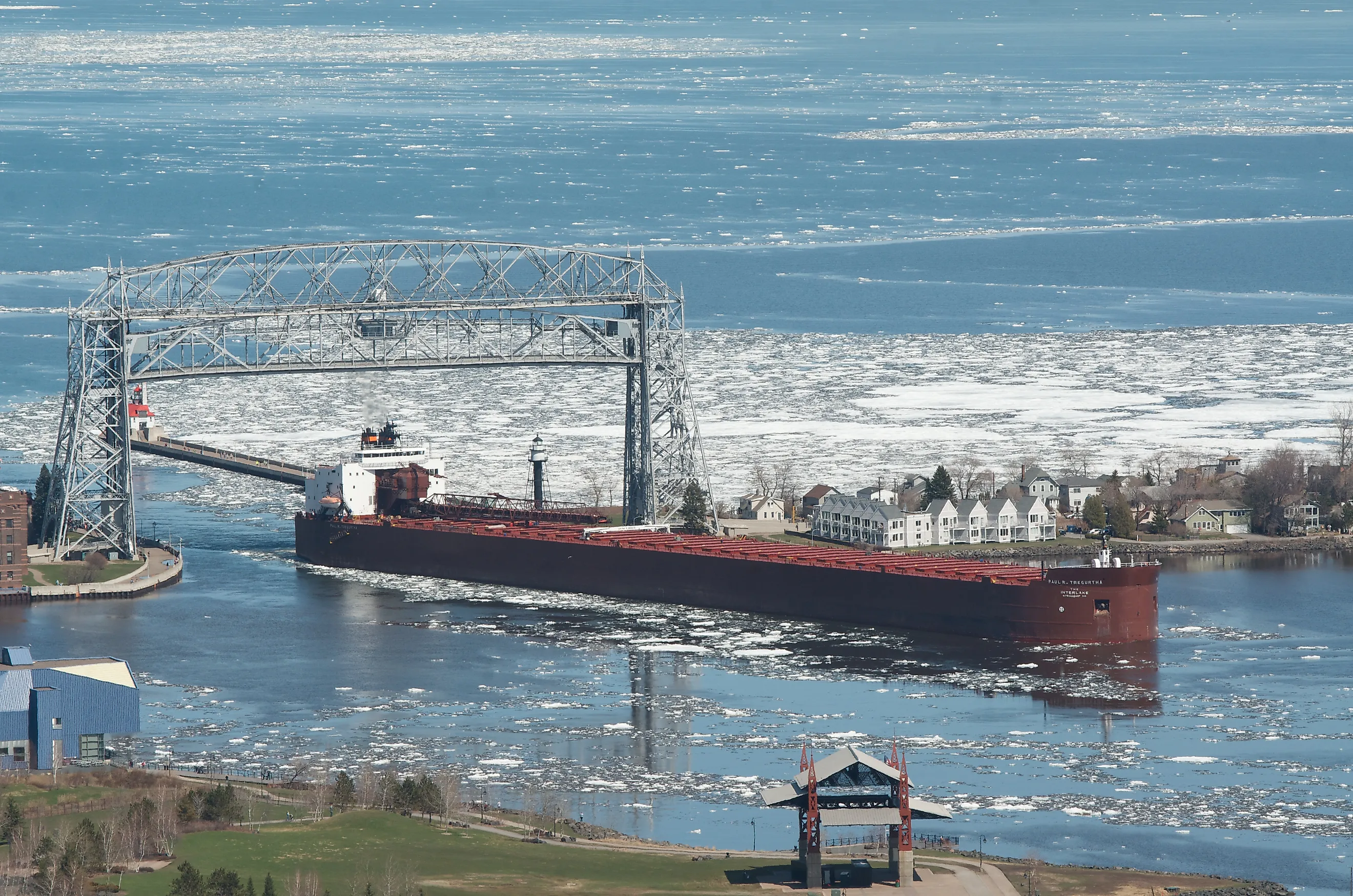
How Long A Great Lakes Freighter Is Compared To The Empire State Building
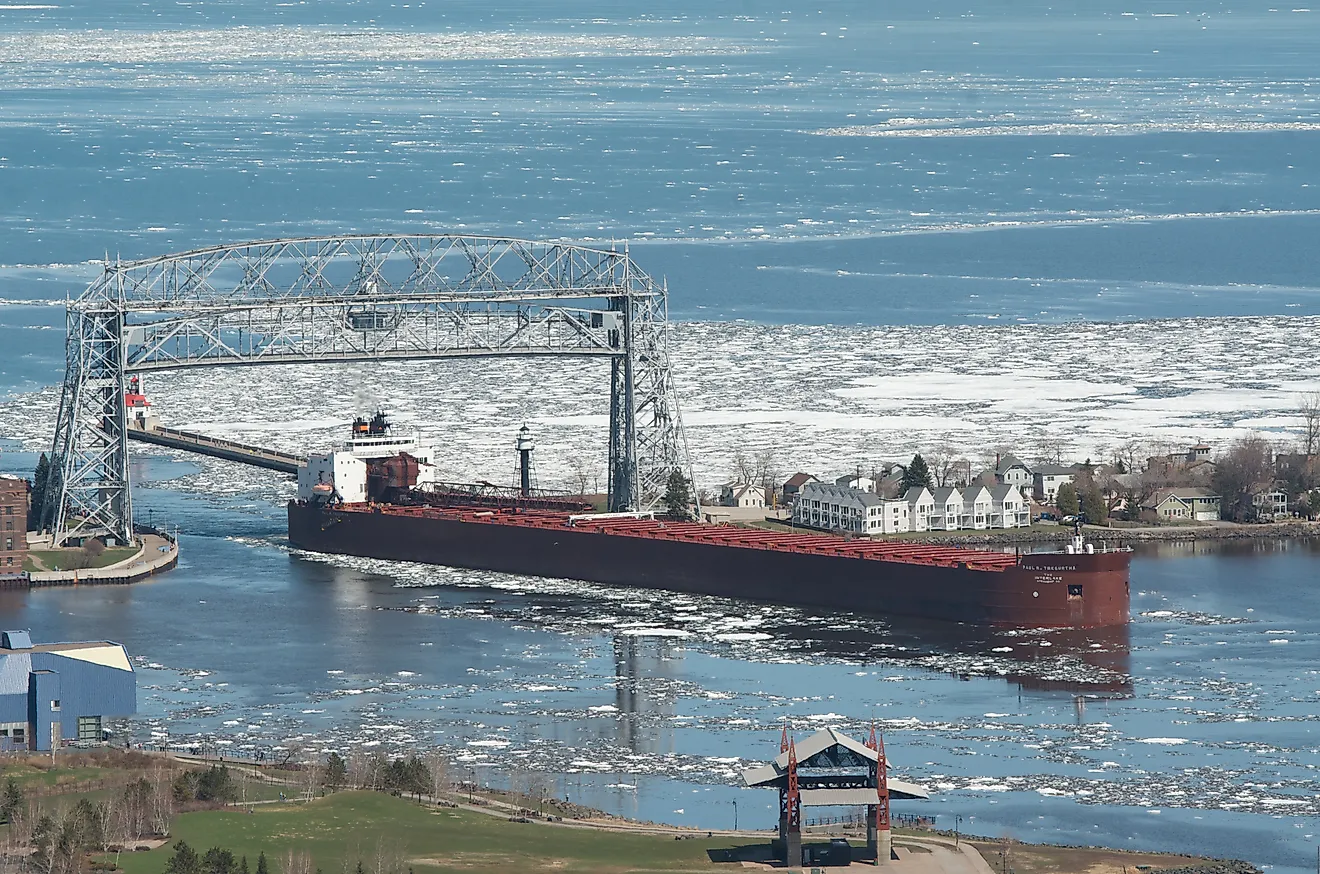
The longest freighter on the Great Lakes, the Paul R. Tregurtha, is 1,013.5 feet long. The Empire State Building rises 1,250 feet to its highest occupied floor and 1,454 feet to the top of its antenna. Stand the ship on its stern beside the building and its bow would stop 36.5 feet below the open-air observation deck on the 86th floor, which sits at 1,050 feet. All that hull is built for bulk cargo. The Tregurtha was launched at Lorain, Ohio, in 1981, and in April 2026 it was loading taconite, the iron ore pellets shipped from Lake Superior ports such as Two Harbors, Minnesota, for American steel mills. It is the longest of 13 lake freighters that reach the 1,000-foot mark, and on any run to or from Lake Superior, every one of them has to squeeze through the same lock at Sault Ste. Marie, Michigan.
Stood on End, the Tregurtha Stops Short of the 86th Floor

The 86th floor is the easiest place to picture the comparison, because it is where visitors step outside onto the open-air deck. At 1,050 feet, that deck sits 36.5 feet above the highest point the Tregurtha's bow would reach. The 102nd-floor observatory, 1,250 feet up behind glass, would be another 236.5 feet out of reach. The ship equals about 81 percent of the building's height to its top occupied floor and about 70 percent of its full height with the antenna.
Stood on end, the hull would form a steel slab 105 feet across, which is the ship's beam, or width, and 56 feet thick, its depth from deck to keel. Laid flat on the ground, the rectangle formed by its length and beam covers about 106,000 square feet, more ground than the Empire State Building's entire 79,288-square-foot lot.
Laid Along an Avenue, It Would Span Nearly Four Blocks

Manhattan's street grid gives the horizontal version of the same comparison. About 20 north-south blocks make a mile there, so a typical block runs roughly 264 feet. Set the Tregurtha down along an avenue in Midtown, where the Empire State Building stands, and it would stretch across almost four of those blocks. Even the ship's self-unloading boom, the 260-foot arm that swings out over a dock to discharge cargo, would cover about one Manhattan block by itself.
All 13 Thousand-Footers Would Top Out Within 14 Feet of Each Other

The Tregurtha leads a closely matched group. The Stewart J. Cort became the first 1,000-foot vessel on the Great Lakes in 1972, and the Tregurtha's launch in 1981 brought the class to 13 ships. Their listed lengths start at an even 1,000 feet for vessels such as the Burns Harbor and the Indiana Harbor, rise to 1,004 feet for the Edwin H. Gott and the Mesabi Miner, and end at the Tregurtha's 1,013.5. From shortest to longest, the whole class spans 13.5 feet.
What the 13 share is a lock. Of the Soo Locks at Sault Ste. Marie, only the Poe Lock, 1,200 feet long and 110 feet wide, can handle the large freighters that work the upper lakes. The fit is tightest across the width. A 105-foot beam leaves about two and a half feet of clearance on each side of the chamber as a thousand-footer rises or drops between Lake Superior and the lower lakes.
The Edmund Fitzgerald Would Cover Less Than Three Blocks

The freighters that came before the thousand-footers were far shorter. The Edmund Fitzgerald, lost on Lake Superior on November 10, 1975, with all 29 men aboard, was 729 feet long. Laid on the same Manhattan grid, it would cover a little less than three blocks where the Tregurtha covers almost four, and even the shortest thousand-footer is 271 feet longer than the Fitzgerald was.
A limit at the eastern end of the lakes sits close to the Fitzgerald's size. Ships passing through the Welland Canal and the St. Lawrence Seaway toward the Atlantic can be no longer than 740 feet and no wider than 78 feet. A thousand-footer runs 260 to 273.5 feet past that length limit, so the 13 largest freighters never reach Lake Ontario or the ocean. They spend their working lives on the four lakes above Niagara Falls.
One Load Would Fill 700 Rail Cars

Within those four lakes, the Tregurtha's five cargo holds take up to 68,000 gross tons of taconite on a single trip. The Empire State Building weighs 365,000 tons, roughly five full loads of the ship's ore. Moving the same cargo over land would take a long line of equipment: Interlake Steamship, the ship's owner, calculates that 70,000 tons would need 700 rail cars carrying 100 tons each, or 2,800 trucks carrying 25 tons each. The Tregurtha handles it with a crew in the low 20s, and it needs no help from shore to unload, because its boom empties all five holds in about eight hours.
Where to Watch a Thousand-Footer Go By

Two places on the upper lakes put that length right in front of the shore. In Duluth, Minnesota, the Aerial Lift Bridge rises to 135 feet to let large freighters through the ship canal into the harbor the city shares with Superior, Wisconsin, and ships often sound a salute to the crowds along the canal, one long blast followed by two short ones. The Tregurtha itself opened Duluth's 2026 shipping season when it arrived on March 26, a ship almost four Midtown blocks long passing under the lifted span.
At Sault Ste. Marie, Soo Locks Park has a viewing platform beside the locks, and the nearby Soo Locks Visitor Center is open each year from May 1 through October 31. From the platform, a thousand-footer fills most of the Poe Lock's 1,200-foot chamber. The Tregurtha, the longest of them, leaves 186.5 feet of it empty, less than one Manhattan block.
Two numbers decide how a Great Lakes freighter measures up to the Empire State Building, and both fall short of the skyscraper. The Tregurtha's 1,013.5 feet ends below the 86th-floor deck, and the Poe Lock's 1,200-foot chamber, stood on end, would stop 50 feet below the 102nd floor. Of the two, the lock is the firmer ceiling. The new lock under construction at the Soo is being built to the same 1,200 by 110 feet and is scheduled to open in the summer of 2030, so the next generation of lake freighters will have no more room there than the current one. The Tregurtha has held the title of Queen of the Lakes, given to the longest ship in service, since 1981. Any ship that takes the title on Lake Superior runs will still have to fit that 1,200-foot chamber, which keeps the biggest freighter on the lakes, stood beside the Empire State Building, below its highest occupied floor.