Why Great Lakes Freighters Unload Themselves
A ship longer than three football fields pulls into port, and there is no crane on the dock. Minutes after the lines are tied, a long steel arm swings out over the shore and pours iron ore or crushed stone onto the ground in a steady stream. That is how a Great Lakes freighter unloads itself, and the trick starts below deck, where sloped holds drop the cargo onto conveyor belts that carry it up and out. The dock itself can be little more than open ground beside deep water. Aboard the 1,004-foot James R. Barker, the whole system can empty a full load in about eight hours. The route the cargo takes, down through the hold and up and out the boom, is where it gets interesting.
The Cargo Leaves Through The Bottom Of The Holds

Many Great Lakes self-unloaders have cargo holds with angled bottoms that funnel loose material toward gates underneath. Opening a gate lets the cargo fall onto a conveyor belt running in a tunnel below the holds. That belt carries it toward the machinery that raises it to deck level.
One common lifting arrangement is called a C-loop. Two moving belts face each other and hold the cargo between them as it travels upward. At the top, the material transfers onto the boom conveyor, which carries it out over the ship's side. Gravity feeds the material out of the hold, and the belts supply the powered movement after that.
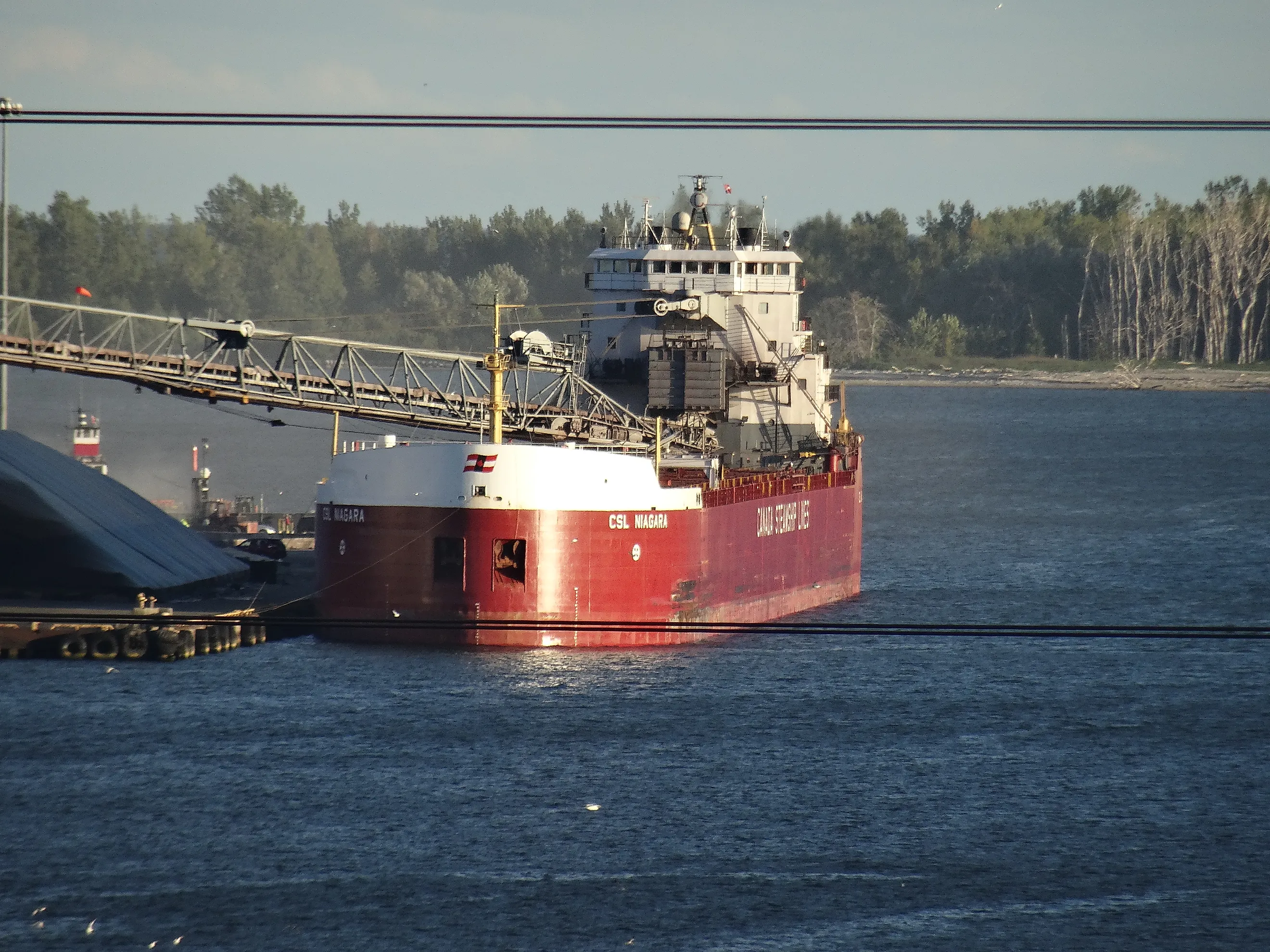
CSL Niagara, built in 1972 and converted to a self-unloader in 1998, has hopper-shaped holds, hydraulic cargo gates, two tunnel conveyors, and a C-loop elevating belt. Its unloading boom measures 79 meters, or about 259 feet. The crew still runs cargo operations and maintains the equipment. Self-unloading describes the machinery carried aboard, not a vessel working without people.
A Dock Can Receive Cargo Without A Giant Crane

Putting the unloading equipment aboard changes what a receiving dock has to have. A self-unloader can drop bulk material directly onto a dockside stockpile, feed it into a receiving hopper, or discharge into a barge. No crane has to reach down into each hold to lift the load out. Water depth and room for the hull still matter, and the receiving point has to lie within the boom's reach.
A delivery on Chicago's Calumet River shows how this works at an industrial site. In 1997, Kaye E. Barker loaded grain in Milwaukee and carried it to Continental Grain's elevator in South Chicago, where a new hopper installed on the side of a silo received the cargo. It was the first grain shipment aboard an Interlake Steamship Company self-unloader.
Thousands Of Tons Can Move Ashore Each Hour

James R. Barker has three cargo-hold belts feeding an unloading system with a 250-foot boom, and Interlake's published figure for a full discharge is about eight hours. The Smithsonian's record of the vessel puts the rig's capacity at 10,000 tons of ore or 6,000 net tons of coal per hour. The rate depends on the material. CSL's spec sheet for CSL Niagara lists 5,500 metric tons per hour for ore and 4,000 for coal. The hourly figure describes the discharge system alone. A full port call also includes securing the vessel and preparing for cargo operations, and the receiving facility has to keep up with the flow leaving the boom. Faster discharge cuts time alongside, which lowers port costs, frees the berth for other vessels, and lets the ship leave sooner for its next loading port.
The Boom Has To Fit The Port

The boom's position on the vessel matters as much as its reach, especially where nearby structures limit the space a dock has to work with. Mark W. Barker, built at Fincantieri Bay Shipbuilding in Sturgeon Bay, Wisconsin, and delivered in 2022, carries its unloading boom at the forward end. Interlake's designers chose that arrangement so the ship could place material in particular areas of a customer's dock in congested ports.
The 639-foot vessel was also designed to negotiate the tight bends of Cleveland's Cuyahoga River. Its cargo space departs from the traditional funnel shape. A square, flat-bottomed hold with vertical walls leaves more usable room, and large hatch openings add flexibility. The designers had unusual cargoes in mind, including wind-turbine blades. A long blade needs a different handling method than loose stone passing through a conveyor system, even when both travel aboard the same self-unloading ship.
Some Great Lakes Freighters Still Use Shore Equipment

Great Lakes shipping also includes gearless bulk carriers, which depend on equipment at the receiving terminal to unload. CSL St-Laurent, one of Canada Steamship Lines' two gearless Trillium-class bulkers, works the grain trade on the lakes and the St. Lawrence Seaway. On one documented voyage, the ship loaded about 31,000 metric tons of grain at Thunder Bay, Ontario, and carried it down through the Soo Locks, the Welland Canal, and the Seaway to a grain elevator in Montreal. At the Montreal end, marine towers fitted with bucket elevators scooped the grain out of the holds and into the elevator for transfer to ocean-going ships.
A gearless hull carries no conveyor tunnel, loop elevator, or boom, so more of the volume allowed by the Seaway's locks goes to cargo. A self-unloader trades some of that space for the ability to discharge at a dock with no fixed unloading plant. Grain itself does not require a gearless ship. Kaye E. Barker's 1997 run to South Chicago showed that a self-unloader handles it when the receiving arrangement suits.
A Freighter Can Gain The Capability Decades Later
Kaye E. Barker was built at Toledo in 1952 as Edward B. Greene, the flagship of the Cleveland-Cliffs Steamship Company. Fraser Shipyards in Superior, Wisconsin, added a 120-foot midbody section in 1976, and American Ship Building Company in Toledo converted the vessel to a self-unloader in 1981, when the hull was 29 years old. The lengthening enlarged the ship. The conversion changed how its load could leave the holds, so a hull that had always depended on shore equipment could discharge through machinery carried aboard. Its 1997 season ended with a gypsum cargo loaded at Alabaster, Michigan, and delivered to U.S. Gypsum's facility on the Rouge River, another first for the Interlake fleet. Repowered at Bay Shipbuilding in Sturgeon Bay in 2012, the ship still sails for Interlake more than seven decades after its maiden voyage.