The Largest Squid Ever Filmed
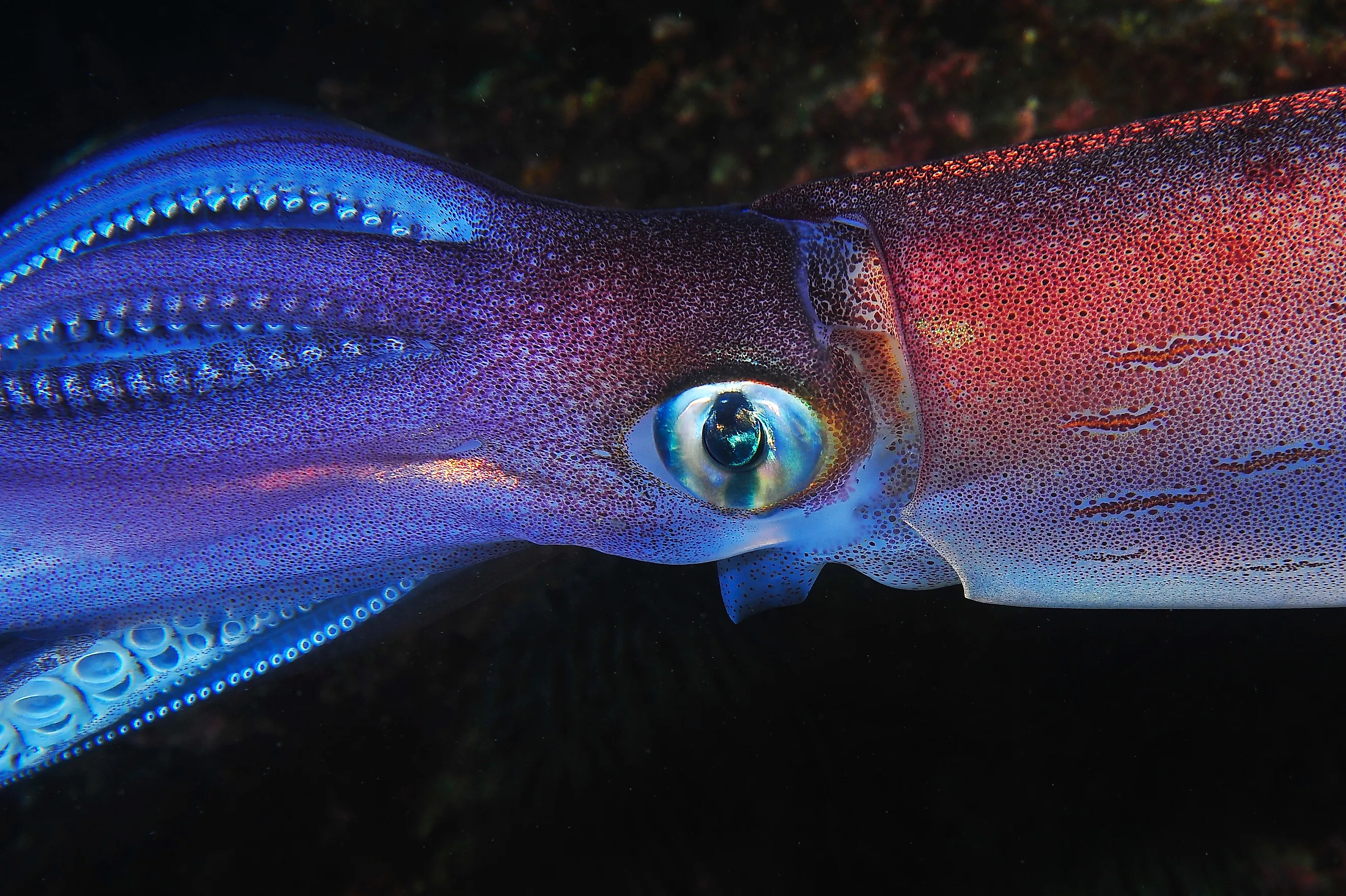
The largest squid ever filmed is a giant squid, and the strongest claim to the record belongs to a female that Japanese researchers caught on video in December 2006. She attacked bait suspended beneath a research vessel near Japan's Ogasawara Islands, and the team pulled her to the surface and videotaped her. It was the first time a giant squid had been filmed alive. The Smithsonian puts her at 7 meters (24 feet), though some news reports at the time described her as about 3.5 meters (11.5 feet), close to the size of giant squid filmed since.
A larger giant squid, estimated at 8 meters (26 feet), was photographed in 2004, but only in still images. In 2012, researchers captured video of a living giant squid in its natural habitat for the first time. That squid, and those filmed in later years, measured around 3 to 4 meters (10 to 13 feet). The colossal squid, a heavier relative, has so far been filmed alive only as a juvenile about one foot long.
The Squid That Took The Bait

Researchers first photographed a live giant squid in September 2004, when an expedition led by Japanese zoologist Tsunemi Kubodera used a novel method. The team attached a camera to a large fishing lure baited with the preferred food for squids. The team then left the lure dangling at almost 3,000 feet deep and waited, and on the morning of September 30th, a giant squid latched onto the lure.
Over the four hours before the squid broke free of the lure, leaving behind one of its tentacles, the camera photographed the 26-foot giant squid specimen repeatedly. These photos sometimes only gave glimpses of the squid, but the methods used taught scientists much about how the giant squid hunts, showing that it is an active hunter rather than a passive one which waits for prey to come to it.
Two years later, in December 2006, Kubodera's team hooked a female giant squid, pulled her to the surface, and filmed her alive for the first time. She holds the strongest claim to the title of largest squid ever caught on video.
Face To Face In The Twilight Zone

Scientists learned more when the giant squid was first filmed in its natural habitat off the coast of Japan in July 2012 via a more adventurous method: a three-man submersible. A team that included Tsunemi Kubodera of Japan's National Museum of Nature and Science made repeated dives in the submersible in search of the squid after a special camera system developed by Edith Widder and a lure which mimicked bioluminescent jellyfish, also designed by Widder, captured images of a giant squid.
About 600 miles south of Tokyo and at a depth of over 2000 feet, the team managed to find their quarry, coming face-to-face with a 10-foot-long specimen. They observed it for 18 minutes and noted the shifting gold-silver hues of the squid's skin.
The same camera system was used by a NOAA-funded expedition to film a similarly sized giant squid in the Gulf of Mexico in 2019. The 10-to-12-foot specimen was filmed at almost 2,500 feet below the surface, where the giant squid's huge eyes, almost a foot in diameter, help them watch for prey and predators. These two films provided valuable insights into the species, but neither squid matched the 24 feet the Smithsonian gives for the 2006 female, and no giant squid filmed comes close to the 43 feet the species can reach.
A Heavier Rival Makes Its Debut

The 2006 squid remains the largest filmed, but a 2025 development suggests that perhaps a larger squid might be found soon. In March 2025, a colossal squid (Mesonychoteuthis hamiltoni) finally made its film debut when an expedition from the Schmidt Ocean Institute caught a juvenile colossal squid on film at a depth of about 1,970 feet near the South Sandwich Islands.
A type of glass squid, the colossal squid is found in the waters surrounding the Antarctic, but very few specimens have been found. They can grow to be 23 feet long. Colossal squids are the heaviest invertebrates on the planet, and many believe they might be the largest squids. Yet the one filmed in 2025, the only specimen ever seen in its natural habitat, was a juvenile measuring only about one foot in length.
Because colossal squid specimens are so scarce, the footage is a major moment in the study of the species, and it raises the possibility that cameras might one day find a colossal squid larger than any filmed giant squid.
A Record Still Waiting To Be Broken
The 2006 female filmed by Tsunemi Kubodera's team still holds the strongest claim to the title of largest squid ever filmed, but giant squid can grow to be far larger than any specimen filmed so far. Since it was first photographed in 2004, every new photo and footage not only gives us a deeper understanding of these mysterious and massive cephalopods, but also fresh chances to film larger and larger specimens, and chances for other contenders such as the juvenile colossal squid to steal the spotlight.
And with the bottom of the sea still largely unexplored, there might be even larger species waiting to be discovered.