10 Of The Smartest Animals In The Wild
- Orangutans are the only great ape besides us to talk about the past.
- Ants are very smart as a collective, and have been compared to Google's search engine.
- Dolphins name their offspring for life.
Intelligence is hard to measure in a creature that cannot sit an exam or explain itself. We are left to judge it by behavior, by watching how an animal solves problems, uses tools, remembers, and handles others of its kind. That approach carries a built-in bias, since we tend to call an animal smart precisely when it reminds us of ourselves. Even allowing for that, the evidence is striking. Of the roughly 7.7 million animal species thought to exist, only about 1.2 million have been formally described, and within that sliver scientists keep finding minds capable of grief, planning, deception, and toolmaking. Here are ten animals whose intelligence stands out.
Chimpanzees

The chimpanzee (Pan troglodytes) is, alongside the bonobo, our closest living relative, and it behaves like it. Beginning in the 1960s, primatologist Jane Goodall documented wild chimpanzees stripping twigs to fish termites out of their mounds, a finding that forced scientists to abandon the idea that toolmaking was uniquely human. They go further than that. Chimps recognize themselves in mirrors, mourn their dead, and hunt cooperatively, with groups coordinating to corner colobus monkeys.
The most advanced example comes from the savanna chimps of Fongoli, Senegal, where researchers led by Jill Pruetz watched chimps break off branches, trim them, and sharpen the points with their teeth to make spears, then jab them into tree hollows to hunt small nocturnal primates called bushbabies. It remains the only well-documented case of a non-human animal making a weapon to hunt sizable prey. Listed as endangered, chimpanzees also communicate through a complex repertoire of calls and gestures.
Gorillas

The western lowland gorilla (Gorilla gorilla gorilla) gave us one of the most famous animals in the history of cognition research. Koko, raised in California by psychologist Penny Patterson, learned to use more than 1,000 hand signs and to understand a large vocabulary of spoken English before her death in 2018. Asked by a National Geographic writer where gorillas go when they die, she signed something like "comfortable hole, bye." Linguists still debate whether Koko used true language or simply learned associations, but her ability to combine signs hinted at a rich inner life.
In the wild, gorillas show the same practical intelligence. One famous photograph from the Congo captured a female testing the depth of a swampy pool with a stick before wading in, an improvised tool used to solve an immediate problem. Western gorillas are now critically endangered.
Orangutans

Orangutans, the red apes of Borneo and Sumatra (genus Pongo, with three species, all critically endangered), appear to be the only great apes besides humans that refer to the past. A 2018 study found that mother orangutans often delay their alarm calls, waiting several minutes after a predator has moved off before warning their young, a sign they can communicate about something that is no longer present.
That same restraint cuts the other way too. An orangutan will sometimes stay silent while a predator is nearby, suppressing the instinct to call out so as not to give away its position. Combined with the fine control they have over their vocal muscles, this points to deliberate, flexible thinking rather than reflex.
Capuchin Monkeys

Capuchins, small monkeys of the Central and South American forests, are widely regarded as the brightest primates of the New World. The bearded capuchin (Sapajus libidinosus) of Brazil cracks hard palm nuts by placing them on stone anvils and striking them with stone hammers, a behavior so well established that archaeologists have traced a capuchin "stone age" back thousands of years at sites like Serra da Capivara.
Their manual dexterity is remarkable enough that capuchins have been trained as assistance animals for people with paralysis, capable of fine tasks such as retrieving dropped objects and operating switches. Whether in a laboratory or a forest, they learn quickly and adapt their behavior to new problems.
Elephants

Elephants pair enormous brains with long memories. An older matriarch can recall the locations of distant water sources across a vast home range and lead her herd to them during drought, knowledge that can mean survival. African elephants (Loxodonta africana) and Asian elephants (Elephas maximus), both endangered, also appear to grieve, returning to the bones of dead companions and lingering over them, and they comfort herd members in distress.
They cooperate to solve tasks, fashion branches into fly swatters, and plug waterholes with chewed bark to keep the water from evaporating. An Asian elephant named Happy passed the mirror self-recognition test, repeatedly touching a mark on her head visible only in a reflection, evidence that elephants may possess a sense of self.
Dolphins

Bottlenose dolphins (Tursiops truncatus) are often called the intellectuals of the sea, and some researchers put their cognitive abilities on a level with the great apes. They recognize themselves in mirrors and can follow human "gesture sentences," grasping that the order of signals changes the meaning of an instruction.
Most striking is their use of signature whistles, unique sounds that function much like names. Dolphins invent a signature whistle early in life, address one another by it, and even copy a companion's whistle to get its attention, a form of naming once thought to be ours alone.
Wild Hogs

Pigs (Sus scrofa) are among the most intelligent of all farm and wild mammals, and feral hogs put that intelligence to ruthless use. Native to Eurasia and descended in the Americas from escaped domestic pigs and Eurasian wild boar released for hunting, they have spread across the American South and pushed steadily northward, outwitting most attempts to control their numbers. They eat almost anything and use a keen sense of smell to find food buried underground.
Laboratory work backs up what farmers already know. Pigs remember details of their surroundings, appear to track the passing of time, use mirrors to locate hidden food, and are highly social and playful. In one 2021 study, four pigs learned to operate a joystick to steer a cursor toward on-screen targets, a video game originally designed for primates, grasping that their own movements controlled what happened on the screen.
Crows

A crow looks nothing like us, but it sometimes problem-solves as if it does. In several Japanese cities, carrion crows (Corvus corone) have been cracking nuts with the help of traffic since at least the 1990s. A crow drops a walnut onto a road, waits for passing cars to crush the shell, then swoops in to eat the kernel once the traffic stops, with some birds reportedly timing their approach to pedestrian crossing signals.
The corvid family is full of such ingenuity. New Caledonian crows (Corvus moneduloides) bend twigs and leaves into hooked tools to extract grubs from logs, and crows have shown they can plan for future needs and solve multi-step puzzles, abilities once associated only with apes.
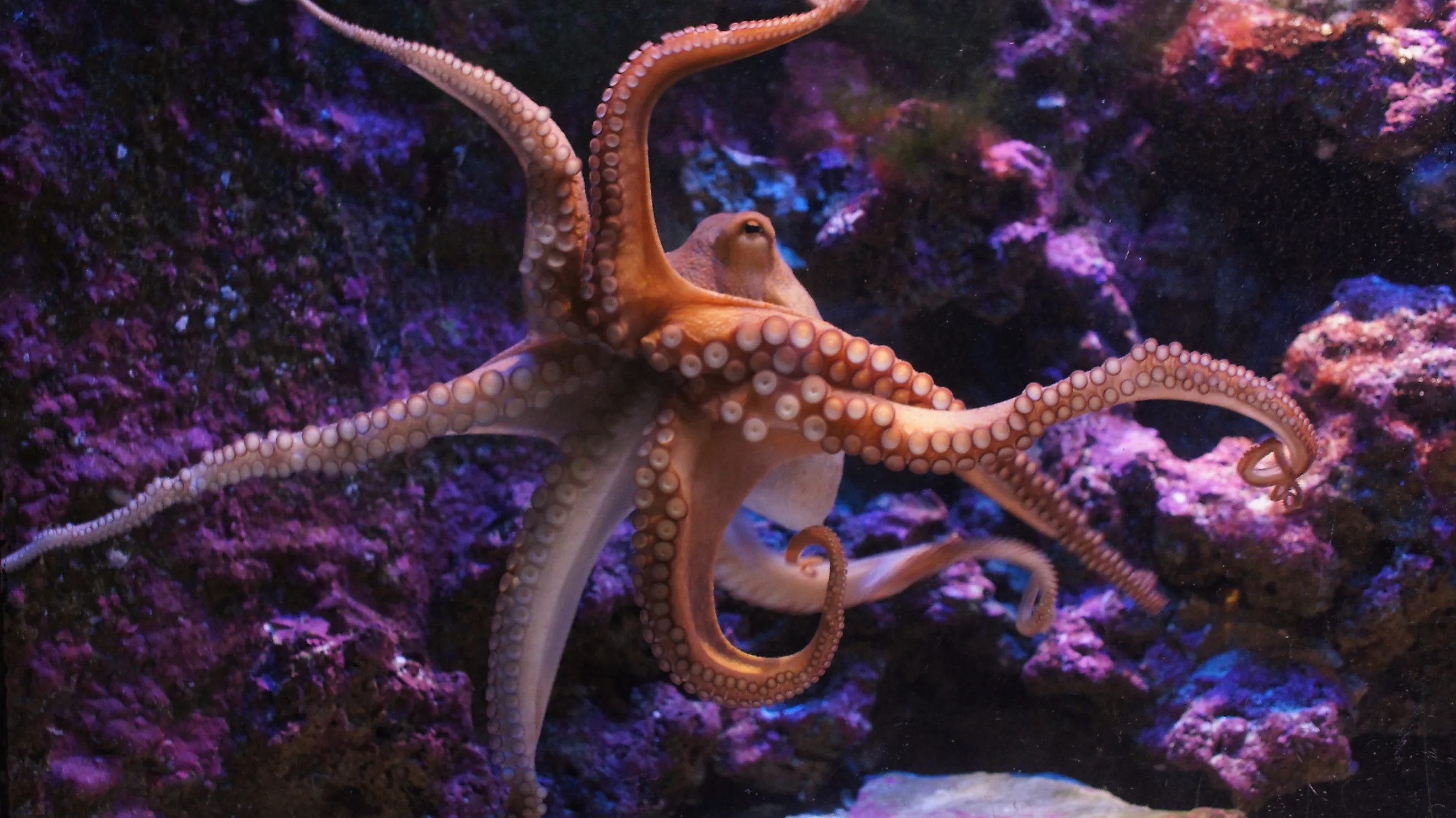
Octopuses

Cephalopods, the group that includes cuttlefish, squid, and octopuses, are the brightest of all invertebrates, with much of their nervous system distributed through their arms. In 2016, an octopus named Inky famously escaped the National Aquarium of New Zealand by squeezing through a gap in his tank and slipping down a narrow drainpipe that led to the sea. Captive octopuses have also been seen short-circuiting unwanted aquarium lights by aiming jets of water at them.
In the wild, the behavior is just as inventive. The veined octopus (Amphioctopus marginatus) collects discarded coconut shells and carries them across the seafloor to reassemble later as portable armor, one of the clearest cases of tool use in any invertebrate.
Ants

Ants are the smallest animals here, and a single ant is not especially bright. The intelligence lives in the colony. Foragers that find food carry it home while laying a trail of pheromones, and other ants follow and reinforce the scent, so the colony quickly converges on the best routes and builds an efficient supply network without any individual being in charge. Army ants take this further, linking their own bodies into living bridges and rafts, while leafcutter ants farm fungus gardens for food.
The result is a kind of distributed problem-solving that computer scientists study directly. One researcher at the Potsdam Institute for Climate Impact Research has argued that a colony processes information about its surroundings more efficiently than a search engine sorting the web, and "ant colony optimization" algorithms borrow the same trail-following logic to solve routing problems.
What Makes An Animal Smart?
There is no single test for intelligence, and our judgments are inevitably shaped by the fact that we are looking through human eyes. Still, a few traits keep turning up in the animals we consider smart: a sense of self, some grasp of time, the ability to recognize oneself in a reflection, the capacity to make and use tools, and the ability to recall events and individuals long after first encountering them. Whether the mind belongs to a chimpanzee, an octopus, or an entire colony of ants, intelligence in the animal kingdom takes far more forms than we once assumed.