Axolotl
An estimated 1 million axolotls exist worldwide, yet they are exceedingly rare in the wild. Native only to Mexico, these charming “smiling” animals are popular exotic pets and fascinating creatures to study, but are nearly impossible to find outside Mexico. Curiously, adult axolotls have relatively few natural predators. Instead, humans remain their largest threat. After centuries of development and habitat loss, axolotls are now officially designated as Critically Endangered by the International Union for Conservation of Nature (IUCN). Formerly widespread across Mexico's lakes and wetlands, these docile, solitary animals are now among the world's most threatened aquatic salamanders, confined to small city canals and fish tanks.
Classification & Characteristics
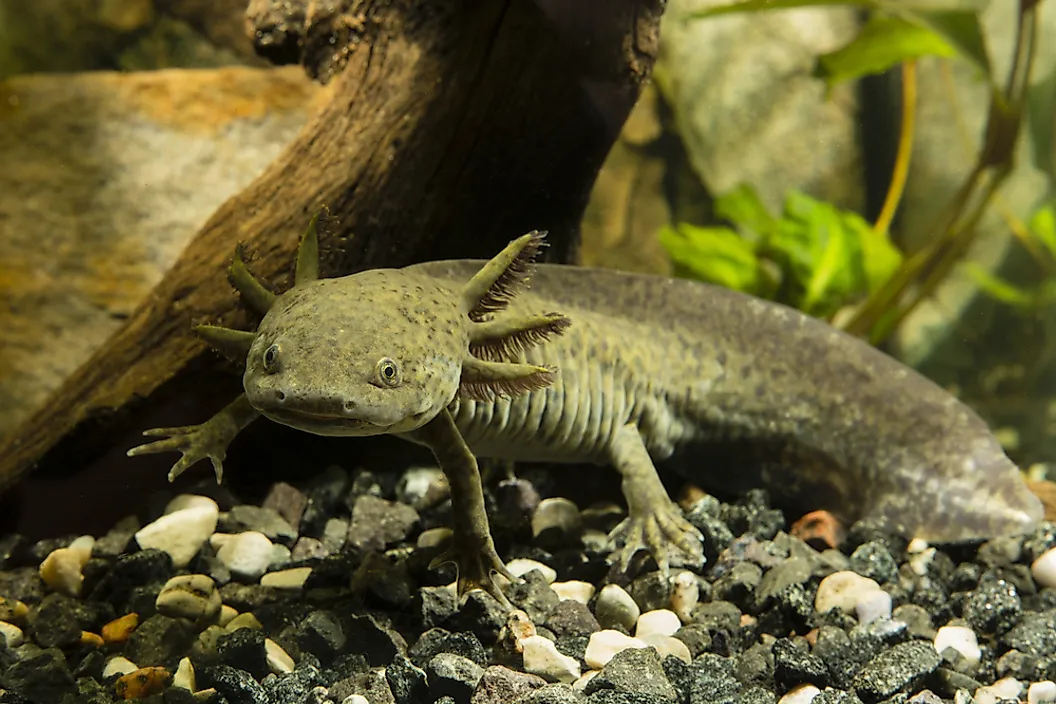
The axolotl (Ambystoma mexicanum) is a member of the Ambystomatidae family, commonly known as mole salamanders. These New World salamanders are amphibians belonging to the genus Ambystoma. In terms of appearance, axolotls generally reach about 10 inches (25 cm) in length. On average, females weigh more than males, having wider bellies for reproduction. While female axolotls generally weigh about 6.0 to 6.3 oz (170 to 180 g), males weigh about 4.4 to 4.6 oz (125 to 130 g).
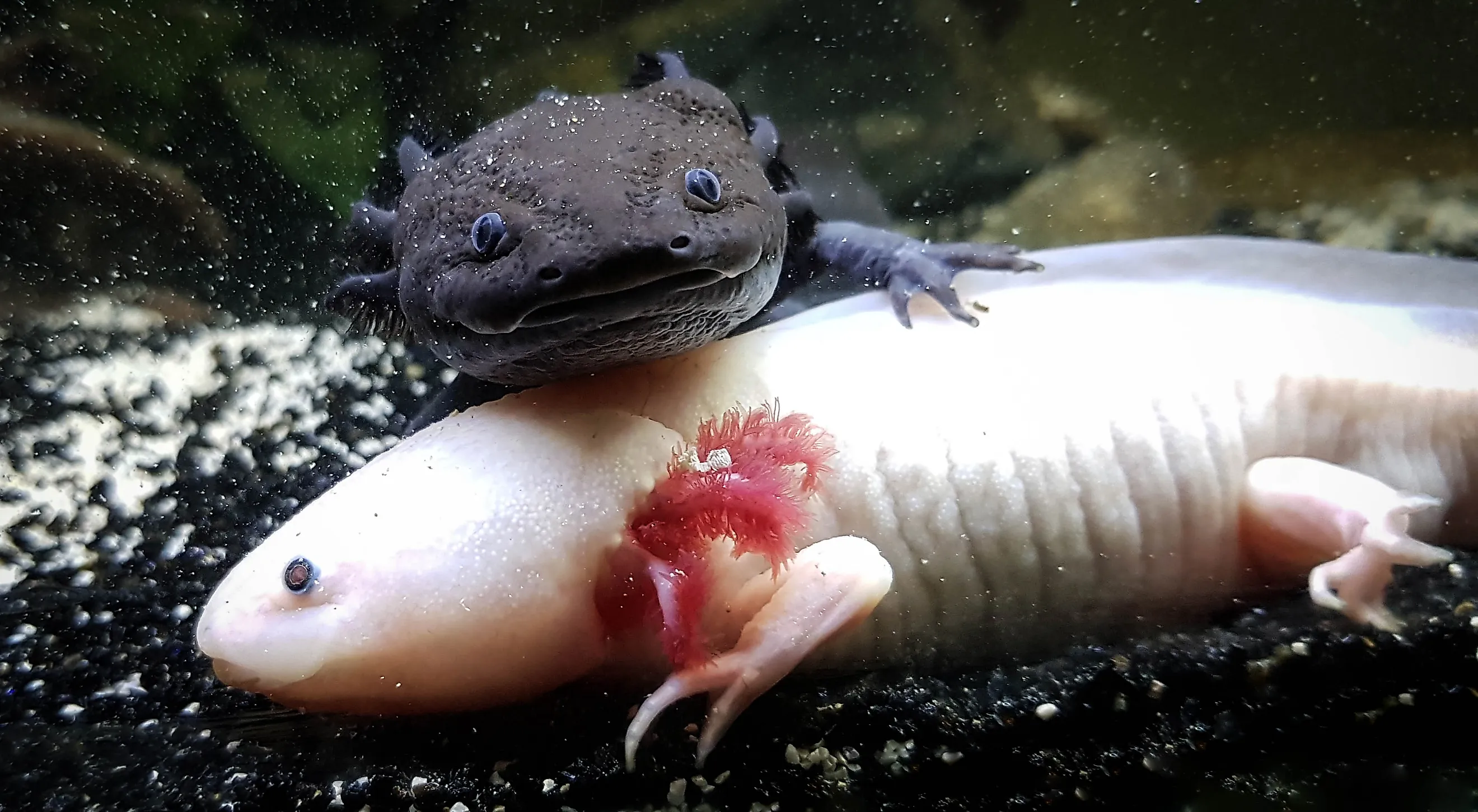
Three pairs of external gills protrude from an axolotl’s head, featuring feathery filaments used for gas exchange. While its legs are short and stout, the axolotl’s tail is long and eel-like for swimming. Its feet are webbed for similar reasons. As for coloration, wild axolotls range from black to dark brown, serving as camouflage in murky, vegetation-rich waters. Due to selective breeding, domesticated axolotls exhibit a wider range of hues, including pink, white (albino), and multicolored.
Range & Habitat

Axolotls are lentic, meaning they inhabit still/ standing bodies of water. Historically, they are native to wetlands and lakes throughout Mexico’s Central Valley. However, due to habitat degradation, this range is much smaller, and wild axolotl populations have been significantly reduced. Now, the once-widespread amphibian is limited to two to three isolated sites. Wild axolotls are primarily found in the canals of Lake Xochimilco and, to a lesser extent, in those of Lake Chalco in Mexico City. There is also speculation about the status of axolotl populations in Chapultepec Lake.
Threats & Conservation Status

In pre-Columbian times, axolotls were so abundant in Mexico's Central Valley that humans consumed them as a source of protein. Aztec engineering forged a system of wetlands and canals that allowed these aquatic amphibians to thrive. By contrast, today’s wild axolotl populations are extremely small. Ecologists estimate that fewer than 1,000 adult axolotls remain in their native habitats in Mexico, though the number could be as low as 50. The International Union for the Conservation of Nature and Natural Resources classified the axolotl as critically endangered in 2006.
Habitat loss is one of the axolotl’s greatest threats, primarily caused by continued urbanization. Mexico City’s main axolotl habitats, Lakes Xochimilco and Chalco, have both undergone significant shrinkage. This depletion is largely linked to draining projects, carried out to mitigate flooding and enable city expansion. Although Xochimilco is now a protected wetland, the battle to save its ancient canals continues. This delicate ecosystem is at risk of collapse due to ongoing urbanization, pollution, and climate factors. Likewise, the once-massive Lake Chalco now only features small, marshy remnants. Much of its dried lakebed is occupied by Mexico City.
The remaining Central Valley is unsuitable for axolotls for similar reasons. After centuries of aggressive drainage projects, urbanization, and water pollution, the region suffered catastrophic habitat loss. Invasive species are another significant threat, forcing axolotls to compete for food. Certain invasive fish, such as tilapia and carp, will also consume axolotl juveniles, eggs, and larvae, further affecting populations.
Life Cycle

Axolotls are neotenic, meaning they retain juvenile characteristics into adulthood. Unlike other salamanders, these fascinating amphibians remain in “tadpole” form forever, or more scientifically, don't metamorphose into a terrestrial adult form. Instead, they retain their juvenile features, including their external gills, even as they mature sexually. Axolotls typically reach sexual maturity between six and twelve months of age. At this point, courtship efforts ensue. For mating, the pursuit begins with male axolotls. The male initiates a mating dance by releasing courtship pheromones called sodefrin precursor-like factors (SPF). If receptive, the female will follow the lead and participate in the ritual, which resembles a “hula dance.”
Following this dance, the male deposits up to 12 cone-shaped sperm packets, which the female collects using her cloaca. The entire mating ritual is then repeated multiple times in a single encounter to ensure a successful fertilization. Within just a few days, the female axolotl will lay between 300 and 1,000 eggs, each individually placed on plants and rocks to shield them from predators. About two weeks later, the eggs will hatch, relying on their attached yolk sacs for nutrition. Soon after, the limbless larvae will begin swimming and hunting, as adult axolotls provide no parental care.
Over time, the juvenile axolotl will develop its front and hind legs. Although they also develop fully functional lungs, these amphibians remain aquatic throughout their lives, unlike land-dwelling salamanders. As previously mentioned, axolotls reach sexual maturity but retain juvenile traits due to neoteny. Despite this “incomplete” metamorphosis, axolotls live about four to six years in the wild. If given proper care in captivity, they can live to be 15 years old.
Diet & Hunting

Despite their gentle, unassuming appearances, axolotls are excellent hunters. These carnivorous creatures are hatched into a competitive environment, meaning the larvae will feed on anything that moves—in some cases, their own siblings. Otherwise, the larvae will hunt and feed on worms and zooplankton. In adulthood, axolotls are nocturnal predators. They use a unique suction technique to consume insects, worms, tadpoles, crustaceans, and small fish. By targeting benthos (organisms that live at the bottom of a body of water), axolotls also inhale gravel and sand, which aids with digestion.
Behavior & Biology

Axolotls are primarily nocturnal. During the day, they will burrow into mud or underwater flora to hide from predators such as fish and birds. To sleep, the axolotl slows its breathing and becomes completely motionless. Since they lack eyelids, these quirky critters are forced to sleep with their eyes wide open.
Although axolotls have poor eyesight, they can detect movement through light and shadows. They also rely on smell and a lateral line system, which consists of sensory organs to detect vibrations in the water. As for respiration, an axolotl primarily breathes through the three pairs of gills on its head. These filaments extract dissolved oxygen from the water and expel carbon dioxide. Since axolotls have working lungs, they will also occasionally surface for air.
Wild axolotl sightings are especially rare because they are solitary creatures. Generally, they interact with other axolotls only during the mating season from March to June. After breeding, the male and female will separate. Even newly hatched axolotls are immediately left to their own devices. Consequently, wild axolotls face high mortality rates during the first year of life. However, they also possess the powerful ability to regrow limbs. If an axolotl loses a leg, arm, or tail, it will regrow all its muscles, bones, nerves, and skin through a rapid healing process called epimorphic regeneration.
Humans & Axolotls

The Indigenous word “axolotl” originates from the ancient Aztec language of Nahuatl. Pronounced as “ashlotl,” the name translates to “water dog,” “water sprite,” or “water monster.” Historically, the axolotl was a mythological figure. In Aztec beliefs, the amphibious creature was thought to be a transfiguration of the god Xolotl. In some translations, the animal’s name means “water twin,” in reference to Xolotl’s twin brother, Quetzalcoatl, another Aztec deity. Today, axolotls are a source of national pride in Mexico. The animal is frequently depicted in tourist souvenirs and graces Mexico’s 50-peso banknote.
While fewer than 1,000 axolotls live in the wild, captivity tells a different story. By some estimates, there are 1 million axolotls worldwide. Easily bred, they are popular as lab subjects and exotic pets. Unfortunately, there is a widespread misconception about axolotls being low-maintenance pets. Although they may not require the same attention as dogs or cats, these sensitive exotic amphibians require intensive research, preparation, and care. To ensure a high quality of life for axolotls, they require a high-quality diet and a pristine aquatic environment. This includes strict control of water temperature, proper water chemistry, and proper cleaning and filtration.
Why Wild Axolotls Matter
The loss of an entire species is always a tremendous issue, and axolotls are no exception. The once-widespread animal is rarer than ever in the wild. Regardless of its population in captivity, this is a cause for serious concern. Axolotls serve as important bioindicators due to their sensitivity to water conditions. A healthy axolotl indicates a healthy wetland, while the reverse suggests an issue to address. Consequently, without wild axolotls, humans lose a valuable resource.
Additionally, axolotls are apex predators, occupying the top of their food chain. Despite their small size, axolotls play a crucial role in balancing the delicate waterways in Mexico through population control. Without them, these ecosystems are at risk of collapsing. In sum, the axolotl population may be high in captivity, but without them in the wild, humans stand to lose a lot.