Saw-Scaled Viper
The saw-scaled vipers, a group of small snakes that make up the genus Echis, rank among the snakes responsible for the most human deaths anywhere in the world. They live across the dry country of Africa, the Middle East, India, Sri Lanka, and Pakistan, and are blamed for thousands of fatal bites every year. Insects such as mosquitoes kill far more people, but they do so by spreading disease; saw-scaled vipers kill directly, with venom delivered by their own fangs.
The genus name, Echis, is the Latin transliteration of the Greek word for viper (ἔχις). What makes these snakes so dangerous is not the sheer potency of their venom, which proves fatal in only a minority of untreated bites, but the way they cross paths with people. They are quick-tempered and strike readily, they are most active after dark and easy to overlook, and they frequently turn up around farmland and rural homes far from the nearest supply of antivenom.
They also give an unmistakable warning. When cornered, a saw-scaled viper draws itself into tight coils and rubs its rough flank scales together, producing a dry, rasping sizzle. That sound, and the serrated scales that create it, are what give the group its name.
Range And Habitat
The genus as a whole covers an enormous territory, yet any single snake tends to keep to a small patch of ground around its preferred shelter and hunting spots. Saw-scaled vipers are animals of arid and semi-arid country, adapted to some of the harshest landscapes on the continents they inhabit. They occupy gravel flats, sandy desert, rocky hillsides, dry scrub, and open grassland, sheltering by day beneath rocks or in crevices.

At night and during rainy periods, they readily climb into low vegetation. They also move into cultivated fields and settle close to villages and farms, and it is this overlap with people, rather than any attraction to them, that drives the high number of bites across their range. Because so many encounters happen in remote areas where medical care is hours away, bites that might otherwise be survivable too often turn fatal.
Diet And Hunting

The saw-scaled viper is an opportunistic carnivore that makes the most of whatever its environment offers. After hatching, young vipers feed largely on insects and spiders until they are big enough to take larger prey. Adults eat small mammals such as mice and shrews, along with lizards, geckos, frogs and toads, and a wide range of arthropods, including scorpions, centipedes, and large insects. Small perching birds are occasionally taken, often near desert springs.
That arthropod-heavy diet has left a mark on the venom itself. Research comparing different Echis populations has found that snakes preying heavily on scorpions and other invertebrates carry venom that is especially potent against those animals, evidence that diet has shaped venom chemistry over evolutionary time. Saw-scaled vipers can also go long stretches without eating and digest meals quickly when food is available.
Physical Description

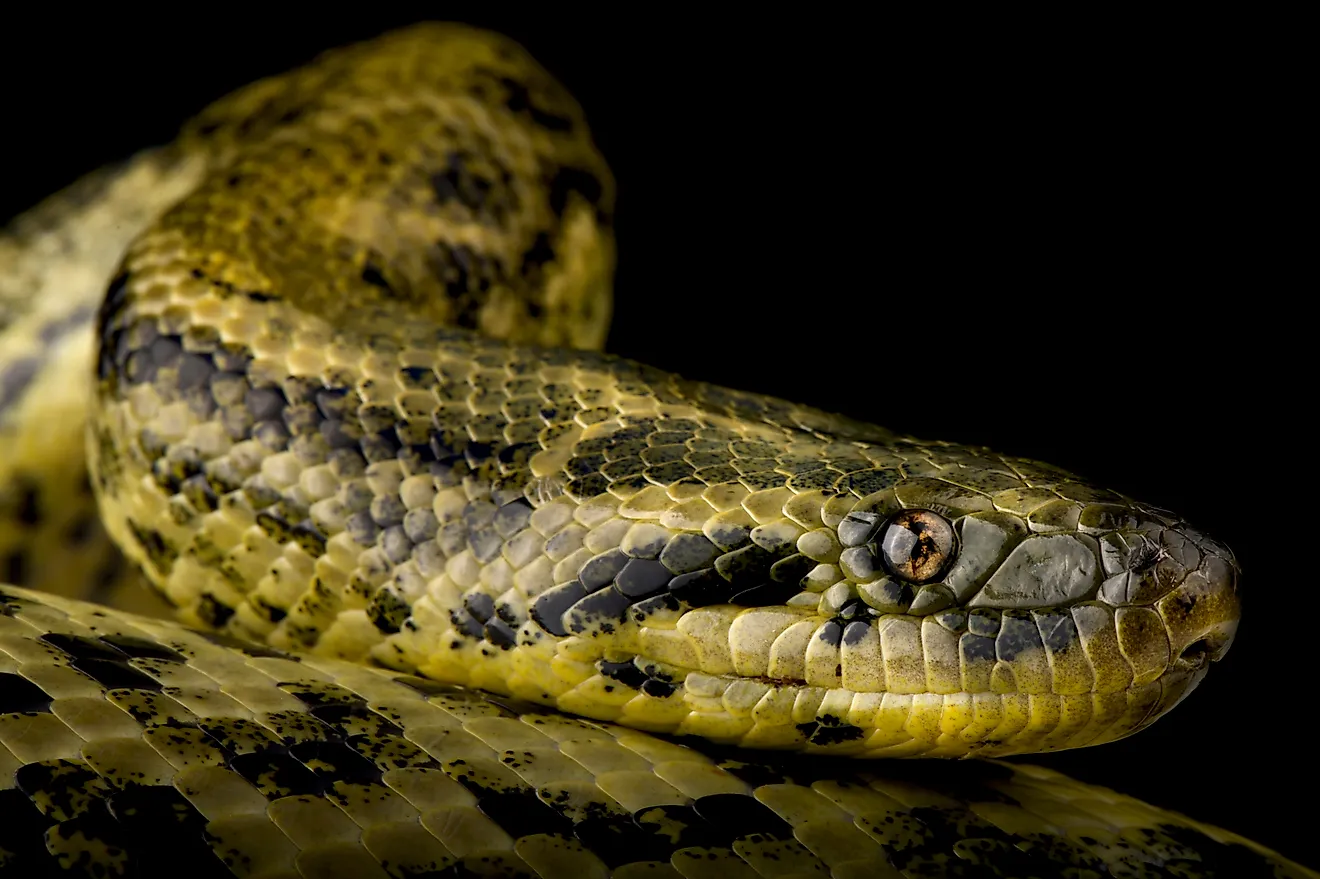
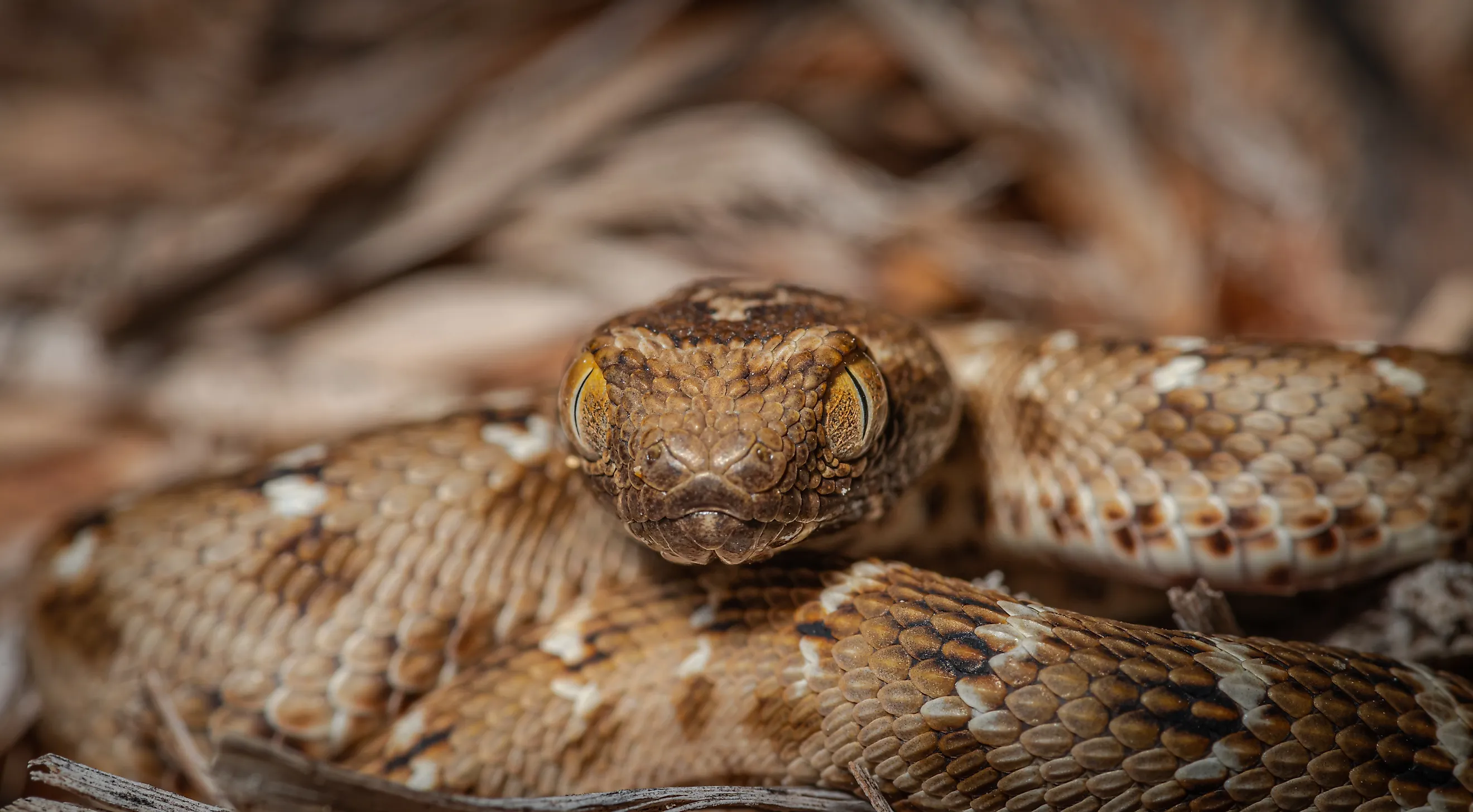
Saw-scaled vipers are small as venomous snakes go. Most measure well under 90 cm (about 35 inches), with the largest species, the white-bellied carpet viper (Echis leucogaster) and the Egyptian saw-scaled viper (Echis pyramidum), reaching roughly that length and several species staying far shorter. The body is stout, ending in a short, pear-shaped head that is distinct from the neck, with vertically elliptical pupils. The defining feature is the scaling: strongly keeled, serrated scales along the flanks, the ridges that the snake rasps together in defense. Coloration runs through pale tan, gray, reddish, olive, and brown, with whitish or yellowish blotches along the back edged in darker brown, a pattern that blends closely with dry soil and sand.
Behavior
The saw-scaled viper's signature behavior is its threat display. When alarmed, it folds into a series of tight, shifting coils, often in a figure-eight shape, and draws the serrated scales on opposite sides of its body across one another. The friction produces the sizzling rasp that warns off intruders, a system that serves much the same purpose as a rattlesnake's rattle. This is one of the more excitable and aggressive snakes in its range, prone to striking quickly and repeatedly when disturbed.

On loose sand, saw-scaled vipers travel with a sidewinding motion, an efficient way to move across shifting surfaces that is shared by several unrelated desert snakes. They are also capable climbers and will pull themselves up into shrubs and trees, particularly during rains. Most of their activity takes place at night, which is when the majority of bites to people occur.
Reproduction
Reproduction in the genus is not uniform. Most species, including the African ones, lay eggs, while some, notably the Indian saw-scaled viper (Echis carinatus), give birth to live young. Egg-laying species deposit clutches of roughly 4 to 20 eggs in moist, sheltered spots. Mating tends to occur during the cooler part of the year, with development spanning several months. In every case the young are precocial: fully venomous, independent, and able to hunt as soon as they emerge.
Ecological And Medical Importance
In its native landscapes, the saw-scaled viper plays a useful ecological role. By preying on rodents and other small animals, it helps hold down populations that damage crops and spread disease, and it in turn feeds birds of prey and other predators that have few food sources in such harsh, dry country.
Its greater significance, though, is medical. The venom is strongly hemotoxic and dominated by enzymes called snake venom metalloproteinases, which attack the blood-clotting system and produce a condition known as venom-induced consumption coagulopathy, leaving victims unable to stop bleeding. Those same properties have made the venom valuable in the laboratory. A clotting enzyme isolated from Echis venom, ecarin, is used in diagnostic blood tests, and venom components such as disintegrins guide research into anticoagulant drugs and human clotting disorders. Treatment relies mainly on polyvalent antivenoms; for the West African carpet viper (Echis ocellatus), purpose-built antivenoms include Echitab-plus-ICP, made by Costa Rica's Instituto Clodomiro Picado, and EchiTabG, made by MicroPharm in the United Kingdom.
Notable Species
Taxonomists currently recognize about a dozen species in the genus, several of them described only in recent decades. The most significant include:
- Indian saw-scaled viper (Echis carinatus): the type species and best-known member, ranging across the Indian subcontinent and into parts of Central Asia and the Middle East. It is one of India's "big four" medically important snakes.
- West African carpet viper (Echis ocellatus): endemic to West Africa and responsible for more snakebite deaths than any other African snake.
- Roman's saw-scaled viper (Echis romani): a Sahel species ranging between central Nigeria and southern Sudan, long treated as part of E. ocellatus before being described separately.
- Joger's saw-scaled viper (Echis jogeri): a small West African species of Senegal, Mali, and Guinea.
- Egyptian saw-scaled viper (Echis pyramidum): one of the larger members, found across northeastern Africa and into Egypt and Arabia.
- White-bellied carpet viper (Echis leucogaster): a comparatively large species of arid North and West Africa.
- Painted carpet viper (Echis coloratus): a snake of rocky, mountainous country in Egypt, the Levant, and the Arabian Peninsula, including Saudi Arabia.
- Oman carpet viper (Echis omanensis): a small species of the Hajar Mountains of Oman and the United Arab Emirates.
- Hughes' saw-scaled viper (Echis hughesi): one of the smallest members of the genus, restricted to northern Somalia.
- Khosatzk's saw-scaled viper (Echis khosatzkii): found in Oman and Yemen, and sometimes treated as a synonym of E. pyramidum.
- Borkin's saw-scaled viper (Echis borkini): native to southwestern Saudi Arabia and western Yemen.
- Cherlin's saw-scaled viper, or big-headed carpet viper (Echis megalocephalus): relatively large for the genus and endemic to a single island in the Red Sea off the coast of Eritrea.
A Small Snake With Outsized Consequences
For all their modest size, saw-scaled vipers leave a mark on both the ecosystems they occupy and on human medicine. They check rodent populations across some of the planet's driest landscapes, while their venom drives the development of antivenoms and the study of how blood clots. The danger they pose to people comes less from raw venom potency than from how often they come into contact with humans, which is also why wider access to antivenom across their range would do so much to reduce the toll they take.